An AI-powered recruitment tool is essentially smart software designed to handle the administrative heavy lifting in hiring. Think of it as an efficient assistant that manages repetitive tasks—like sourcing candidates, screening resumes, and scheduling interviews—so your team can focus on the more human aspects of their work.
The goal isn't to replace recruiters, but to free them up to build relationships and make better strategic decisions.
What Are AI Powered Recruitment Tools?
Let's cut through the noise for a moment. AI in recruiting isn't about letting a robot make the final hiring call. It’s about using intelligent systems to manage the high-volume, data-intensive parts of the process that often bog down even the most effective teams.
Think of it like a GPS for your talent search. It scans the entire map of potential candidates, finds efficient paths to the right people, and helps you navigate around common roadblocks, like the pile of irrelevant resumes in your inbox. This technology is changing how modern talent acquisition works.
Let's look at how this plays out in practice. The table below shows the contrast between traditional methods and a more streamlined, AI-driven approach.
Traditional vs AI-Powered Recruiting At a Glance
| Hiring Stage | Traditional Approach | AI-Powered Approach |
|---|---|---|
| Sourcing | Manually posting on job boards and searching LinkedIn. | Proactively identifying and engaging passive talent based on skills. |
| Screening | Visually scanning hundreds of resumes, looking for keywords. | Instantly screening resumes for qualifications and potential. |
| Assessment | Using generic, one-size-fits-all tests or gut-feel evaluations. | Deploying role-specific, adaptive assessments that verify real skills. |
| Scheduling | Endless back-and-forth emails to coordinate interview times. | Automated scheduling that syncs with everyone's calendars instantly. |
| Communication | Candidates left without updates, often for weeks. | Automated, personalized updates keeping candidates engaged. |
As you can see, the shift isn't just about speed; it's about making every step of the process more intelligent and focused on what really matters: finding the right person for the job.
Shifting From Keywords to Capabilities
For a long time, hiring has resembled a keyword-matching game. Recruiters scan resumes, and the person with the most buzzwords that align with the job description often moves forward. This method can overlook great candidates who just happen to describe their experience differently.
AI tools are changing this dynamic. They move us from simply reading resumes to actually verifying skills.
Instead of just trusting what a candidate says they can do, modern AI platforms are built to confirm what they can actually do. This focus on proven abilities ensures you’re evaluating talent on genuine competence, not just their resume-writing skills.
This is particularly useful for technical roles like software development or data analysis, where practical ability is paramount. While this guide focuses on recruitment, this same shift toward skill verification is happening everywhere. For instance, developers are now using specialized AI for code tools to improve their work in real-time.
The Driving Force Behind AI Adoption
The momentum is clear. The global AI recruitment market was valued at US$661.56 million in 2023 and is projected to reach US$1.12 billion by 2030. This growth indicates that companies are actively seeking more efficient and effective ways to hire, especially in a competitive talent market.
For talent acquisition leaders and engineering managers, this presents a significant opportunity. You can move past long shortlists and focus on candidates who have already demonstrated their skills through practical assessments. Some early adopters are already seeing their time-to-hire drop by nearly 50%. You can discover more insights about AI recruiting statistics to see the full picture.
Exploring the Types of AI Recruiting Software
Entering the world of AI recruiting can feel a bit like walking into a large electronics store. You're surrounded by new gadgets, and each one promises to solve your hiring problems. The reality is, not all AI-powered recruitment tools are the same.
The key is to understand the different categories. Instead of getting caught up in brand names, it’s more helpful to think about what these tools actually do. Most fall into a few key areas, each designed to address a different bottleneck in the hiring process. Some are designed for talent-scouting, others are expert communicators, and a few are built to be impartial judges of skill.
This simple framework shows how different AI tools can automate, analyze, and connect the dots throughout your entire hiring workflow.
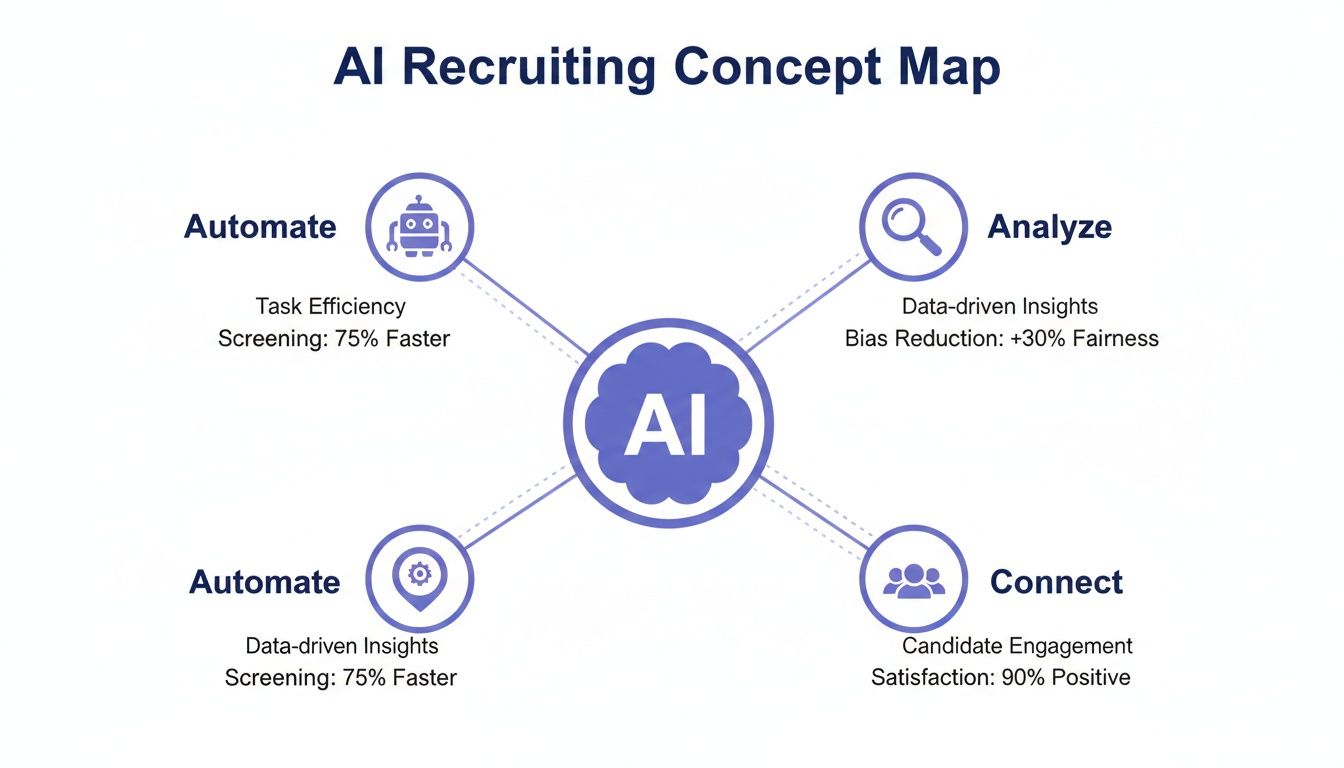
Ultimately, the goal is to let AI handle the repetitive tasks and heavy data analysis. That frees up your human recruiters to do what they do best: build genuine relationships with top candidates.
AI Sourcing and Outreach Platforms
Think of these tools as your team of talent scouts, working around the clock. AI sourcing platforms scan the web, professional networks like LinkedIn, and even your own internal databases to find passive candidates. These are the talented people who aren't actively job hunting but might be a great fit for your open role.
The technology has moved beyond simple keyword matching. Modern platforms can understand context, career progression, and potential.
- Problem Solved: Manually searching for qualified candidates is a significant time commitment. These tools automate the process, building a pipeline of prospects before you even publish a job ad.
- Real-World Example: Imagine a tech company needs a senior backend engineer with niche experience in distributed systems. Instead of a recruiter spending days scrolling through profiles, an AI sourcing tool could identify 50 relevant candidates in minutes. It might even highlight those who have contributed to relevant open-source projects.
Once the platform finds these people, AI-powered outreach tools can even automate the first contact, sending personalized messages to see if they're open to a conversation.
Chatbots and Scheduling Assistants
Recruitment chatbots are like a helpful concierge for your company's career page. They engage candidates instantly, answer common questions about benefits or culture, and can even handle initial screening by asking a few basic qualifying questions. It’s a considerable time-saver; one study found that 75% of candidate communications can be automated.
After that initial chat, AI scheduling assistants take over one of the more tedious parts of recruiting: coordinating interviews. These tools sync with everyone’s calendars and let candidates book a time that works for them, eliminating the frustrating email back-and-forth.
These tools help ensure no candidate falls through the cracks or feels ignored. Instant responses and simple scheduling can significantly improve the candidate experience, which is important for protecting your employer brand.
Skill Verification Platforms
This is where things get particularly interesting. While other tools focus on finding people and communicating with them, skill verification platforms are built to answer a critical question: Can this person actually do the job?
These platforms help you hire beyond the resume. Instead of just reading about a candidate's experience, you get to see their skills in action. They use AI to create dynamic, role-specific assessments that measure real-world abilities, which is a significant step up from the static, multiple-choice tests of the past.
- Problem Solved: Resumes can be unreliable predictors of on-the-job performance. Skill verification tools provide objective, data-backed evidence of what a candidate can do.
- Real-World Example: A growing startup needs a new marketing manager. The AI platform generates a custom case study asking candidates to outline a launch plan for a new product. It then assesses their strategic thinking, data analysis, and communication skills, ranking the top performers for the hiring manager.
This approach gives you a much clearer picture of who can deliver results from day one. If you want to go deeper, you can learn more about the different kinds of pre-employment assessment tools that are changing how modern companies hire.
Cohesyve
See what candidates can do before you interview them
Cohesyve turns a job description into a role-specific assessment with a scoring rubric. Each candidate gets a different version, so questions cannot be shared. Ten candidates free, no card.
What AI in Hiring Actually Delivers
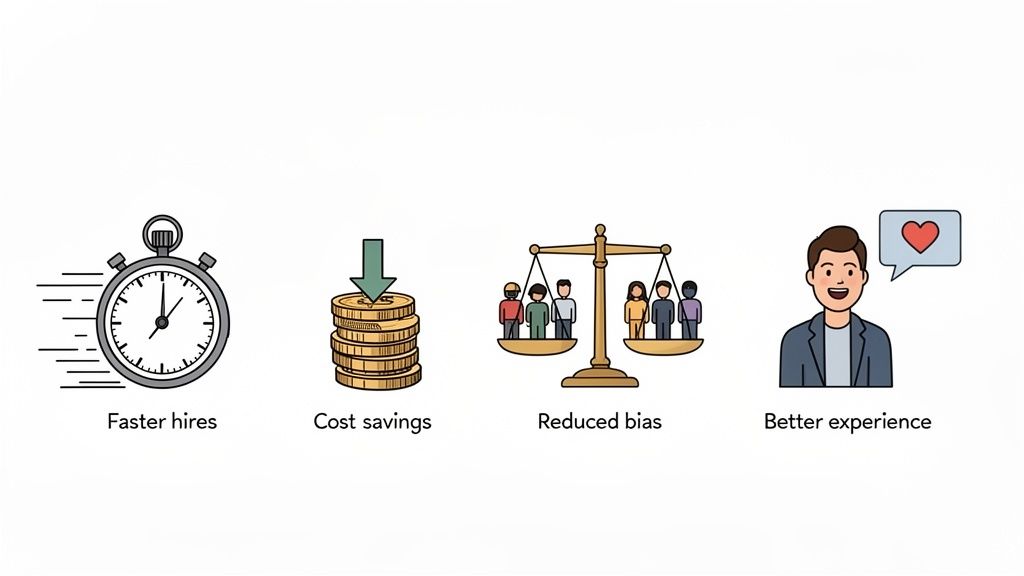
Let's look at the practical, on-the-ground advantages of bringing AI-powered recruitment tools into your hiring process. The return on investment often appears in four key areas: speed, cost savings, fairness, and the quality of your candidate experience. It’s about making smarter, data-driven decisions where they count the most.
The first thing most teams notice is how much faster everything becomes. All those manual, time-consuming tasks—sifting through hundreds of resumes, scheduling endless screening calls—get automated. What used to take weeks can now be done in days, sometimes even hours.
This isn’t just a minor efficiency gain; it’s a fundamental change in how you operate. For any company trying to scale quickly, this speed can be a competitive advantage, letting you find and secure top talent before others get a chance.
Slashing Time-to-Hire and Boosting Efficiency
The numbers are compelling. Companies that have adopted AI recruiting tools are seeing their time-to-hire metrics reduced by up to 50%. By automating nearly 75% of candidate communications and initial screening, these platforms free up recruiters to focus on building relationships and making strategic judgment calls.
This shift can help turn your talent acquisition function from a cost center into a growth driver. You can learn more about the impact of AI on hiring speed to see just how significant this change can be. When the initial heavy lifting is handled for you, your team can jump straight to engaging with the most qualified people.
Minimizing Costly Hiring Mistakes
We all know the impact of a bad hire. The financial cost can be significant, often estimated at 30% to 200% of that person's annual salary when you factor in recruitment fees, training, lost productivity, and the effect on team morale. This is where skill verification can provide a strong return.
The hard truth is that traditional hiring methods—like resumes and unstructured interviews—can be poor predictors of who will succeed in a role. They tell you a story about a candidate's past but may offer limited insight into their future performance.
By shifting the focus from resume keywords to proven abilities, AI assessment platforms give you objective data on what a candidate can actually do. This move toward evidence-based hiring is one of the most effective ways to reduce the risk of making a costly mis-hire.
When you can confidently pinpoint top performers based on how they handle real-world challenges, you’re not just filling a seat. You're making a sound investment in your company's future.
Promoting Fairer, Less Biased Hiring
Unconscious bias is one of the most persistent challenges in recruiting. Despite good intentions, it’s easy to be swayed by factors that have little to do with job performance—like a candidate's name, the university they attended, or their personal background.
AI can help create a more level playing field by focusing on what truly matters: objective, role-relevant skills.
- Standardized Evaluation: Every candidate is assessed against the same criteria. This removes some of the guesswork and subjectivity from initial screening.
- Focus on Skills, Not Pedigree: The system values what someone can do over where they come from, opening up opportunities for talented people from non-traditional backgrounds.
- Data-Driven Decisions: Hiring managers get a clear, ranked shortlist based on performance data, making it easier to focus on competence.
This isn’t about taking humans out of the equation. It's about arming them with better, fairer information so they can make the final call with confidence.
Creating a Better Candidate Experience
Finally, let's talk about the people this whole process is for: your candidates. A clunky, slow, or impersonal hiring process can be a turn-off for top talent and can damage your employer brand.
A well-designed AI-powered system keeps candidates in the loop with prompt, automated communication. No more "application black hole." Even better, when the assessment involves relevant, job-specific tasks, candidates often feel seen and respected. They may view it not as a corporate hurdle, but as a chance to genuinely show what they can do.
This positive experience can translate directly into higher assessment completion rates—often exceeding 95%. It leaves every applicant, whether they get the job or not, with a good impression of your company.
Navigating the Risks of AI in Recruitment
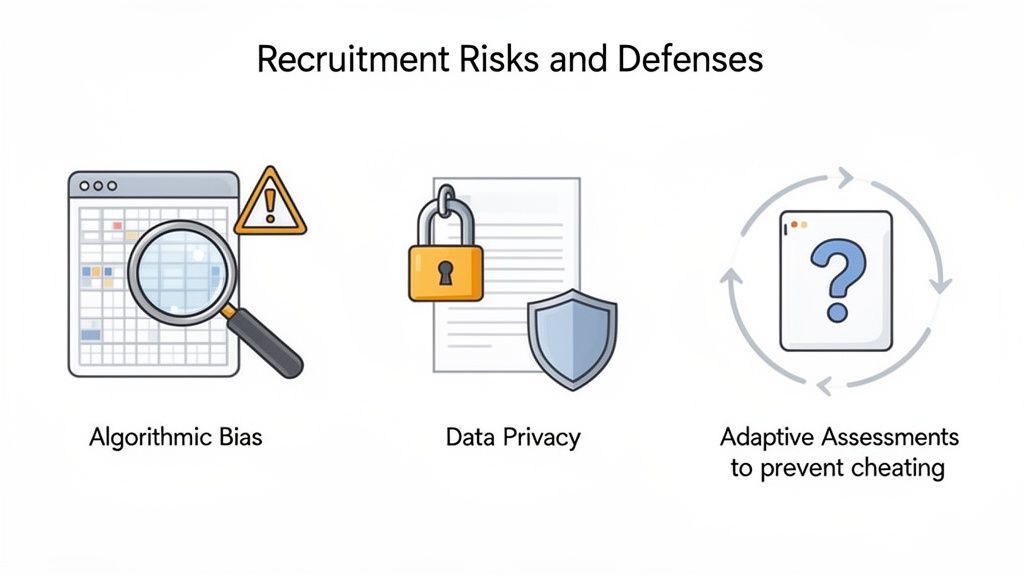
Adopting new technology means looking at it with open eyes, and that includes seeing the potential downsides. While AI-powered recruitment tools can bring significant efficiency, it's just as important to understand and prepare for the risks. A smart approach ensures you get the benefits of AI while building a hiring process that’s fair, secure, and effective.
Taking an honest look at these potential pitfalls isn't about discouraging AI adoption; it's about helping you choose the right tools and implement them in a way that strengthens your talent strategy.
The Shadow of Algorithmic Bias
The biggest concern for many is algorithmic bias. If an AI is trained on your company's past hiring decisions, and those decisions—consciously or not—favored certain groups, the AI might learn to replicate those patterns. It can become a high-tech echo chamber for old biases.
For instance, if a company has historically hired mostly male engineers, an AI trained on that data might start flagging male candidates as a better "fit," even when their skills are identical to female applicants. The tool could end up reinforcing the very inequity you're trying to eliminate.
When you're looking at any AI tool, it's important to ask how the system is trained and what measures are in place to prevent bias. The best platforms often sidestep this problem by focusing on objective, role-specific skills instead of trying to find patterns in subjective resume data from the past.
This shift changes the evaluation from "Who looks like the people we've hired before?" to a much more useful question: "Who can do this job best?"
Protecting Candidate Data Privacy
In today's world, data privacy is a fundamental responsibility. When candidates provide their resumes, assessment results, and personal details, you become the guardian of that information. A breach can lead to legal fines and, just as importantly, damage the trust you've built with talent.
Any AI recruitment tool you consider should comply with major data privacy regulations.
- GDPR (General Data Protection Regulation): The standard for protecting the data of anyone in the European Union.
- CCPA (California Consumer Privacy Act): A similar framework that grants robust data privacy rights to California residents.
These regulations aren't just red tape. They ensure a vendor has strong security, gives candidates control over their own data, and operates transparently. Always review a vendor’s privacy policies and security certifications before you commit.
The Overlooked Threat of Cheating in Assessments
Finally, there’s a risk that can be overlooked when people get excited about new assessment tools: cheating. Most traditional pre-employment tests use static question banks. Think of it as a fixed pool of questions that get recycled for every candidate.
The problem is that those question banks can leak. It’s only a matter of time before the questions and answers end up on forums like Reddit or Glassdoor. Once that happens, your assessment is no longer measuring someone's actual ability—it's just measuring how well they can use a search engine. The results become unreliable.
This is where a more advanced approach makes a difference. Instead of static questions, some platforms use AI to generate dynamic, adaptive challenges. This means every candidate gets a unique assessment that can adjust in real-time based on their answers. It's like giving each person a different version of the test, making it virtually impossible to cheat and ensuring the scores you see reflect genuine skill.
How to Choose the Right AI Recruitment Tool
With so many options available, picking the right AI tool can feel like trying to find the perfect coffee shop in a new city. Every corner has one, and they all claim to have the best brew. The secret is to ignore the flashy signs and focus on what you actually need.
It’s the same with AI-powered recruitment tools. The best choice always starts with a clear understanding of your specific hiring challenges.
Before you book your first demo, take a hard look at your process and find the biggest bottleneck. Is your team overwhelmed with unqualified resumes? Are you struggling to find passive candidates for specialized roles? Or is your biggest challenge accurately predicting if a candidate can do the job? Your answer will point you in the right direction and help you avoid buying a tool that solves a problem you don't have.
Start by Defining Your Core Needs
The first step is to diagnose your primary challenge. Are you struggling with sourcing, screening, or skills assessment? A tool that’s great at finding passive talent might not be the right fit if your main problem is verifying technical skills.
Once you know what you're trying to fix, you can start evaluating the features that matter. A nice-looking dashboard is fine, but it won’t fix a broken hiring process. Focus on the practical elements that directly impact your team’s efficiency and the quality of your hires.
The goal isn’t to find a vendor who will sell you software. The goal is to find a partner who understands your challenges and offers a solution that genuinely solves them, making your hiring process smarter and more effective.
To make this process a little easier, we've put together a checklist. Use it to score potential tools against what your team truly needs.
Evaluation Checklist for AI Recruitment Tools
Use this checklist to score potential AI tools against the core needs of your hiring team, ensuring a smart and strategic investment.
| Evaluation Criteria | Key Questions to Ask | Why It Matters |
|---|---|---|
| Problem-Solution Fit | Does this tool directly solve our biggest hiring bottleneck? | A tool that doesn't address your primary pain point is a wasted investment, no matter how impressive its features are. |
| ATS Integration | How deep is the integration with our current ATS? Is it a true two-way sync or just a basic data-pass? | Poor integration creates manual workarounds, defeating the purpose of automation and frustrating your team. |
| Candidate Experience | Is the interface intuitive and engaging? Does the assessment feel relevant to the role and respectful of the candidate's time? | A clunky, generic, or confusing experience will cause top talent to drop out and can damage your employer brand. |
| Skills Verification | Does the tool assess practical, on-the-job skills, or does it rely on keyword matching and multiple-choice questions? | True competence is demonstrated through action, not just words on a resume. You need to see what candidates can do. |
| Bias & Fairness | What steps does the vendor take to identify and mitigate algorithmic bias? Can they provide validation studies? | An unfair process not only costs you great candidates from diverse backgrounds but also exposes you to legal risk. |
| Language Support | Can the platform support assessments in the native languages of our candidates? | Assessing candidates in their own language is essential for fairness, accuracy, and creating an inclusive process for a global talent pool. |
| Pricing & ROI | Is the pricing model flexible and transparent? Does it align with our fluctuating hiring needs, or are we locked into a rigid contract? | A pay-as-you-go model ensures you only pay for what you use, providing better ROI and adapting to your business cycles. |
This checklist isn't exhaustive, but it covers the non-negotiables. A great tool should work with your existing systems, not force you to adapt to its limitations.
Key Features to Prioritize
As you evaluate different platforms, keep these priorities top of mind:
Seamless ATS Integration: Your new tool has to play nicely with your current Applicant Tracking System. A clunky or non-existent integration creates more manual work, which defeats the entire purpose of bringing in a new tool.
A Stellar Candidate Experience: First impressions are everything. A confusing interface or an irrelevant, generic assessment will cause high drop-off rates, especially among top-tier candidates. Look for platforms that offer engaging, intuitive experiences that make your company look good.
Multi-Language Support: If you’re hiring globally or in diverse regions, assessing candidates in their native language isn't just a "nice-to-have"—it's crucial for fairness and accuracy.
Focus on Practical Skills: This is a big one. Many tools still rely on simple keyword parsing, which is just a faster version of the old resume review process. You should prioritize platforms built to verify real, on-the-job skills through practical, role-specific challenges. Understanding the different types of candidate assessment tools will help you spot the ones that truly measure competence.
Rethink Your Pricing Model
Finally, let's talk about cost. Most vendors will try to lock you into a rigid, long-term subscription. This model often benefits them more than it benefits you, especially if your hiring needs fluctuate throughout the year.
Look for more flexible pricing options. A transparent, pay-as-you-go model lets you scale your usage up or down as needed, ensuring you're only paying for what you actually use. This approach not only aligns the vendor’s success with yours but also gives you the agility modern companies need. When a partner offers a flexible model, it shows they’re confident in the value they provide.
The Future of Hiring Is Skill-First and Human-Led
So, where is this all heading? The evolution of AI-powered recruitment tools isn't about replacing recruiters with robots. The goal is to forge a partnership where technology elevates the human art of hiring.
Think of it this way: AI is effective at handling high-volume, repetitive work with a speed and precision that humans can't match. This frees up recruiters to do what they do best—building relationships, understanding complex team dynamics, and acting as strategic talent advisors. It’s a move from processing candidates to curating talent.
The Rise of the Human-Led, AI-Powered Team
This new model isn't just about hiring faster; it's about hiring smarter. As companies work to build a resilient workforce, AI tools are becoming essential to modern talent management strategies, especially those built around hiring for skills. The most effective tools are the ones that look past the resume to see what a candidate can actually do.
The ultimate goal is to build stronger, more capable teams by confidently identifying people who have proven they can do the job before they’re even hired. This focus on verified ability is the core of a more equitable and effective hiring process.
This creates a win-win. Companies reduce the risk and cost of a bad hire. At the same time, candidates get a fair opportunity to prove their real-world skills, no matter their background or how their resume is formatted.
Building Your Team on a Foundation of Proven Skills
When you boil it down, bringing AI into your recruitment process comes back to one simple, powerful idea: hire based on evidence, not just educated guesses. By focusing on practical, verifiable skills, you strip away much of the ambiguity and unconscious bias that can enter hiring decisions.
This skill-first philosophy isn't just a trend; it's a more sustainable and intelligent way to build a great company. You can learn more about skills-based hiring and see how it’s reshaping talent acquisition. By pairing human insight with AI-driven skill verification, you're not just filling roles—you're making a strategic investment in your company's future.
Frequently Asked Questions About AI in Recruitment
Jumping into AI-powered recruitment tools always brings up a few questions. It's a significant change from how we've traditionally approached hiring, so it’s natural to be curious. Here are some straight answers to the questions we hear most often.
The goal of these tools is to make your job easier, not harder. Let’s tackle some of those common uncertainties.
Will AI Replace Recruiters?
No. This is probably the biggest myth out there. AI isn't here to replace recruiters; it's here to empower them. Think of it like giving a great chef a state-of-the-art kitchen—the tools don't replace the talent, they amplify it.
AI is very good at handling the repetitive, high-volume work that bogs recruiters down, like screening thousands of resumes or coordinating interview times. This frees up your team to do what they do best: build relationships with candidates, act as a strategic advisor to hiring managers, and close top talent. Those are the human touches that AI can't replicate.
How Does AI Help Reduce Hiring Bias?
This is a really important one. When used correctly, AI can be a powerful tool for building a more equitable hiring process. The key is using a system that focuses on objective, job-related skills instead of just learning from historical hiring data, which is often riddled with old biases.
A well-built AI platform helps create a level playing field by measuring every candidate against the same standard. It focuses on what a person can actually do—not their name, their alma mater, or their background—which opens the door for talented people who might have been filtered out by traditional screening.
By providing objective, performance-based data, these tools help hiring teams make calls based on competence.
What Is the Most Important Thing to Look For in an AI Tool?
You’ll see lots of discussion about features like ATS integration or a slick interface, and those are important. But the single most critical thing to look for is the assessment methodology at its core. You have to ask: does this tool just put a techy spin on the old way of doing things, like keyword-matching resumes, or does it genuinely change how you identify talent?
You want a platform that measures real, on-the-job skills. The best tools use dynamic, adaptive challenges that are unique for every candidate, which makes it nearly impossible to cheat. This approach ensures you’re seeing true ability, not just how good someone is at Googling answers. That focus on skill verification is what separates a tool that delivers real value from one that's just more noise.
Ready to move beyond resumes and start hiring based on proven skills? Cohesyve helps you instantly create dynamic, role-specific assessments that identify top performers with confidence. See how it works.