A formal communications skills assessment is your chance to see beyond the interview small talk and evaluate how a candidate handles job-specific scenarios. It’s a structured way to observe and measure abilities like clarity, persuasion, and active listening, giving you solid data on their real-world potential.
Why Traditional Interviews Often Fall Short
Let's be practical. A candidate who is a great conversationalist over a 45-minute video call isn't always a great communicator when the pressure is on. Many hiring managers have hired someone who seemed polished and articulate, only to discover their communication style creates friction, confusion, or delays. The friendly interview persona can mask underlying communication gaps.
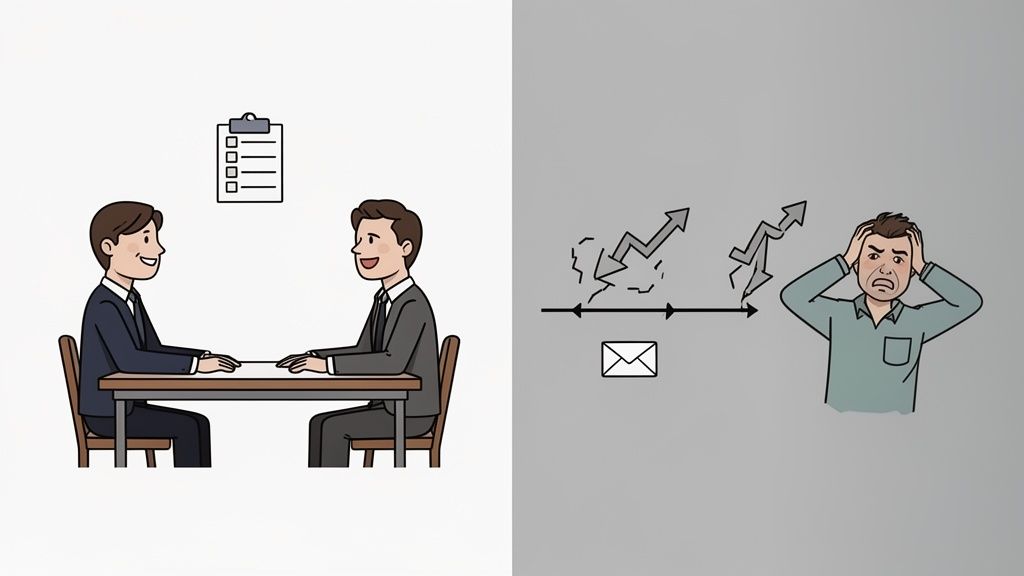
This disconnect happens because standard interviews are often poor predictors of on-the-job performance. They tend to test how well a candidate can interview—a skill in itself—rather than their ability to handle the job’s core communication tasks. Anyone can list "strong communication skills" on a resume, but that’s not proof.
The Hidden Costs of Poor Communication
Poor communication isn’t just an annoyance; it can be a significant drain on resources. One joint study estimates that businesses may lose up to $1.2 trillion annually due to ineffective communication. This figure, detailed in a communication skills study on aiirconsulting.com, highlights the hidden costs of misunderstandings and failed collaborations.
The ripple effects are felt everywhere:
- Productivity drops: Projects get derailed by unclear emails or poorly articulated goals.
- Team morale suffers: Constant misunderstandings breed tension and affect collaboration.
- Client relationships weaken: A lost client can often be traced back to a poor presentation or an issue handled with a lack of empathy.
Even when recruiters try to dig deeper with soft skills interview questions, the artificial setting of a traditional interview doesn't always reveal the whole picture. It rarely mirrors the dynamic, often stressful challenges an employee will face.
The core problem is that we’re asking candidates to tell us they are good communicators instead of asking them to show us.
Moving Beyond Unreliable Predictors
Relying on resumes and unstructured interviews is like judging a chef by reading their menu instead of tasting the food. The information is on the surface, lacking the depth needed to make a confident decision.
This is why a structured communications skills assessment is so valuable. It shifts the evaluation from a subjective chat to an objective, evidence-based process. By simulating real job challenges—like handling an upset client in a role-play or drafting a project update for stakeholders—you get a genuine preview of a candidate's abilities. This approach builds a better hiring process, one that verifies skills and helps you pinpoint the top performers who will drive your business forward.
Defining What Good Communication Looks Like for the Role
Before building an assessment, you need to know what you’re looking for. Simply saying you want to hire for “good communication” is too vague to be useful.
What works for a high-pressure sales role is different from the communication style needed for a detail-oriented software engineer. The goal is to move from abstract ideas to concrete, observable behaviors you can measure.
Instead of just listing "clarity," define what clarity looks like on the job. Does it mean translating complex technical specs for a non-technical audience? Or does it mean writing concise, unambiguous bug reports that leave no room for error?
This level of specificity is what transforms your evaluation from a subjective exercise into a strategic tool. You stop hiring people who just talk well and start hiring people who communicate effectively to get the job done.
Deconstruct the Job Description
Your job description is more than just an ad; it’s a blueprint for your assessment. Go through it line by line and highlight every word or phrase that points to a communication need, whether it's direct or implied.
Look for the action verbs and core responsibilities. A phrase like "manage stakeholder expectations" isn't just a task—it’s a signal that you need someone with skills in persuasion, active listening, and proactive updates. "Collaborate with cross-functional teams" suggests the ability to articulate ideas clearly and navigate different working styles.
Once you have a list of these clues, group them into broader communication competencies. This helps you see the bigger picture and figure out what’s truly critical for success.
- Clarity: The ability to get a point across in a simple, direct way.
- Empathy: The knack for understanding and responding to how others are feeling. Essential for customer-facing and team leadership roles.
- Persuasion: The skill of getting others on board with an idea or action. Think sales, marketing, and leadership positions.
- Active Listening: Not just hearing words, but concentrating, understanding the message, and responding thoughtfully.
Role-Specific Communication Profiles
The weight you give each of these skills will shift depending on the role. A customer success manager needs empathy to de-escalate tough situations, while an engineer needs precision and clarity to prevent coding mistakes.
Let’s look at a couple of examples.
For a Customer Success Manager:
- Primary Need: Building rapport and solving problems.
- Key Skills: High empathy, active listening, and consistently positive phrasing.
- Observable Behavior: You’d see them acknowledging a customer's frustration, summarizing the issue to confirm they understand, and then calmly outlining a path to a solution.
For a Software Engineer:
- Primary Need: Precise technical collaboration.
- Key Skills: High clarity, conciseness, and the ability to give and receive constructive feedback.
- Observable Behavior: This looks like a project update that clearly states progress, blockers, and next steps—all without technical jargon that would confuse other teams.
To get this right, you need to map out the specific communication demands of each role you're hiring for. A simple framework can make this process much clearer.
Mapping Role Requirements to Communication Skills
| Role Type | Primary Communication Need | Key Skills to Assess | Example Assessment Task |
|---|---|---|---|
| Sales Representative | Building trust & influencing decisions | Persuasion, active listening, rapport-building | Role-play a call with a skeptical prospect. |
| Customer Support Agent | Problem-solving & de-escalation | Empathy, clarity, patience, positive framing | Respond to a simulated angry customer email. |
| Project Manager | Alignment & proactive updates | Clarity, conciseness, managing expectations | Draft an email updating stakeholders on a delayed project. |
| Software Engineer | Technical accuracy & collaboration | Technical clarity, giving/receiving feedback | Explain a complex technical concept to a non-technical colleague. |
By thinking through what each role demands, you can design tasks that mirror the real-world challenges a candidate will face.
Of course, it goes beyond just words. Establishing a clear tone of voice definition is also important for consistency, especially in roles where brand representation is part of the job.
This contextual approach ensures your communication assessment is directly tied to performance. You're not just testing a generic skill; you're verifying that a candidate can handle the specific communication hurdles they’ll face.
This focus on practical ability has become increasingly important. When it comes to the digital skills people need in modern workplaces, communication and collaboration rank second, beaten only by information and data literacy.
Data from 83 countries shows the median prevalence for these skills is 51%, placing them far ahead of problem-solving (36%). This trend highlights why verified communication assessments are useful for roles across many industries. You can dive deeper into these findings in the ITU's Facts and Figures 2023 report.
By taking the time to clearly define what success looks like first, you build the foundation for a hiring process that’s fair, accurate, and predictive.
Cohesyve
See what candidates can do before you interview them
Cohesyve turns a job description into a role-specific assessment with a scoring rubric. Each candidate gets a different version, so questions cannot be shared. Ten candidates free, no card.
Choosing Assessment Tasks That Mirror the Job
Once you've defined what great communication looks like for a specific role, it's time to pick assessment tasks that measure it. The goal here is to get away from abstract questions and generic tests. We want to see candidates in action, which means creating dynamic simulations that look and feel like the real challenges they'd face on the job. This is how you get a true preview of their abilities.
A well-designed communications skills assessment doesn’t just ask candidates if they can handle pressure; it puts them in the middle of it. This shift from "telling" to "showing" is what generates reliable data, helping you distinguish between someone who interviews well and someone who will perform well.
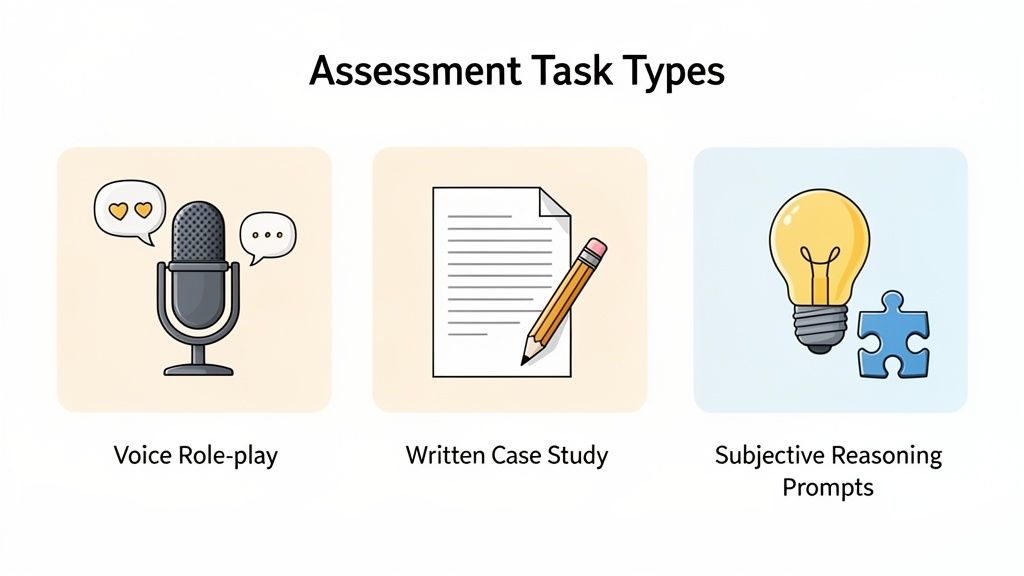
The most effective tasks are always tied directly to the core functions of the role. For a sales rep, that might mean navigating a tricky negotiation. For a project manager, it could be delivering bad news to a stakeholder. Let's dig into three formats that bring these scenarios to life.
Voice Role-Plays for Real-Time Reactions
Voice role-plays are a good choice for assessing interpersonal skills in jobs that are heavy on real-time, unscripted interaction. Think customer service, sales, or team leadership. This format lets you evaluate a candidate's tone, empathy, and ability to think on their feet in a way a written task can't.
So, instead of asking, "How would you handle an angry customer?" you create the scenario and let them handle it. This gives you a direct, unfiltered look at their problem-solving process and emotional intelligence when the pressure is on.
Example Scenario for a Sales Development Representative (SDR)
- Prompt: "You're calling a prospect who just had a bad experience with a competitor's product, which is similar to yours. They're frustrated and skeptical. Leave them a voicemail that acknowledges their frustration, briefly highlights what makes your solution different (without criticizing the competition), and aims to secure a 15-minute discovery call."
- What It Measures:
- Empathy: Can they connect with the prospect's frustration?
- Persuasion: Do they build value without pushing a hard sell?
- Clarity and Conciseness: Can they deliver a compelling message in under a minute?
This kind of task is more predictive than a standard interview question because it simulates the environment—and pressure—of the job. You can get creative with implementation, and a popular, scalable method is through asynchronous tasks, sometimes known as one-way video interviewing. It's a useful way to collect and compare responses consistently.
Written Case Studies for Strategic Thinking
For roles where sharp written communication is key—like product management, marketing, or consulting—a case study is a useful tool. This format tests a candidate’s ability to break down a complex situation, structure their thoughts logically, and communicate a clear, strategic response in writing.
The trick is to create a scenario that’s both realistic and open-ended enough to allow for different valid approaches. You're not looking for a single "right" answer. You're evaluating the reasoning and clarity behind the candidate's proposed solution.
Example Scenario for a Product Manager
- Prompt: "The engineering team just told you a key feature for an upcoming product launch will be delayed by four weeks. This will disrupt the marketing timeline and disappoint early customers. Draft an email to the Head of Product and the Head of Marketing explaining the situation, outlining the immediate next steps you're taking, and proposing a revised communication plan."
- What It Measures:
- Clarity: Is the update direct, concise, and free of jargon?
- Strategic Thinking: Do they just state the problem, or do they propose a solution and manage expectations?
- Audience Awareness: Is the tone appropriate for communicating with senior leadership?
A great case study reveals how a candidate thinks. It shows you their problem-solving process, their ability to prioritize information, and how they structure an argument—all critical components of effective professional communication.
Subjective Reasoning Prompts for Judgment
Subjective reasoning prompts are short, open-ended questions designed to see how a candidate exercises judgment and sets priorities. They are useful for uncovering how someone approaches nuanced or ambiguous situations where there's no clear playbook.
This format is versatile and can be adapted for almost any role, from operations to finance. It gives you a window into a candidate's decision-making framework and how they would navigate the gray areas of a job.
Example Scenario for an Operations Manager
- Prompt: "Two high-priority projects are behind schedule, and your team is at capacity. Project A is critical for a major client. Project B is an internal initiative essential for our long-term efficiency. You can only give extra resources to one. Which project do you prioritize and why? Describe the key factors behind your decision."
- What It Measures:
- Prioritization: Can they build a logical case for their choice?
- Problem-Solving: Do they consider the downstream consequences of their decision?
- Conciseness: Can they explain their reasoning clearly and efficiently?
By choosing tasks that mirror the actual demands of the job, you create a communications assessment that is not only fair and relevant but also highly predictive of who will succeed in the role.
Building a Fair and Consistent Scoring Rubric
An assessment is only as good as its scoring system. Without a clear, objective rubric, you risk letting unconscious bias creep in, turning what should be a data-driven evaluation into a subjective judgment call.
A strong rubric is your foundation for a fair and consistent communications skills assessment. It ensures every candidate is measured against the same standard. This isn't about creating a rigid checklist; it's about defining what "good" looks like in a way that’s transparent, consistent, and defensible.
Think of it as a translator. It turns abstract qualities like "clarity" or "persuasion" into concrete, observable behaviors. This shift takes you from a vague, "I liked their answer," to a specific, "The candidate successfully de-escalated the situation by first validating the customer's frustration." That's how you make a confident, evidence-based hiring decision.
From Vague Concepts to Measurable Criteria
The first step is to break down big-picture skills into smaller, tangible components. Let's say you’re assessing "persuasion" for a sales role. What does that look like in action?
You might break it down into several observable behaviors:
- Framing the Problem: Does the candidate diagnose the customer's core pain point before pitching a solution?
- Articulating Value: Can they connect a product feature directly to a benefit that solves the customer's specific problem?
- Handling Objections: How do they react to pushback? Do they listen, address the concern without getting defensive, and steer the conversation back to the value proposition?
By deconstructing the skill this way, you create a set of clear criteria to evaluate. These criteria become the rows of your scoring rubric. Our guide on content validity examples digs deeper into why tying these criteria directly to job functions is important for building a legally sound process.
Developing a Clear Rating Scale
With your criteria set, you now need a scale to score them. A simple 3 or 4-point scale often works best. You could use categories like 'Needs Improvement,' 'Meets Expectations,' and 'Exceeds Expectations.'
The labels themselves aren't enough. The key is to define what each level looks like in practice with clear behavioral anchors.
An effective rubric doesn't just score the outcome; it evaluates the process. It helps you see how a candidate arrived at their answer, which is often more revealing than the answer itself.
Let's walk through a practical example. Imagine a voice role-play where a candidate has to handle an upset customer.
| Skill Assessed | 1 - Needs Improvement | 2 - Meets Expectations | 3 - Exceeds Expectations |
|---|---|---|---|
| Empathy | Dismisses or ignores the customer's feelings. Jumps straight to a solution without acknowledging frustration. | Acknowledges the customer's frustration with a standard phrase ("I understand you're upset"). | Validates the customer's feelings with specific, genuine language ("It sounds incredibly frustrating to have that happen..."). |
| Problem-Solving | Offers a generic or irrelevant solution. Fails to ask clarifying questions to understand the root cause. | Asks basic questions and proposes a logical solution to the stated problem. | Asks insightful follow-up questions to uncover the underlying issue and offers a tailored, proactive solution. |
| Tone & Professionalism | Sounds defensive, rushed, or impatient. Uses negative language or places blame. | Maintains a professional and calm tone throughout the interaction. Uses neutral language. | Maintains a warm and reassuring tone, even when challenged. Uses positive framing to build confidence. |
Training Evaluators for Consistency
A rubric is only effective if everyone uses it the same way. This step is important. Before you start scoring real candidates, run a calibration session with your hiring team.
Have two or three people score the same sample responses—without consulting each other—and then get together to compare the results. You'll quickly see where the rubric is unclear or where your evaluators are interpreting the criteria differently. Talk through the discrepancies and refine the descriptions until everyone is on the same page. This upfront investment in training is critical for reducing bias and ensuring every candidate gets a fair shot.
This kind of rigor is what today’s employers are looking for. Corporate recruiters consistently rank communication as a top skill for new hires. Findings from GMAC's 2023 Corporate Recruiters Survey, which polled over 1,000 respondents, confirm that this demand isn't going anywhere. You can read the full survey report on efmdglobal.org to see the data for yourself. An objective, well-calibrated rubric is your best tool for reliably finding the talent that meets this high bar.
Integrating the Assessment into Your Hiring Workflow
You’ve designed an effective assessment and a fair rubric. But a great test is only useful if it fits into your hiring process. The final piece of the puzzle is fitting your communications skills assessment naturally into your existing workflow.
This is where logistics meet strategy. You need to get the data you need without alienating top candidates or burning out your hiring team. The goal is to make the assessment feel like a logical next step in the journey—not a frustrating hurdle that makes great people drop out.
Finding the Sweet Spot in Your Funnel
Timing is important. Ask for an assessment too early, and you’ll create a lot of work for your team and might screen out promising people who need more context. Ask for it too late, and you’ve already invested valuable interview time into candidates who lack the core communication skills you need.
The ideal spot is usually after the initial resume screen but before the in-depth, face-to-face interviews. This creates an efficient filter at a critical stage.
Here's how that looks in practice:
- Initial Screen: You’ve confirmed the candidate meets the basic requirements—things like years of experience or key technical certifications.
- Assessment: Now, you verify they have the essential communication abilities to succeed on the job.
- In-Depth Interview: Your team can finally focus its valuable time on a pre-vetted shortlist of candidates who can both "do the work" and communicate effectively.
This approach respects everyone's time. Candidates invest about 30-45 minutes in a meaningful task, and your hiring managers only spend hours with the most qualified people. It transforms your funnel from a wide net into a focused pipeline.
By front-loading this kind of skills verification, you shift your hiring process from a game of chance to a strategic evaluation. You’re no longer just hoping a candidate can communicate—you know they can before they even walk through the door.
Connecting the Dots with Your ATS
Manually sending assessment invites, tracking who has completed them, and shuffling candidates between stages can lead to administrative challenges. The process becomes much smoother when you integrate your assessment platform with your Applicant Tracking System (ATS).
A proper integration lets automation take over the repetitive work. For instance, you can:
- Automate Triggers: Automatically send an assessment invitation the moment a candidate is moved to a specific stage in your ATS.
- Centralize Data: View scores and results directly within the candidate’s ATS profile. No more flipping between tabs or systems.
- Streamline Communication: Keep candidates in the loop with automated reminders and status updates, ensuring a professional and organized experience.
This automation frees up your recruiting team to do what they do best: build relationships with top-tier talent. If you're curious about what's out there, you can explore our guide on various candidate assessment tools.
This diagram breaks down the fundamental steps for getting your scoring system ready before any candidates take the assessment.
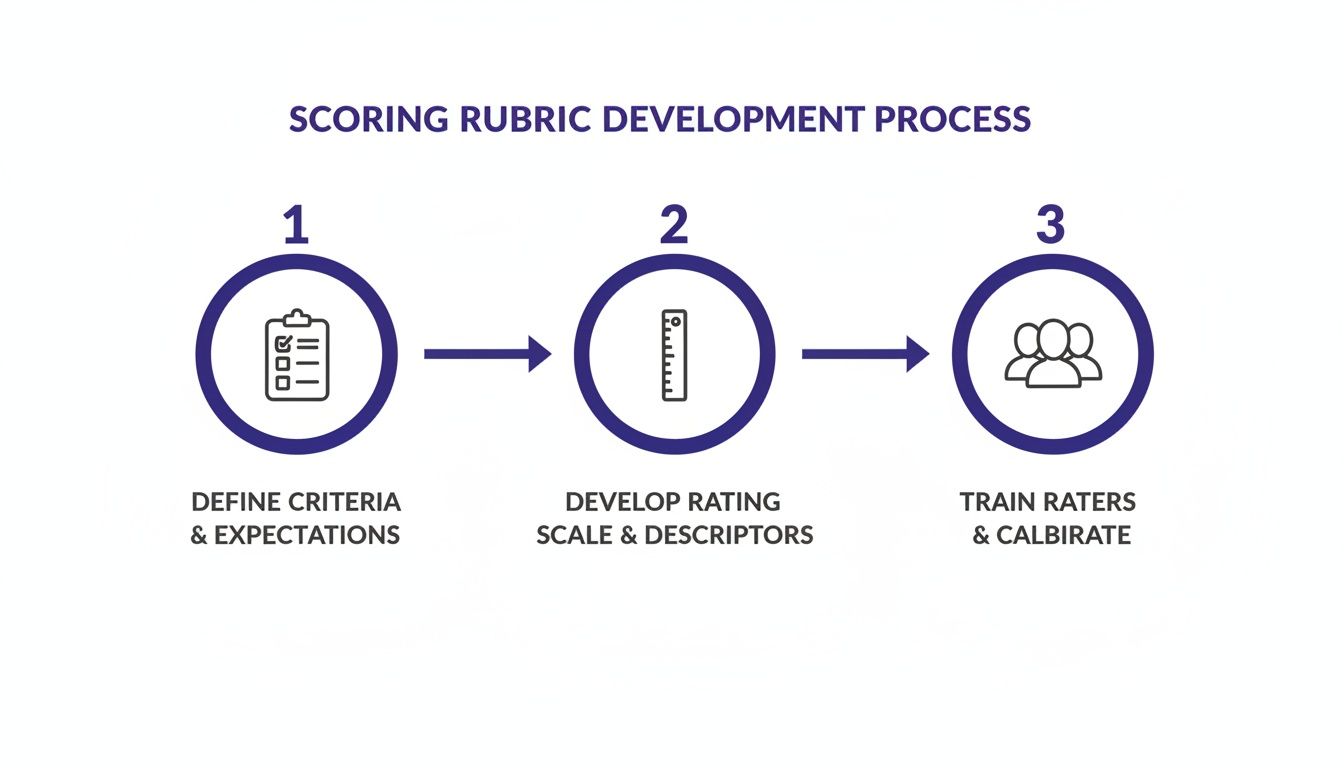
The image highlights a simple, repeatable process that’s foundational to a fair workflow: define what good looks like, create a consistent scale to measure it, and make sure your team is calibrated on how to use it.
Championing the Candidate Experience
Never forget that your assessment is a direct reflection of your company culture. A clunky, confusing, or overly long process will send talented people elsewhere. A smooth, relevant, and respectful one, however, can boost your employer brand.
To keep your completion rates high—modern platforms often see rates above 95%—focus on a few key things:
- Clear Instructions: Don’t just send a link. Explain why you're using an assessment and frame it as an opportunity for them to showcase their real-world skills.
- Reasonable Time Commitment: Respect their time. A well-designed assessment should give you all the data you need in under an hour.
- Job Relevance: Make sure the tasks clearly mirror the actual challenges of the role. People are far more willing to engage when they see the assessment is a fair test of their abilities, not just a generic quiz.
By thoughtfully weaving your assessment into your process, you build a system that's not only more efficient and predictive but also more engaging for the very people you want to hire.
Frequently Asked Questions About Communications Assessments
Stepping into the world of structured skills verification can bring up a few questions. That's normal. Getting clear on the practical side of things is the first step to feeling confident about a new hiring approach. Let's tackle some of the most common questions from hiring managers and talent acquisition leaders.
How Can We Ensure Our Assessment Is Fair and Unbiased?
This is a key question. The answer comes down to structure and specificity.
Fairness starts with a solid, role-specific rubric. You need to score observable behaviors—what a candidate actually says and does—not subjective personality traits or a vague "gut feeling." The point is to evaluate how someone performs, not who you think they are.
Using structured tasks, where every candidate faces a comparable challenge, is also essential. Some platforms, like Cohesyve, take this a step further by generating unique scenarios for each person, which levels the playing field and makes sharing answers impossible.
Finally, never rely on a single opinion. Train a few different evaluators on your rubric and have them score independently before they discuss. This calibration process is one of the best ways to reduce individual bias and make sure every candidate is measured against the same standard.
Will Adding an Assessment Scare Away Good Candidates?
It’s a valid concern, but the data tells a different story. Top candidates often appreciate a process that values their real skills over perfectly polished resume keywords.
When an assessment is well-designed and directly relevant to the job, it feels like a fair challenge, not just another administrative hoop.
The key is how you frame it. Be transparent. Explain that this is their chance to show off the skills a simple resume could never capture. When the experience is smooth, professional, and respects their time, candidates respond well. Modern platforms often see completion rates over 95%, which shows that candidates are willing to engage when they see the value.
An assessment doesn't scare away top talent; it filters for it. The candidates who embrace the chance to prove their skills are exactly the people you want on your team.
How Long Should a Communications Skills Assessment Take?
Keep it concise. The sweet spot is usually between 20 and 45 minutes.
That’s enough time to gather meaningful data on a few critical competencies but short enough to respect the candidate's time and avoid burnout. You're not testing their endurance. You’re looking for a clear signal on the skills that matter for success in the role.
Focus on a handful of high-impact tasks that simulate the job's core communication challenges. A powerful, focused assessment sends a message: you value their time and you know exactly what you’re looking for.
Can AI Assess Something as Human as Communication?
Yes, but it's about how you use it. Think of AI as a powerful co-pilot, not the final judge.
AI can analyze specific, measurable components of communication with speed and consistency. It can evaluate things like clarity, conciseness, or language complexity in a written response more objectively than a human can.
The most effective approach, however, is often a hybrid one. Let AI do the initial, scalable analysis that flags top performers based on objective criteria. This frees up your human evaluators to focus their expertise on the final judgment call, assessing those human nuances like empathy, strategic influence, or persuasive tone.
This combination gives you the best of both worlds: the scale and speed of AI, paired with the deep, contextual understanding that only an experienced human can provide.
Ready to move beyond resume guesswork and see what your candidates can really do? At Cohesyve, we help you build dynamic, role-specific assessments that verify skills. Discover how you can hire with confidence.