Improving the candidate experience is about treating people with respect. It means communicating clearly and often, valuing their time, and building a hiring process that's both efficient and fair for everyone involved. From the moment someone reads your job ad to the final offer—or rejection—every interaction matters.
This isn't just about being polite; it's about turning a transactional process into an opportunity to build your brand.
Why Candidate Experience Is a Critical Business Metric
Candidate experience can often feel like a "soft" metric, a nice-to-have that gets pushed aside until it starts costing you top talent. In reality, it's a core business metric with a direct, measurable impact on your brand, your hiring speed, and ultimately, your bottom line. The days of employers holding all the cards are over. Today's candidates have more choices and less patience for clunky, impersonal hiring processes.
Think about it this way: just as businesses focus on how to improve customer satisfaction to drive growth, a positive candidate experience is what attracts and secures the very people who will build that growth. A negative experience doesn't just lose you one applicant; it can tarnish your reputation for years.
The Real Cost of a Poor Process
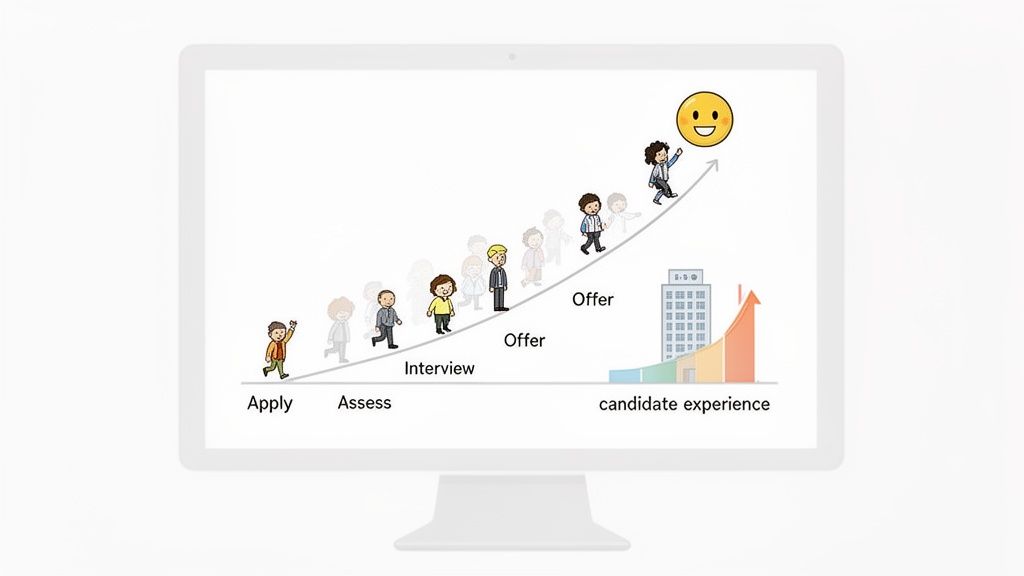
A flawed hiring journey creates tangible business problems that reach far beyond a few frustrated applicants. When candidates feel disrespected, ignored, or strung along, the consequences ripple outward.
Here’s what’s at stake:
A Damaged Employer Brand: Unhappy candidates talk. A single negative review on Glassdoor or a post on LinkedIn can deter dozens—if not hundreds—of future applicants from ever considering your company.
Losing Top Talent to Competitors: The most sought-after candidates are often off the market in just 10 days. A slow or confusing process is an opportunity for your competitors to make an offer while you're still scheduling a second interview.
A Drop in Hire Quality: When your process is a mess, you don't just lose impatient candidates; you lose the discerning ones. Top performers expect an efficient, professional, and respectful process because they see it as a reflection of how the company operates.
Understanding the Modern Candidate's Perspective
The current job market is challenging for candidates. They might submit anywhere from 32 to over 200 applications just to land a single offer. This exhaustive, often demoralizing, process takes a real toll. In fact, 72% of job seekers report negative mental health impacts from long hiring cycles and poor communication.
Many applicants are simply ghosted, never hearing back after they apply. This erodes trust and makes them selective about where they invest their time and energy next.
A candidate's journey with your company is a direct reflection of your company's values. If the process is chaotic and impersonal, they will assume the work environment is too.
Investing in a better candidate journey isn't just a feel-good initiative; it's a strategic move. By focusing on clarity, respect, and efficiency, you directly improve your ability to attract, vet, and hire the people who will drive your business forward. A smooth process sends a clear signal: your company is organized, values people's time, and is a great place to work.
Crafting Your First Impression in Job Ads and Applications
The candidate’s journey doesn’t kick off with an interview; it starts the second they see your job description. This first touchpoint is your digital handshake, and it sets the tone for everything that follows. It's your chance to either pull them in with a clear and respectful message or push them away with a confusing, high-friction process.
Think of your job ad and application form as the lobby of your office. Is it welcoming, easy to navigate, and professional? Or is it a cluttered maze with locked doors and endless paperwork? Many companies unintentionally create the latter, losing out on talented people before even getting a chance to say hello.
Write Job Descriptions That Attract the Right People
A good job description does more than list responsibilities—it tells a story. It paints a picture of the role, the team, and the real impact someone can make. It’s a marketing tool for your open position, and it has to be compelling enough to make someone stop scrolling. The goal is to filter in the right people, not just weed out the wrong ones.
Too often, job descriptions are filled with internal jargon, vague corporate-speak, and an intimidating list of "must-have" qualifications. This approach is known to scare off great candidates, especially those from diverse backgrounds who might have 70% of the skills but won't apply if they can't check every single box.
Here are a few simple tweaks to fix that:
Focus on Impact, Not Just Tasks: Instead of listing "Manage social media accounts," try something like "Grow our community and drive engagement across our key social platforms." One is a chore; the other is a mission.
Use Inclusive Language: Avoid gendered terms (like "rockstar" or "ninja") and corporate clichés. Stick to direct, clear language that feels welcoming to everyone.
Distinguish Needs from Wants: Be honest about what's truly essential versus what's just "nice-to-have." This small change opens the door for more qualified people to take a chance on your role.
Streamline Your Application Process
Let’s be direct: the application form is where most hiring funnels spring a leak. A clunky, long, and desktop-only application is a reliable way to lose top talent. In fact, 41.2% of candidates abandon applications before hitting "submit"—a clear sign that friction is hurting your pipeline. You can dig into the full global hiring insights to see just how significant this is.
A candidate's willingness to complete your application is a direct measure of how much you respect their time. If the process is a burden, they’ll assume working for you will be too.
The best candidates are busy people, often juggling their current job while exploring multiple opportunities. They don't have 45 minutes to manually re-enter their entire work history from a resume into your ATS. Simplifying your application isn't just a nice-to-have; it's a competitive necessity for improving the candidate experience.
Common Application Friction Points and How to Fix Them
Pinpointing exactly where candidates are dropping off is the first step toward fixing the problem. I’ve seen the same handful of issues pop up time and time again. The good news is that the solutions are usually straightforward.
Here’s a quick breakdown of the most common culprits and how you can address them.
Common Application Friction Points and How to Fix Them
| Friction Point | Impact on Candidates | How to Fix It |
|---|---|---|
| Too Many Fields | Overwhelms candidates and feels redundant when they've already uploaded a resume. | Only ask for the absolute essentials: name, email, phone, and resume. You can always gather more details later. |
| Not Mobile-Friendly | Prevents candidates from applying on the go, which is where many start their job search. | Ensure your application form is fully responsive and just as easy to complete on a phone as it is on a desktop. |
| Forced Account Creation | Creates an unnecessary barrier and adds yet another password for them to remember (or forget). | Offer a one-click "Apply with LinkedIn" option or a simple guest application process. No sign-up required. |
| Repetitive Information | Asking candidates to manually re-enter work history from their resume is a top complaint and feels disrespectful. | Use a modern ATS with resume parsing technology that automatically pulls data from their uploaded document. |
By fixing these common pain points, you're not just improving a process; you're sending a powerful message. Treating your job ad as a compelling invitation and your application as a simple RSVP reframes the entire start of your hiring process. A smooth, respectful beginning shows you value people's time—and that’s the foundation of a great candidate experience.
Cohesyve
See what candidates can do before you interview them
Cohesyve turns a job description into a role-specific assessment with a scoring rubric. Each candidate gets a different version, so questions cannot be shared. Ten candidates free, no card.
Ditch the Resume Guesswork: Fair and Engaging Assessments
Once a candidate gets past your initial application, the real evaluation begins. For decades, hiring has hinged on two things: the resume and the unstructured interview. While they're familiar, both are poor predictors of who will actually succeed in a role. They also often open the door for unconscious bias.
A resume is a candidate's highlight reel, and a charming conversation doesn't always signal strong performance. It’s time to stop guessing who can do the job and start verifying it. This means building an evaluation process that's fair, relevant, and engaging for everyone.
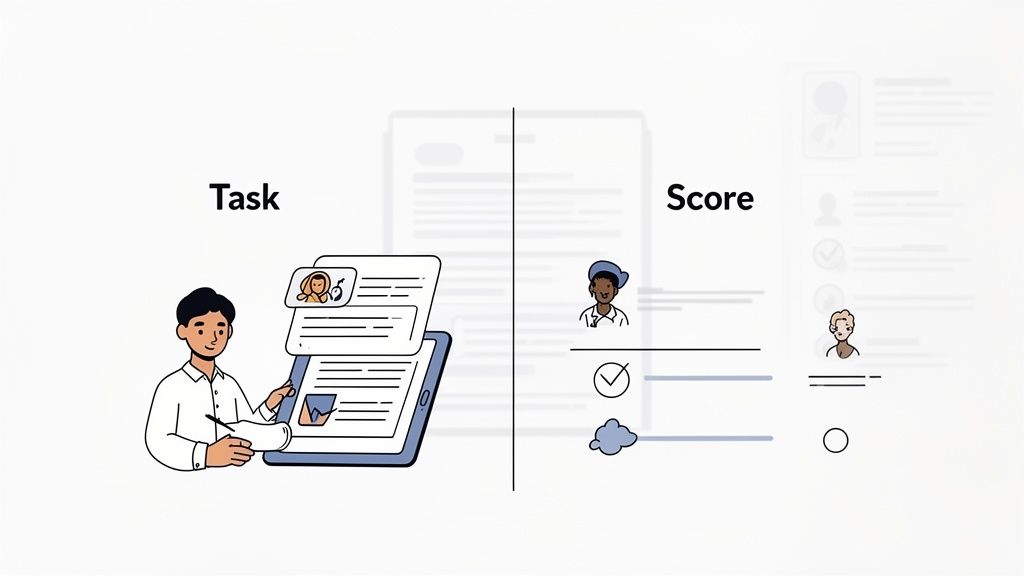
The goal is to design an evaluation that feels less like a quiz and more like a preview of the job itself. When assessments mirror the actual challenges of the role, candidates see the process as a legitimate test of their abilities, not just another arbitrary hoop to jump through. That feeling of respect is a major win for their experience.
Why the Old Ways Don't Work
Leaning too heavily on resumes and casual interviews creates a couple of big problems. First, it favors people who are great at selling themselves over those who are great at the actual work. Second, it leaves your process vulnerable to bias, where a name, a university, or a well-known former employer can carry more weight than it should.
A fair assessment process doesn't just find the best person for the job; it gives every qualified candidate an equal opportunity to prove they are the best person for the job.
Research has shown that unstructured interviews are one of the least effective predictors of performance. They often become conversations about shared hobbies or backgrounds instead of a real evaluation of skills. This not only leads to inconsistent hiring but also leaves candidates feeling like their true talents were never seen. This is where a more intentional, skills-based hiring model can make a difference. You can learn more about what is skills-based hiring in our dedicated article.
Designing Assessments Candidates Appreciate
The best assessments give people a chance to show you what they can do in a context that makes sense. Forget the abstract brainteasers and generic personality quizzes. Instead, focus on practical, role-specific challenges. This gives your team objective data to work with and gives candidates a real taste of what they’d be doing every day.
Here are a few modern assessment types that improve the candidate experience:
Work Sample Tests: Give candidates a small, self-contained project that mimics a real task. For a content marketing role, this could be writing a short blog post on a given topic. For a data analyst, it might be cleaning and finding insights in a small dataset.
Real-World Scenarios: Present a hypothetical but realistic problem. Ask a customer support candidate how they'd handle a specific, tricky customer email. This tests their judgment and problem-solving skills in a way that feels relevant.
Adaptive Assessments: Use platforms that automatically adjust the difficulty of questions based on a candidate's answers. This keeps every person appropriately challenged without feeling overwhelmed, giving you a more accurate and personalized measure of their abilities.
The key is transparency. Always tell candidates what to expect, how long it will take, and how it connects to the job. Simply setting expectations shows you respect their time and effort.
How to Be Tough but Fair
A rigorous assessment process and a great candidate experience aren't at odds with each other—they go hand in hand. Top performers want to be challenged; they want to join a company that cares about quality. A thoughtful assessment signals that you’re serious about building a talented team.
But "rigorous" can quickly become "burdensome" if you're not careful. Your evaluation needs to be efficient and focused on what truly matters for the role.
Here are a few tips to strike that balance:
Assess Early, Interview Later: Use a well-designed assessment early on to screen candidates. It’s more effective and equitable than scanning for resume keywords. It also means you spend your interview time with a smaller, more qualified group of people who have already demonstrated their skills.
Keep It Concise: No one wants to do a massive, unpaid project. An assessment should be long enough to be meaningful but short enough to respect the candidate’s time. For most roles, around an hour is a good benchmark.
Nail the User Experience: If you’re using a digital assessment tool, make sure it’s intuitive, mobile-friendly, and bug-free. Nothing sours an experience faster than a technical glitch. A smooth platform shows you care about the details.
Ultimately, moving to a modern assessment strategy is one of the most powerful changes you can make. It replaces ambiguity with clarity, bias with objectivity, and guesswork with proof. When candidates feel they were given a fair chance to show what they can do, they walk away with a positive impression of your company, no matter the outcome.
Humanizing Your Interview and Feedback Process
Assessments give you objective data, but the interview is where the human connection happens. This is where candidates get a gut feeling about your team and decide if they can see themselves working alongside you. It's your best opportunity to show them who you are beyond the polished job description.
A good interview feels less like an interrogation and more like a conversation—a mutual discovery. Technology can handle scheduling and organize your notes, but it can’t fake the warmth of a real human interaction. Get this stage right, and you’ll increase a candidate's excitement. Get it wrong, and you can undo all the good work you've done up to this point.
Making Interviews a Two-Way Street
A common mistake is treating the interview as a one-sided grilling session. Candidates aren’t just there to impress you; they’re interviewing you, too. They’re trying to figure out if the team is sharp, if their future manager is someone they can learn from, and if the company culture is a place where they can thrive.
To make this happen, every interviewer needs to be ready to be interviewed. That means being prepared for questions about team dynamics, the biggest challenges in the role, and real opportunities for growth.
The goal of an interview isn't just to find out if the candidate can do the job. It's to figure out if you both want to do the job together.
This shift in mindset changes everything. It transforms a high-stress evaluation into a collaborative discussion, which gives you a much better sense of how they’ll contribute as a teammate.
Train Your Interviewers to Be Brand Ambassadors
Your interviewers are the face of your employer brand. An unprepared, distracted, or inconsistent interviewer can ruin a candidate’s experience in minutes. Training is essential for making sure every candidate walks away with a fair and positive impression of your company.
A quick training session can cover the essentials:
Be Prepared: Read the candidate's resume and assessment results before the call. Asking questions that are clearly answered in their application materials signals a lack of care.
Be Present: This one is simple. Close your other tabs. Silence your notifications. Give the candidate your undivided attention. They can tell when you're multitasking, and it's disrespectful.
Be Consistent: Use a structured interview format with a core set of questions for each role. This ensures you’re comparing candidates fairly and reduces bias.
Be Human: Remember to build rapport. Start with a bit of small talk to ease into the conversation before diving into more detailed questions.
This consistency doesn't just improve the candidate experience; it also leads to smarter, less biased hiring decisions. Using a good pre-employment skills assessment early on helps ensure that by the time a candidate gets to you, the conversation can be less about ticking boxes and more about team fit and shared goals.
The Feedback Loop is Non-Negotiable
This is where many companies drop the ball. After a candidate has invested hours into your process, the worst thing you can do is leave them hanging. Timely, transparent communication is the foundation of a respectful hiring process.
Even a simple "no, thank you" is infinitely better than radio silence. Ghosting candidates is the number one frustration for job seekers and a sure way to tarnish your company's reputation.
Recent data shows just how critical this is. A positive experience is a huge driver, with 66% of job seekers saying it's key to accepting an offer. And despite the rise of remote work, 70% still prefer in-person interviews, which points to a desire for authentic connection. The human touch matters. You can see more insights about current candidate experience statistics on CareerPlug.
Closing the loop gracefully is your chance to turn every single applicant—even the ones you turn down—into a brand advocate. To do this well, you can adapt some proven employee feedback strategies for your candidates.
For anyone who made it to the final rounds, consider offering a line or two of constructive feedback. It doesn’t need to be an essay. A brief, thoughtful email can make all the difference.
Here's a simple template for constructive feedback:
"Thank you again for your time. While we were impressed with your project management skills, we decided to move forward with a candidate whose experience was more closely aligned with the specific B2B software environment this role requires. We encourage you to apply for future roles."
This small act of respect acknowledges their effort, provides closure, and leaves them with a positive final impression. It humanizes the rejection and shows you see them as a person, not just another application in the pile.
How to Measure and Continuously Improve Your Hiring Process
You can’t improve what you don’t measure. After refining your job ads, assessments, and interviews, the real test is tracking whether those changes are actually making a difference. This is where you move from guesswork to data-driven insights, turning a one-time project into a sustainable system for creating a better candidate experience.
The goal isn't to get buried in spreadsheets. It's about identifying a few key numbers that tell a clear story about your hiring process. Think of these metrics as your vital signs—they let you know when things are healthy and alert you when a specific stage needs attention. Collecting this data is often simpler than you think.
A good interview doesn't just happen. It's a deliberate process built on preparation, genuine connection, and respectful feedback.
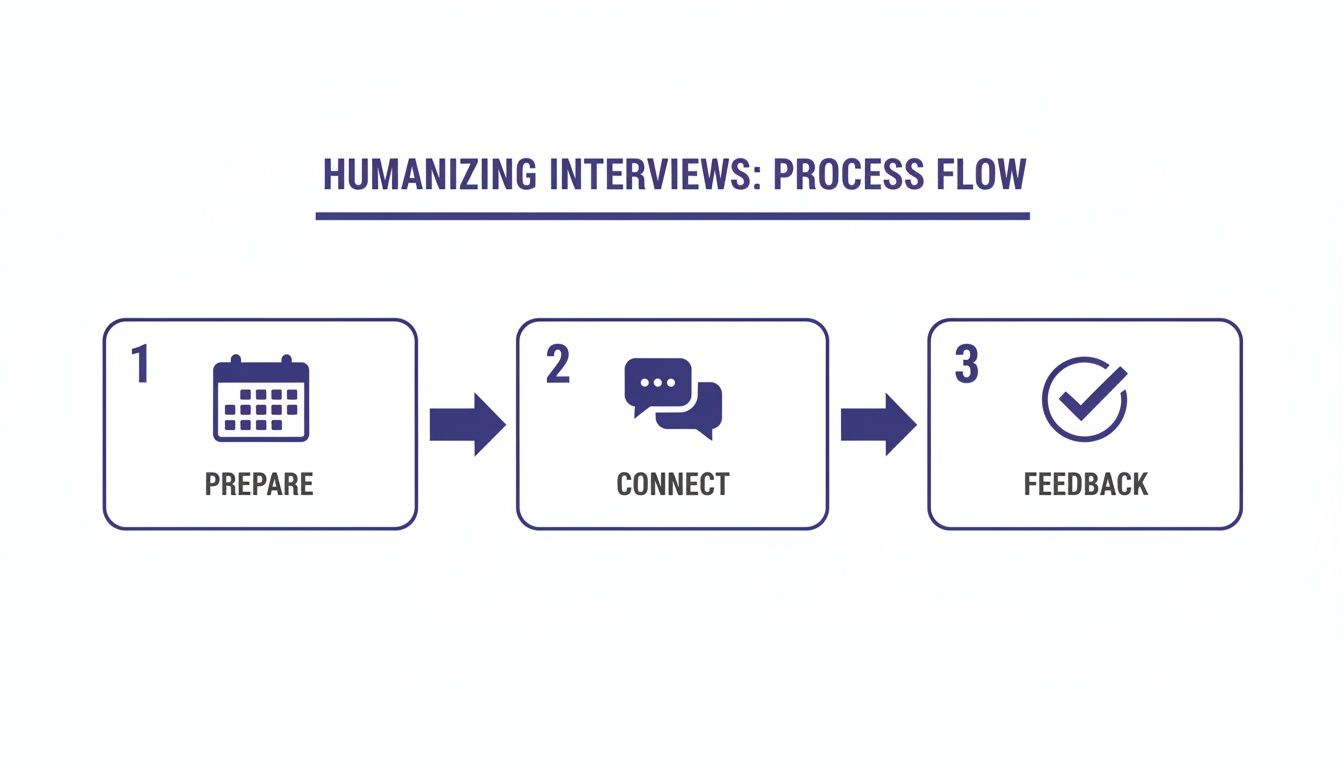
This simple flow is a good reminder that every interaction matters and that a structured, human-centric approach is key.
Key Metrics You Should Be Tracking
To get started, focus on a handful of metrics that give you a balanced view of both candidate sentiment and process efficiency. You don’t need a dozen different KPIs; these three provide a powerful snapshot of what's really going on.
Candidate Net Promoter Score (cNPS): This is a standard way to measure how people feel. After the process wraps up, send a simple, anonymous survey asking, "On a scale of 0-10, how likely are you to recommend our hiring process to a friend or colleague?" It's a direct pulse check.
Application Completion Rate: Your Applicant Tracking System (ATS) should make this easy to track. It shows the percentage of people who start an application versus those who finish it. A low rate—say, anything below 60%—is a red flag that your application is too long, buggy, or confusing.
Offer Acceptance Rate: Of all the job offers you extend, how many are accepted? If you see this number dipping, it could signal issues with your interview process, compensation, or the overall impression your team is leaving on candidates.
Turning Data into Actionable Insights
Collecting numbers is only half the battle. The real value comes from turning that data into actual improvements.
Let's say you notice a sharp drop in your cNPS score right after the assessment stage. That’s a powerful clue. It suggests candidates might find the assessment too long, irrelevant, or technically frustrating. This is your cue to dig in. Are the tasks genuinely representative of the job? Is the platform intuitive? You can find helpful guides on choosing better candidate assessment tools that prioritize a positive user experience.
Data tells you where the problem is, but candidate feedback tells you why. Always combine your metrics with open-ended survey questions to get the full story.
Key Metrics for Measuring Candidate Experience
Here's a quick look at the essential metrics, what they reveal, and how to use them to strengthen your hiring process.
| Metric | What It Measures | How to Track It | What a Good Score Indicates |
|---|---|---|---|
| Candidate Net Promoter Score (cNPS) | Overall candidate sentiment and willingness to recommend your company. | Post-process anonymous surveys (automated via ATS or email). | A positive, memorable experience, even for rejected candidates. |
| Application Completion Rate | The ease and accessibility of your initial application process. | Tracked within your Applicant Tracking System (ATS). | Your application is clear, concise, and mobile-friendly. |
| Time-to-Hire | The efficiency and speed of your entire hiring lifecycle, from application to offer. | Calculate the average number of days from when a job is posted to when an offer is accepted. | A streamlined process that respects candidates' time and keeps them engaged. |
| Offer Acceptance Rate | The competitiveness of your offers and the quality of the final-stage candidate experience. | (Accepted Offers / Total Offers Extended) x 100 | Your compensation, culture, and interview process align with top candidates' expectations. |
| Source of Hire | The effectiveness of your different recruiting channels (e.g., job boards, referrals). | Ask candidates in the application or track links via your ATS. | You are investing your time and budget in the most effective channels. |
Tracking these metrics gives you a 360-degree view, helping you pinpoint exactly where to focus your efforts for the biggest impact.
Creating a Continuous Improvement Cycle
Improving the candidate experience isn’t a one-and-done task. The best hiring teams treat it as an ongoing cycle of measuring, learning, and refining.
Here’s a simple framework to make this a regular practice:
Collect Data Monthly: Set a recurring reminder to pull your key metrics—cNPS, completion rates, and acceptance rates.
Review with the Team Quarterly: Get recruiters and hiring managers in a room to talk about the trends. What’s working well? Where are the friction points?
Pick One Key Improvement: Don't try to fix everything at once. Choose one area to focus on for the next quarter. Maybe it's rewriting rejection email templates or shortening a skills assessment by 15 minutes.
Implement and Measure Again: Make the change, then watch your metrics to see if it moved the needle.
By adopting this rhythm, you create a system where your hiring process naturally evolves. It ensures the candidate experience remains a priority, driven by real data instead of assumptions. This approach transforms hiring from a series of disconnected tasks into a strategic function that constantly gets smarter.
Candidate Experience FAQ
Even the most dedicated hiring teams run into questions when overhauling their process. Let's tackle some of the most common hurdles you might face.
How Can a Small Team with Limited Resources Improve Candidate Experience?
You don't need a massive budget to make a difference. The real wins come from being thoughtful and respectful of a candidate's time, which costs very little.
Start with the easy stuff: communication. Set up a few basic email templates to confirm you’ve received an application and to give people updates along the way. Next, take a hard look at your job descriptions and application forms—if a field isn't absolutely essential, get rid of it. These simple tweaks build goodwill without touching your budget.
What Is the Best Way to Handle Rejections?
The aim here is to be timely, respectful, and human. First things first: ditch the generic, no-reply rejection email. It's a poor experience for the candidate and reflects poorly on your brand.
For anyone who made it to the later stages, a brief, personal note can go a long way. Thank them for their time and, if appropriate, offer a single piece of constructive feedback. This small act of kindness shows you valued their effort and can leave them with a positive feeling about your company, even if they didn't get the job.
Your goal should be to make every candidate—even the ones you reject—walk away feeling respected. That's how you turn applicants into brand advocates.
How Do We Balance Speed with a Thorough and Fair Assessment?
This is a common hiring challenge, but it's a problem that modern assessment tools are designed to solve. The old way of doing things—stacking up screening calls and multiple interview rounds—isn't just slow, it's often riddled with bias.
The smarter approach is to verify skills upfront. Instead of endless interviews, use a single, well-designed skills assessment early in your process. Look for tools that use practical, job-related tasks that feel relevant to the work. This helps you quickly and fairly pinpoint your top contenders, so you can spend your valuable interview time with a small, highly qualified group. You end up with a more objective process that moves faster.
Is It Really Worth Surveying Candidates About Their Experience?
Absolutely. There is no better source of truth. A simple, anonymous survey sent after the process wraps up is your direct line into what candidates really thought.
This doesn't need to be a 20-question survey. Just a few quick questions can help you calculate a Candidate Net Promoter Score (cNPS) and gather candid feedback on what you're doing right and where the friction is. It’s the only way to spot the blind spots in your process and get the data you need to keep getting better.
Ready to move beyond resumes and identify top talent with fair, engaging assessments? Cohesyve uses AI to design dynamic, role-specific challenges that reveal true skills, helping you close roles up to 50% faster. See how it works.