HR data analytics is about using your workforce data to make smarter, more strategic decisions about your people. Instead of running on assumptions or what feels right, you’re looking at real numbers on hiring, performance, and retention to understand the story behind the trends. It’s the shift from guesswork to an evidence-based strategy for managing a company’s most important asset: its people.
From Gut Feel to Smart Decisions
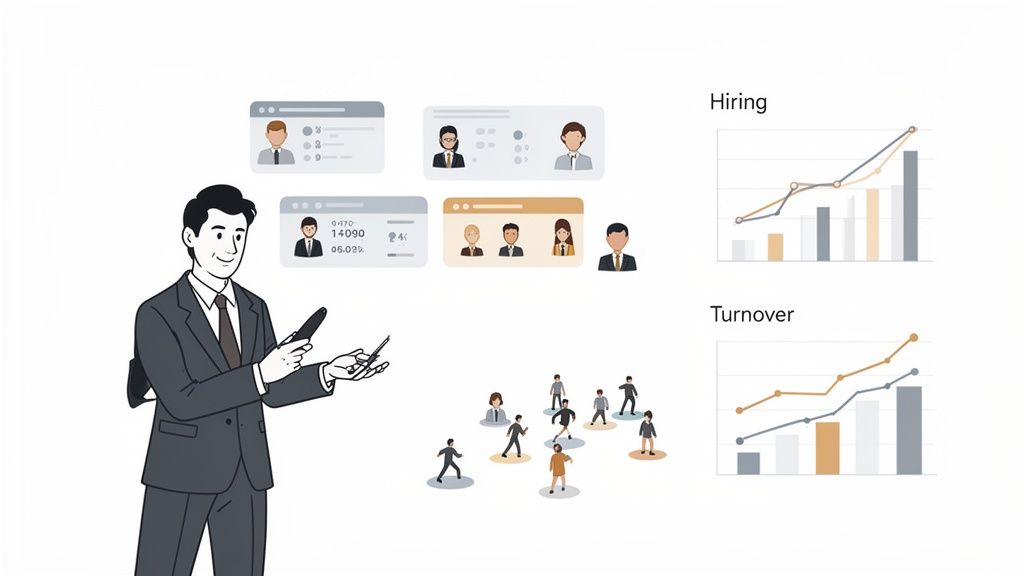
For a long time, many HR decisions were guided by intuition. Think of a seasoned manager hiring someone because they "had a good feeling" about them. While that experience is valuable, it can leave a lot to chance. It doesn't always paint the whole picture.
Today, leading HR teams are moving from this traditional model to one where data sits at the heart of their strategy. HR data analytics is the practice of collecting and analyzing people-related data to improve how you attract, develop, and retain talent—all in a way that supports real business results.
Answering the Big Questions
Instead of just reacting to problems, analytics lets you proactively investigate the why. This changes HR from a support function that puts out fires to a strategic partner that can help prevent them in the first place.
With data, you can get clearer answers to important business questions:
- Hiring: Which of our recruiting channels actually bring in the people who become top performers?
- Retention: Why are our best people leaving? And which teams might have the highest turnover risk right now?
- Performance: What skills and behaviors do our most successful employees have in common?
- DEI: Are our promotion processes and pay scales equitable across every demographic?
This isn’t just a passing trend. The global market for HR analytics tools was valued at USD 2.96 billion in 2022 and is projected to reach USD 5.03 billion in 2025. That’s a significant increase, showing that companies are recognizing the value of their people data.
To see just how different this approach is, let’s compare the old way with the new.
Traditional HR vs. Data-Driven HR
| Aspect | Traditional HR (Intuition-Based) | Data-Driven HR (Analytics-Based) |
|---|---|---|
| Decision-Making | Based on experience, gut feel, and past practices. | Based on empirical data, trends, and predictive models. |
| Recruiting | Relies on standard interview questions and resumes. | Uses data to identify sources of top talent and predictors of success. |
| Retention | Reacts to turnover with exit interviews. | Proactively identifies at-risk employees and addresses root causes. |
| Performance | Annual reviews based on manager observations. | Continuous feedback supported by objective performance metrics. |
| Strategic Input | Functions as an administrative or support role. | Acts as a strategic partner, linking people strategy to business goals. |
This table shows a clear evolution. By adopting People Analytics, you’re not just getting better at HR—you’re building a more resilient and competitive business.
The Competitive Advantage of Data
At its core, using HR data is about making smarter investments in your workforce. When you know what makes people successful in your unique environment, you can build a system to replicate it. This can lead to better hires, lower turnover costs, and a clearer line between your people initiatives and your bottom line.
Moving from anecdotes to actual evidence allows you to spot hidden patterns, anticipate future needs, and build a more engaged, high-performing workforce. It's the difference between navigating with a compass and navigating with a GPS.
This is how your HR team stops just reporting on what happened yesterday and starts shaping what will happen tomorrow, giving your company a useful edge.
Putting HR Analytics into Practice
Let's get practical. Theory is useful, but the real value of HR data analytics comes from using it to solve actual problems that affect your people and your bottom line. It’s about answering the tough questions that pop up every day, from a candidate’s first click on a job ad to their last day in the office.
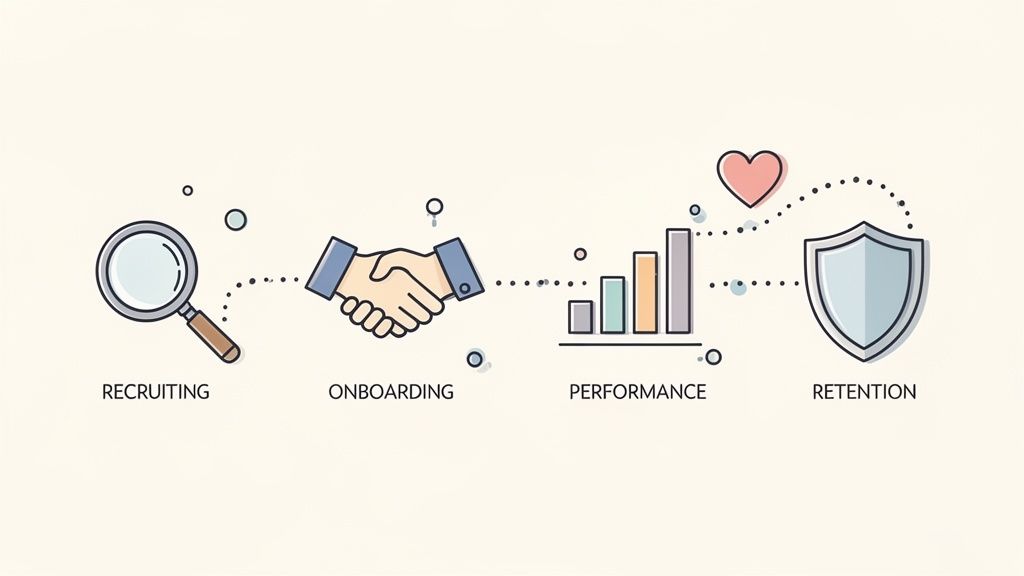
This isn’t about trying to analyze everything at once. A good approach is to pick a specific challenge, ask a focused question, and start there. You'll get tangible results much faster, which helps build momentum for bigger projects down the road.
Sharpening Your Recruiting Strategy
Most recruiting teams are already tracking the basics, like time-to-fill and cost-per-hire. These are fine for gauging your team's efficiency, but they don't tell you much about the quality of the person you just hired. This is where real HR analytics comes in, connecting the dots between your hiring process and an employee's long-term success.
For example, maybe you're spending a large part of your budget on a premium job board that sends you a high volume of résumés. Looks good on the surface, right? But what if your data showed that the people you hire from that source consistently receive lower performance reviews or leave within 18 months?
By analyzing source-of-hire data alongside performance scores and tenure, you can see which channels deliver genuine top performers, not just a high volume of candidates. You might find that employee referrals, though smaller in volume, bring in people who get up to speed faster and stay longer.
That's an insight you can act on immediately, shifting your recruiting budget from quantity to quality and fit. To go deeper on this, it's worth exploring modern talent acquisition best practices that incorporate this data-first approach into the process.
Uncovering the Real Reasons for Turnover
Employee turnover can be costly. But just knowing your turnover rate is like knowing you have a fever without knowing the cause. You have to find the why. Exit interviews are meant to help, but that feedback can sometimes be vague or overly polite.
HR analytics turns exit survey data from a collection of individual comments into a useful diagnostic tool. By systematically analyzing responses, you can identify recurring themes and pinpoint potential root causes of attrition.
For instance, you might spot a pattern where a high number of people leaving one specific department all mention a "lack of growth opportunities." That's a clear signal to investigate career pathing and development for that team.
You can get even more specific by layering in other data points.
- Performance Data: Are you losing your top performers or your underperformers? The answer completely changes how you should respond.
- Manager Data: Is turnover unusually high under a couple of specific managers? That might signal a need for leadership training.
- Tenure Data: Are people leaving within their first year? This can point to a mismatch between the job description and the actual role, or a challenging onboarding experience.
Boosting Performance and Productivity
With HR analytics, you can build a clearer profile of what a successful employee looks like at your company. By analyzing the skills, behaviors, and backgrounds of your top performers, you can essentially create a model for high performance.
This isn't just an HR exercise; it has practical applications across the business. Managers get a data-backed roadmap for coaching their teams. Your L&D department can see which training programs actually correlate with improved performance metrics.
Most importantly, it connects your people to business results. You can move from tracking activity to measuring impact. For example, did that new sales training actually lead to a measurable increase in quarterly revenue? Your data can help you find out.
Building a More Equitable Workplace
HR data analytics is one of the most effective tools you have for advancing your Diversity, Equity, and Inclusion (DEI) goals. It helps ground the conversation about fairness in objective facts. By analyzing your data across different demographic groups, you can hold a mirror up to your processes.
You can start asking specific questions:
- Hiring: Are our interview-to-offer ratios consistent for all groups of candidates?
- Compensation: Do we have any unexplained pay gaps between people doing the same job?
- Promotions: Does everyone here have an equitable opportunity to move up, regardless of their background?
When you use data to ask these questions, you can uncover hidden biases and take targeted action to build a workplace where everyone has a fair chance to succeed.
Cohesyve
See what candidates can do before you interview them
Cohesyve turns a job description into a role-specific assessment with a scoring rubric. Each candidate gets a different version, so questions cannot be shared. Ten candidates free, no card.
Finding the Right Data and Metrics
To get useful answers from HR analytics, you need the right ingredients. It’s like trying to cook a good meal—even the best chef is stuck if the pantry is empty or filled with the wrong stuff. Your data sources are your pantry, and the metrics are your recipe.
The good news? You’re probably already sitting on a lot of valuable data.
The trick isn't to track every single thing. That can lead to analysis paralysis, where you’re drowning in spreadsheets with plenty of numbers but zero clarity. The goal is to be strategic, focusing on the data that directly links your people strategy to what the business cares about.
Tapping Into Your Existing Data Sources
Before you consider new systems, take a look at the tools you already use every day. Most HR teams have access to a handful of data hubs, each telling a different part of your workforce story.
Here are the usual sources:
- Human Resource Information System (HRIS): This is your central hub. It holds foundational employee data—demographics, job history, compensation, tenure, and promotion records.
- Applicant Tracking System (ATS): Your ATS is a rich source of recruiting information. It tracks everything from where your candidates are coming from (source of hire) to how long it takes to fill a role (time to fill).
- Engagement and Pulse Surveys: This is your direct line to employee sentiment. Analyzing this data can help you uncover frustrations, find out what people enjoy about their jobs, and spot potential retention issues.
- Performance Management Systems: This is where you'll find performance review scores, goal completion rates, and manager feedback. It's key to identifying your top performers and figuring out who needs more support.
By pulling data from these different systems, you stop looking at isolated numbers and start seeing the whole story. For example, connecting your ATS data with performance data can help answer the question: which of our hiring sources actually bring in the best long-term employees?
Choosing the Metrics That Actually Matter
Once you know where your data lives, the next challenge is deciding what to measure. It's easy to get lost chasing dozens of "vanity metrics" that look impressive on a dashboard but don't help you make better decisions. An effective HR analytics program focuses on a small, powerful set of metrics that deliver clear, actionable insights.
Let’s look at a few that can have a real impact.
Here's a quick look at where you can typically find the data for some essential HR metrics.
Essential HR Metrics and Their Data Sources
| Metric Category | Example Metric | Primary Data Source(s) |
|---|---|---|
| Recruiting | Quality of Hire | Performance Management System, ATS, HRIS |
| Recruiting | Time to Fill | Applicant Tracking System (ATS) |
| Retention | Employee Turnover Rate | Human Resources Information System (HRIS) |
| Engagement | Employee Net Promoter Score (eNPS) | Engagement & Pulse Survey Tools |
| Performance | Performance vs. Potential (9-Box) | Performance Management System, HRIS |
| Development | Internal Mobility Rate | HRIS, ATS |
This table just scratches the surface, but it shows how different systems hold the puzzle pieces you need to build a complete picture of your workforce health.
Recruiting Metrics
- Quality of Hire: This is a key hiring metric. It measures the value a new hire brings to the business, often by looking at a combination of their performance review scores, how quickly they become productive, and whether they stay with the company. A high Quality of Hire score suggests your recruiting process is finding people who don't just fill a seat—they excel.
- Source of Quality Hires: This takes things a step further. Instead of just tracking where applicants come from, it tells you which channels—like employee referrals, LinkedIn, or specific job boards—consistently deliver candidates who become your future top performers. This lets you focus on what works and reduce spending on sources that don't.
Retention and Engagement Metrics
- Employee Turnover Rate: A classic for a reason. But tracking the overall rate is just the start. The real insight comes when you segment the data. Are you losing your high-performers? Is turnover spiking in one department or under a specific manager? That’s where the valuable information lies.
- Time to Productivity: How long does it take for a new hire to become a fully contributing member of the team? A shorter ramp-up time can point to a great onboarding process and is often a good predictor of long-term success. Pairing this metric with results from effective candidate assessment tools can help show if verifying skills upfront leads to faster onboarding.
Performance and Development Metrics
- Performance vs. Potential: This can help you identify future leaders. By mapping employees on a 9-box grid based on their current performance and future potential, you can make more informed decisions about who gets targeted for development programs and who might be ready for the next step up.
- Internal Mobility Rate: What percentage of your open roles are filled by your own people? A healthy internal mobility rate is a strong signal that you have clear career paths, which is a powerful driver of both engagement and retention.
Starting with a focused set of metrics like these is a good way to demonstrate the value of your HR analytics program. It allows you to deliver concrete insights that leadership can understand and act on, building the credibility you need to create a truly data-driven HR function.
Building Your HR Analytics Strategy
Getting started with HR data analytics can feel like a big undertaking. The key is to start small. Just focus on the first part of the trail.
The most successful strategies don't try to analyze everything at once. They pinpoint one specific, nagging business problem that everyone agrees needs a solution. This approach is powerful because it builds momentum and demonstrates the value of your work right away.
Start with the Right Question
Your journey begins with a question. A good one is specific, measurable, and tied directly to a business outcome.
It’s the difference between asking, "Why is our turnover high?" and asking, "Why are we losing so many of our top-performing software engineers in their first 18 months?"
The second question gives you a clear target. It tells you exactly what data to look for—performance scores, exit interviews, tenure data for a specific role—and, just as importantly, who cares about the answer (your CTO and engineering leads).
When you frame your project around solving a tangible problem for a business leader, you’re no longer just an HR person with a spreadsheet. You’re a strategic partner providing a solution.
This shift in framing makes it easier to get the leadership buy-in you need. You're not asking for resources for a vague "analytics project"; you're proposing a concrete plan to fix a costly retention issue.
Gather and Clean Your Data
Once you have your question, it's time to gather your information. This often means pulling data from a few different places—your HRIS for tenure data, your performance management system for review scores, and your ATS for hiring source information.
Be prepared: this step can be messy. Data is rarely perfect. You’ll likely run into inconsistencies, missing entries, or different formatting across systems. That's normal. This initial "data cleaning" process is important; it ensures your analysis is built on a solid foundation.
This initial loop of gathering, analyzing, and strategizing is the core engine of HR data analytics.
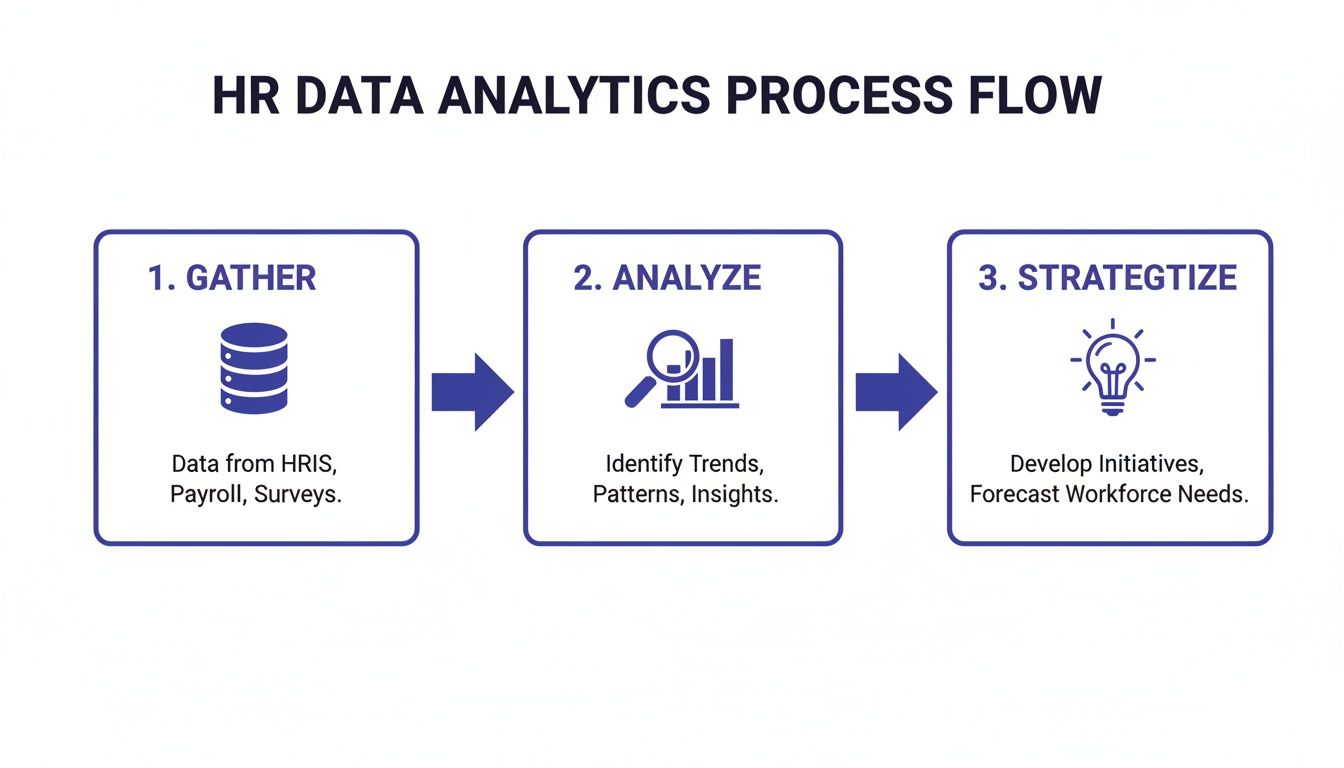
This simple flow shows that success isn't just about collecting data. It’s about turning that raw information into a concrete plan of action.
Despite knowing how valuable this is, many organizations find it challenging. While 48% of HR professionals feel their teams are good at gathering people data, only 40% are confident in analyzing it, and just 32% succeed in turning those insights into business changes. This reveals a gap between having data and actually using it, which you can explore in the full State of People Analytics report.
Choose the Right Tools for the Job
You don't need a massive business intelligence platform to get started. For your first project, the best tool is probably the one you already have.
- Spreadsheets (Excel, Google Sheets): For smaller datasets, you can use pivot tables and basic charts to spot trends and visualize your findings with surprising effectiveness.
- HRIS/ATS Dashboards: Most modern HR systems come with built-in reporting dashboards. Before you look for something new, explore what your current tools can already do.
- Specialized Analytics Platforms: As your needs get more sophisticated, you can explore more advanced tools. These platforms are designed to pull data from multiple sources and offer more powerful analysis and visualization options.
The key is to match the tool to the task. Start simple and let your technology scale as you scale your impact.
Tell a Compelling Story with Data
This is the final, and arguably most important, step. Raw numbers and complicated charts don't always convince people to change course. You have to translate your data into a clear, compelling story that inspires action.
Your job is to connect the dots for your audience. Instead of just stating, "Turnover for high-performers is 15% higher among employees hired from Source X," tell the full story:
"We invested $50,000 last year in Source X, but our data shows the engineers we hire from there are consistently among our lowest performers and are twice as likely to leave within two years. If we reallocate that budget to our employee referral program—which our data shows is our top source of quality hires—we can improve retention on a critical team."
That narrative provides context, highlights the business impact, and offers a clear, data-backed recommendation. That’s how you turn insights from hr data analytics into measurable change.
Supercharge Your Hiring Analytics With Skills Data
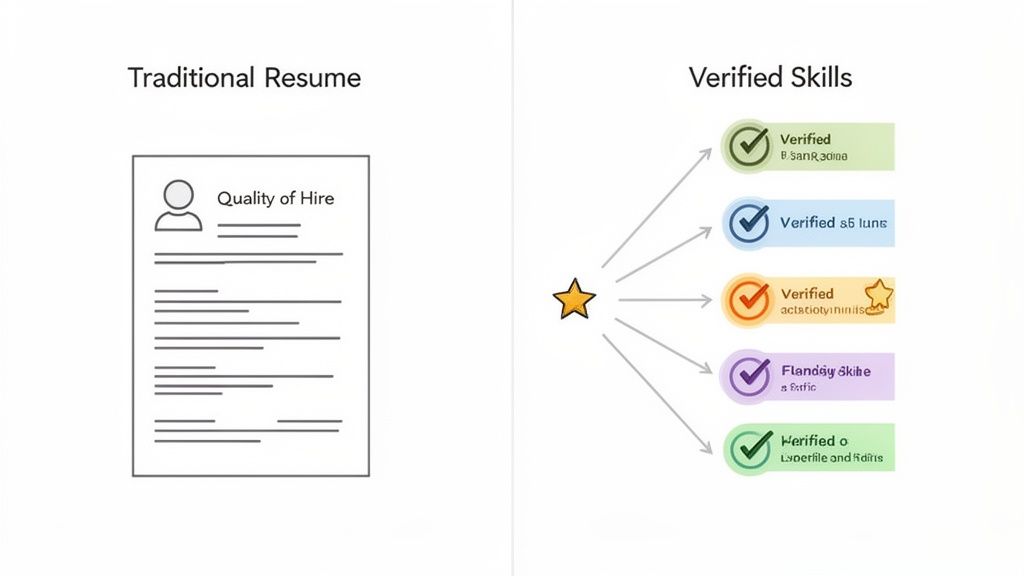
Traditional hiring analytics can have a blind spot. We spend a lot of time tracking proxies—things we hope are connected to job performance. We look at university prestige, years of experience, and previous employers, but these are often just indirect indicators.
Think about it. Would you hire a chef just because they went to a famous culinary school? Probably not. You'd want to taste their food. Yet, in hiring, we often analyze the resume (the school) instead of measuring the actual skill (the cooking). It's time to bring in a sharper, more direct data source.
Moving Beyond Resume Guesses
The next step forward in hr data analytics is to include objective, verified skills data in your models. This is about capturing proof of what a candidate can actually do, not just what they claim on paper. Instead of guessing if five years at Company X translates to proficiency, you measure it directly.
This changes the game for metrics like Quality of Hire. It stops being a backward-looking metric based on performance reviews months later and becomes a predictive tool. When you collect structured data on core skills during the hiring process, you build a direct, measurable link between a candidate’s abilities and their future success.
By measuring actual competencies, you’re no longer making educated guesses based on a candidate’s past. You’re making data-driven decisions based on their present, proven capabilities.
This doesn't mean you throw out everything else. It’s about layering in high-fidelity data that cuts through ambiguity, which can help lower the risk of a bad hire.
Building a Richer Picture of Talent
When you start weaving skills data into your analytics, you can ask—and answer—smarter questions. Instead of just knowing your best source of hires, you can now pinpoint which sources deliver candidates with the strongest problem-solving skills or the fastest aptitude for learning new tech.
Here’s how you can start gathering this kind of data:
- Role-Specific Assessments: Use assessments that mirror real-world job tasks. This gives you hard data on a candidate's practical abilities in coding, financial modeling, or whatever is critical to the role.
- Communication Skills: Structured tasks like voice role-plays can give you quantifiable data on a candidate's clarity, empathy, and how they handle client scenarios.
- Critical Thinking: Use reasoning prompts to measure a candidate's judgment and decision-making process in a standardized way.
This level of detail paints a much clearer picture of who is truly qualified for the job. Companies already on this path are finding it not only improves hiring accuracy but also opens up their talent pool. Suddenly, great candidates without a "perfect" resume have a real shot to prove their worth. To dig deeper into this mindset, you can explore the fundamentals of skills-based hiring and see how it’s reshaping modern talent strategy.
The Impact on Hiring Outcomes
Ultimately, the goal of hiring analytics is to build a reliable, repeatable system for finding and keeping great people. Grounding your analysis in verified skills gives that system a solid foundation. As you look for new ways to improve, exploring the capabilities of AI in recruiting can also add powerful tools to your analytics arsenal.
When you can directly connect a pre-hire skill score with post-hire performance, your analytics can finally give you clear, actionable advice. You might discover that for your top engineering team, a candidate’s score on a debugging challenge is a far better predictor of success than where they went to college. That's the kind of insight that directly improves hiring, reduces ramp-up time, and builds stronger, more capable teams.
Frequently Asked Questions About HR Analytics
As you start exploring the world of HR analytics, a few practical questions often come up. Let's tackle them, because getting these sorted out early will help you build momentum and avoid common pitfalls.
Where Should a Small HR Team Even Begin with Data Analytics?
This is a common question. The key is to start small. Don't try to analyze everything at once.
Instead, pick one specific, high-impact business problem. A great starting point is often figuring out why new hires in a crucial role are leaving within their first year. You likely already have the data you need in your HRIS and exit interview notes.
Start with tools you already know, like Excel or Google Sheets. The goal isn't to build a complex system right away, but to demonstrate value with a small, focused project. A quick win builds the confidence and buy-in you need to do more.
What’s the Real Difference Between HR Metrics and HR Analytics?
It's easy to get these two mixed up, but the distinction is important. Think of it this way: metrics look in the rearview mirror, while analytics looks at the road ahead.
HR metrics are standalone numbers that tell you 'what' happened. Think 'time to fill' or 'number of new hires.' They're snapshots of past activity. HR analytics, on the other hand, connects those numbers to figure out 'why' it happened and predict 'what is likely to happen next.'
For example, a metric tells you your turnover rate is 15%. That's a fact. Analytics digs deeper and tells you that 70% of that turnover is from the sales department, specifically from employees who reported a lack of career development opportunities. One is a number; the other is a story with an actionable insight.
How Does AI Fit into All of This?
Think of Artificial Intelligence as a tool to enhance your analytics engine. It can scale analysis and spot patterns and connections that are difficult to see manually.
For instance, AI can sift through employee data points to predict which top performers might be at risk of leaving. In hiring, it can analyze which candidate skills truly correlate with on-the-job success, moving beyond gut feelings.
It helps HR teams shift from being reactive—reporting on last quarter's numbers—to being more proactive and strategic. By adding objective data like skill verification into the mix, AI can help draw a direct line from a candidate's proven abilities before they're hired to their actual performance on the team. This can make your hiring analytics truly predictive.
Ready to stop guessing and start making data-backed hiring decisions? Cohesyve uses role-specific skill verification to give you objective data on what candidates can actually do before you hire them. Learn how to build a stronger, more capable team today.