Hiring for a role that depends on database expertise? The standard interview loop can sometimes feel like a guessing game. A resume lists “PostgreSQL” or “MongoDB,” but how do you measure a candidate’s ability to design a scalable schema, optimize a slow query, or choose the right replication strategy under pressure? The gap between stated skills and actual proficiency can be significant, leading to hiring mistakes that impact product development and team morale.
The problem isn't a lack of talent; it's the challenge of effective validation. Relying solely on theoretical questions often rewards memorization over practical problem-solving. This guide is designed to help with that. We move beyond the surface by breaking down 10 useful interview questions about databases that simulate real-world challenges. You won't just get a list of questions and answers. Instead, you'll find a strategic framework for evaluating candidates.
For each core topic, from SQL joins and indexing to NoSQL models and the CAP theorem, we provide:
- A foundational question to establish a baseline.
- Targeted follow-up probes to test the depth of their knowledge.
- Clear signals of expertise that distinguish a more experienced contributor from a junior one.
Let's build a better interview process that helps you hire the right engineer, not just the one with the most rehearsed answers.
1. SQL Joins (INNER, LEFT, RIGHT, FULL): Fetching Related Data Across Tables
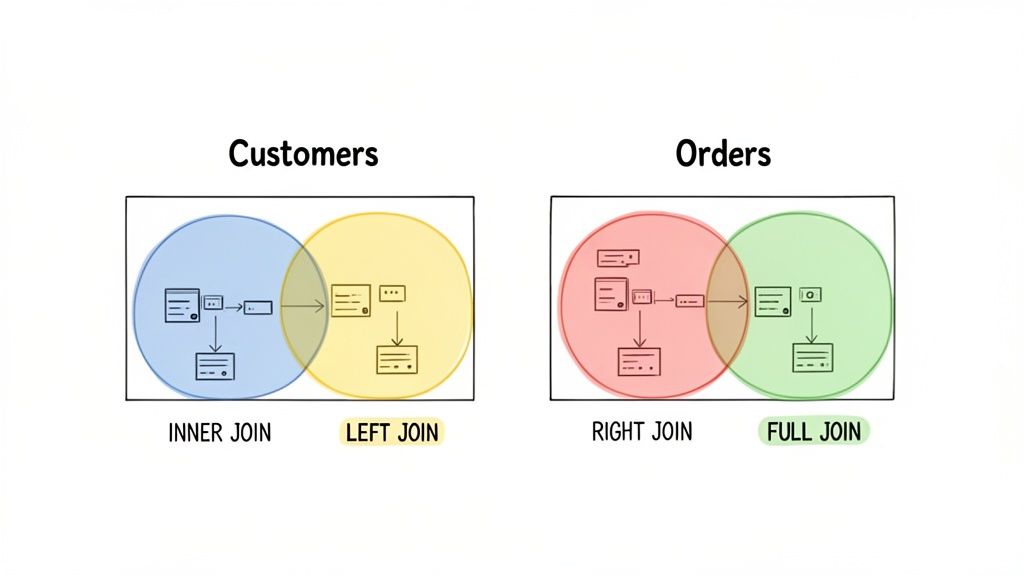
At the heart of any relational database is the ability to connect different pieces of information. This is where SQL joins come in, making them a common topic in any interview about databases. Interviewers use questions about joins to evaluate a candidate’s understanding of relational theory and their ability to retrieve combined datasets from multiple tables. A candidate who can’t explain the difference between a LEFT JOIN and an INNER JOIN may lack the foundational skills needed for roles involving database interaction.
Core Concepts & Interview Probes
The goal is to move beyond rote definitions. A strong candidate can articulate the use case for each join type.
- INNER JOIN: Returns records that have matching values in both tables. Ask: “Show me how to find all customers who have placed at least one order.” This tests the most common join.
- LEFT JOIN (or LEFT OUTER JOIN): Returns all records from the left table, and the matched records from the right table. If there is no match, the result is
NULLfrom the right side. Ask: “How would you find all employees, including those not yet assigned to a department?” - RIGHT JOIN (or RIGHT OUTER JOIN): Returns all records from the right table, and the matched records from the left table. Functionally the inverse of a
LEFT JOIN. - FULL OUTER JOIN: Returns all records when there is a match in either the left or right table. It combines the functionality of
LEFTandRIGHTjoins. Ask: “Write a query to list all products and all suppliers, showing which suppliers provide which products, even if a product has no supplier or a supplier has no products.”
Evaluation Tip: Listen for precision. A good answer doesn’t just define the join; it describes a business scenario where that specific join is the correct choice. For example, using a
LEFT JOINto find customers who have never placed an order (WHERE Orders.CustomerID IS NULL) demonstrates a deeper, problem-solving mindset. This can be a key differentiator between memorization and comprehension.
2. Database Normalization: Eliminating Redundancy and Ensuring Data Integrity
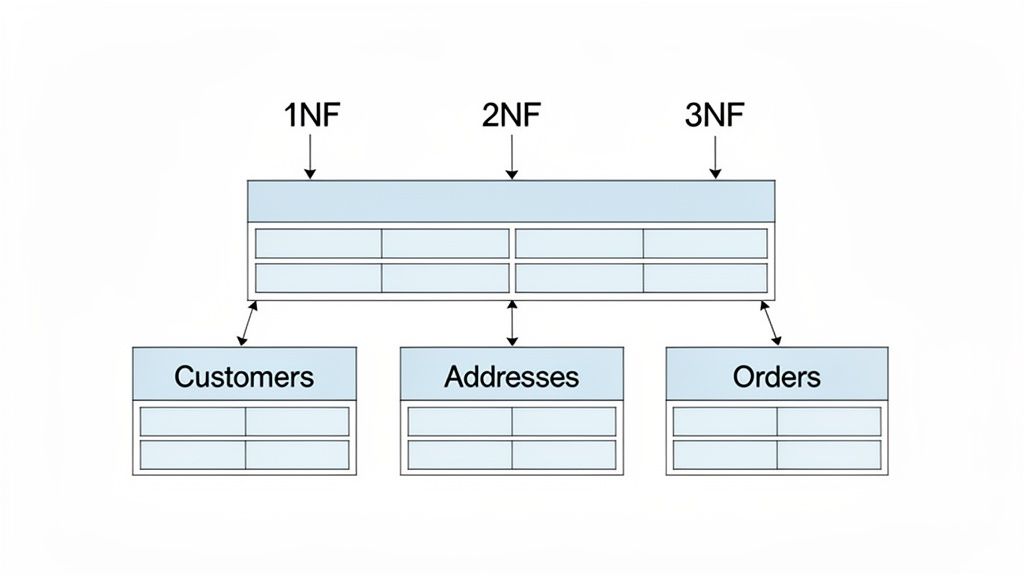
Beyond simply retrieving data, a skilled database professional must know how to structure it efficiently. This is the essence of normalization, a process of organizing tables and columns to minimize data redundancy and improve data integrity. Interviewers ask questions about normalization to gauge a candidate's grasp of relational database design principles. A candidate who struggles to explain the difference between 1NF and 3NF may lack the foresight to build scalable, maintainable systems, which can lead to future data anomalies and performance issues.
Core Concepts & Interview Probes
The goal is to test a candidate's ability to identify and resolve design flaws through normalization. A strong candidate understands the "why" behind each normal form, not just the rules.
- First Normal Form (1NF): Ensures that table cells hold a single value and each record is unique. Ask: “You have a
Productstable with a columnTagsthat stores comma-separated values like 'red, cotton, sale'. How do you bring this table into 1NF and why is it important?” - Second Normal Form (2NF): Requires the table to be in 1NF and all non-key attributes to be fully dependent on the primary key. This applies to tables with composite keys. Ask: “An
OrderDetailstable has(OrderID, ProductID)as a composite key and includesProductPriceandOrderDate. Is this in 2NF? Explain your reasoning.” - Third Normal Form (3NF): Requires 2NF and that all attributes depend only on the primary key, not on other non-key attributes (no transitive dependencies). Ask: “A table of employees includes their
DepartmentIDandDepartmentName. What's the problem here, and how would you resolve it to achieve 3NF?”
Evaluation Tip: The best candidates discuss the trade-offs. While normalization reduces redundancy and prevents update anomalies, it often leads to more joins, which can slow down read-heavy queries. A candidate who can articulate when to selectively denormalize for performance reasons demonstrates a pragmatic understanding of database architecture. This level of insight is often a key differentiator. Identifying candidates with this practical perspective is a common goal of skills verification.
Cohesyve
See what candidates can do before you interview them
Cohesyve turns a job description into a role-specific assessment with a scoring rubric. Each candidate gets a different version, so questions cannot be shared. Ten candidates free, no card.
3. Indexing Strategies: Optimizing Read Performance with B-tree, Hash, and Composite Indexes
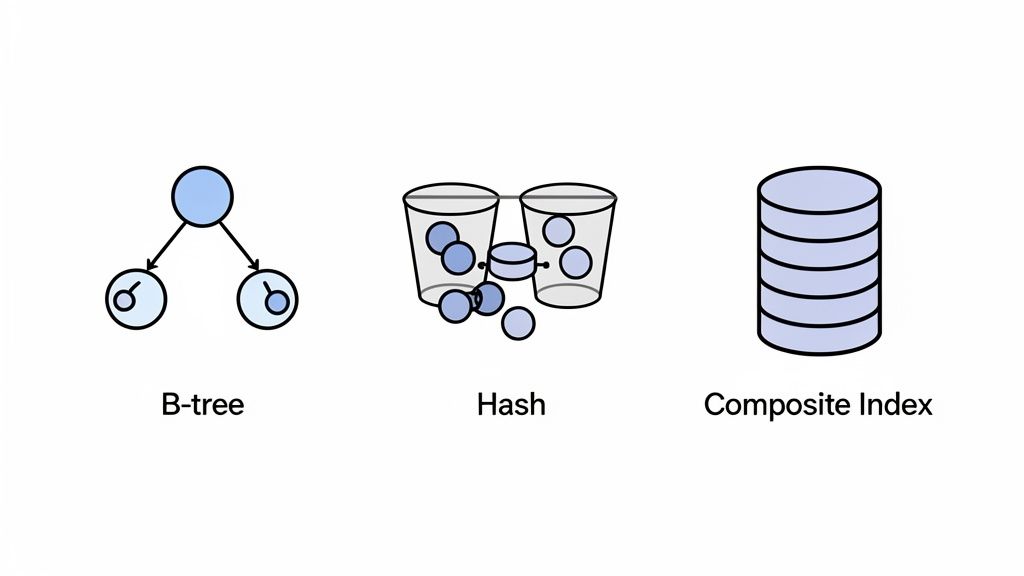
Without effective indexing, a database is like a library with no card catalog. Questions about indexing are a direct test of a candidate's ability to optimize query performance, a useful skill for any role dealing with large-scale data. Interviewers use this topic to gauge whether a candidate can think beyond just writing a query that works and move towards writing a query that performs efficiently. A candidate who can’t explain the trade-offs between different index types will likely struggle to build scalable and responsive applications.
Core Concepts & Interview Probes
The discussion should focus on the practical application of indexes and their impact on system performance, including both reads and writes.
- B-Tree Index: The most common index type, suitable for a wide range of queries, including equality and range searches (
>,<,BETWEEN). Ask: “When would you choose a B-tree index, and how does it handle aWHERE age > 30clause?” - Hash Index: Optimized for exact equality lookups (
=). They are fast but cannot be used for range queries. Ask: “Describe a scenario where a Hash index would significantly outperform a B-tree index. What are its primary limitations?” - Composite Index: An index on multiple columns. The order of columns in the index definition is important for its effectiveness. Ask: “We need to query for users by
lastNameand then bycity. How would you structure a composite index for this, and why is the column order important?” - Index Impact: Indexes speed up reads (
SELECT) but slow down writes (INSERT,UPDATE,DELETE) because the index must also be updated. Ask: “Explain the performance trade-off of adding an index to a table with very high write traffic.”
Evaluation Tip: A strong candidate will discuss using tools like
EXPLAINorEXPLAIN ANALYZEto verify that their queries are using the intended indexes. They’ll also mention the dangers of over-indexing and the importance of monitoring and dropping unused indexes. This demonstrates a holistic understanding of database management, not just isolated theoretical knowledge. For a deeper dive into theoretical aspects, explore foundational relational database principles like normalization and ACID properties.
4. Transactions and ACID Properties: Ensuring Reliable Data Changes
Reliable data modification is the cornerstone of trustworthy applications, from banking systems to e-commerce platforms. This is where transactions and their associated ACID properties become important. Interviewers ask about ACID (Atomicity, Consistency, Isolation, Durability) to gauge a candidate's understanding of data integrity and concurrency control. A candidate who can't explain why a multi-step operation like a bank transfer needs to be a single transaction may not be suited for a role involving state changes.
Core Concepts & Interview Probes
The goal is to verify that the candidate understands not just the definitions, but the consequences of violating these properties.
- Atomicity: Ensures that all operations within a transaction are completed successfully; if any part fails, the entire transaction is rolled back. Ask: "Describe the steps for an e-commerce order placement. What happens if the payment succeeds but the inventory update fails? How does atomicity prevent this data corruption?"
- Consistency: Guarantees that a transaction brings the database from one valid state to another, upholding all rules like constraints and triggers. Ask: “If a transaction attempts to transfer funds from an account with an insufficient balance, which ACID property prevents the database from entering an invalid state?”
- Isolation: Ensures that concurrent transactions do not interfere with each other, making them appear to run sequentially. Ask: "What is a 'dirty read' and which isolation level prevents it? Explain a scenario where choosing a lower isolation level might be a deliberate, strategic choice."
- Durability: Ensures that once a transaction has been committed, it will remain so, even in the event of a system crash or power failure. Ask: “How do database systems typically achieve durability?”
Evaluation Tip: A good answer connects ACID properties to specific business logic. When asked about a bank transfer, a strong candidate will immediately map the "all or nothing" requirement to Atomicity, the balance constraints to Consistency, the need to prevent simultaneous withdrawals from corrupting the balance to Isolation, and the guarantee that the money stays transferred to Durability. This demonstrates a practical, not just theoretical, grasp of these database concepts.
5. CAP Theorem: Balancing Consistency, Availability, and Partition Tolerance
When moving from a single database to a distributed system, the rules change. The CAP theorem, first proposed by Eric Brewer, is a principle that governs these systems, making it a staple of modern database interview questions. Interviewers use CAP-related questions to assess a candidate's grasp of distributed systems design and their ability to make pragmatic architectural trade-offs. A candidate unable to discuss these trade-offs may be less equipped for roles involving scalable, resilient database architectures.
Core Concepts & Interview Probes
The theorem states that a distributed data store can only provide two of the following three guarantees simultaneously: Consistency, Availability, and Partition Tolerance. In any real-world network, partitions (communication breakdowns between nodes) are a given, so the actual trade-off is between Consistency and Availability.
- Consistency: Every read receives the most recent write or an error. All nodes in the system see the same data at the same time. Ask: “Describe a system where consistency is essential, and explain what you would sacrifice to achieve it.”
- Availability: Every request receives a (non-error) response, without the guarantee that it contains the most recent write. The system remains operational even if some nodes fail. Ask: “When would you prioritize availability over strong consistency? Give a business example.”
- Partition Tolerance: The system continues to operate despite an arbitrary number of messages being dropped (or delayed) by the network between nodes.
Evaluation Tip: The strongest candidates don't just define the terms; they connect them to business impact. A great answer will correctly classify real-world databases (e.g., HBase as a CP system, Cassandra as an AP system) and justify those classifications with use cases. For instance, explaining why a banking transaction system must be CP (prioritizing consistency) while a social media feed can be AP (prioritizing availability) shows an ability to align technical decisions with business requirements.
6. NoSQL Database Models: Document, Key-Value, Column-Family, and Graph
While SQL databases provide structure and consistency, the modern data landscape often demands flexibility and scale that relational models can't easily offer. This is where NoSQL databases excel. Interview questions about NoSQL models assess a candidate's understanding of non-relational architectures and their ability to choose the right tool for a specific job. A candidate who only knows SQL may be unprepared for workloads involving unstructured data, high-velocity ingestion, or complex, interconnected information like social networks.
Core Concepts & Interview Probes
The key is to evaluate whether the candidate understands the trade-offs and ideal use cases for each model, moving beyond surface-level definitions.
- Document Databases (e.g., MongoDB): Store data in flexible, JSON-like documents. The schema is not fixed, allowing for varied data structures within the same collection. Ask: "Describe a scenario where a document database would be a better choice than a relational one for a new application. What are the drawbacks?"
- Key-Value Stores (e.g., Redis): The simplest model, storing data as a collection of key-value pairs. Optimized for high-speed lookups. Ask: "You need to implement a user session store for a high-traffic website. Which NoSQL model would you choose and why?"
- Column-Family Stores (e.g., Cassandra): Store data in columns rather than rows. This is efficient for analytical queries that aggregate data over a subset of columns. Ask: "How would you model time-series data, like IoT sensor readings, in a column-family database versus a relational one?"
- Graph Databases (e.g., Neo4j): Designed to store and navigate relationships between entities. Nodes, edges, and properties are the core concepts. Ask: “Explain how you would use a graph database to build a recommendation engine that suggests 'people you may know'."
Evaluation Tip: The strongest answers connect a specific data model to a business problem. A candidate who can explain why a key-value store like Redis is well-suited for caching due to its O(1) time complexity for reads, or why Neo4j is superior for fraud detection because it can traverse complex relationships quickly, demonstrates practical wisdom. This type of response showcases a problem-solving approach that goes beyond theoretical knowledge, reflecting the core principles of skills-based hiring.
7. Replication Strategies: Achieving High Availability and Read Scalability
Modern applications need constant uptime and snappy performance, making database replication an important concept for any engineer to understand. Replication is the process of creating and maintaining copies (replicas) of a database on multiple servers. Interview questions on this topic probe a candidate's understanding of distributed systems, fault tolerance, and the trade-offs between data consistency and performance. A candidate who can discuss replication isn't just a query writer; they are a system architect who can build resilient applications.
Core Concepts & Interview Probes
The discussion should focus on the why and how of replication, not just the what. A strong candidate will connect replication models to specific business needs like disaster recovery or scaling read-heavy workloads.
- Asynchronous vs. Synchronous Replication: In asynchronous replication, the primary node commits a transaction and then sends it to replicas, meaning there can be a delay (lag). In synchronous replication, the primary waits for acknowledgment from at least one replica before confirming the commit. Ask: "Describe a scenario where asynchronous replication is acceptable and one where synchronous replication is necessary. What are the performance implications of each?"
- Single-Leader vs. Multi-Leader: In a single-leader (or primary-replica) setup, all writes go to one primary node, which then propagates changes to read-only replicas. This is common and simpler to manage. Multi-leader allows writes to multiple nodes, which must then be synchronized, introducing complexity. Ask: "When would you choose a multi-leader architecture despite its complexity? What challenges, like write conflicts, must be addressed?"
- Replication Lag: This is the delay between a write occurring on the primary and it being reflected on a replica. Ask: “How would you monitor for replication lag, and what steps would you take to mitigate it if it becomes a problem?”
Evaluation Tip: A knowledgeable candidate will discuss the practical consequences of these choices. They might mention that synchronous replication can increase write latency, impacting user experience, or that asynchronous replication requires applications to be designed to handle potentially stale data from read replicas. Probing their understanding of failover scenarios, such as how a new primary is elected if the old one fails, separates candidates who have only read about replication from those who have implemented or managed it.
8. Sharding and Partitioning: Scaling Databases Horizontally
As datasets grow, a single server's capacity (vertical scaling) can reach its limit. This is where sharding and partitioning become important, and questions on this topic are designed to test a candidate's grasp of distributed systems architecture. Interviewers want to see if a candidate can think beyond a single machine and design systems that scale horizontally to handle large data volumes and high throughput.
A candidate's ability to discuss the trade-offs of different sharding strategies reveals their seniority and architectural maturity. It separates those who can manage a database from those who can design a database system for large-scale use.
Core Concepts & Interview Probes
The focus here is on the strategic implications of splitting up data. A strong candidate will discuss not just the "how" but the "why" and "what if."
- Partitioning vs. Sharding: While related, partitioning often refers to splitting a table within a single database instance (e.g., by date), whereas sharding spreads partitions across multiple independent machines. Ask: "When would you choose vertical partitioning over horizontal sharding?"
- Shard Key Selection: The choice of a shard key (the column used to distribute data) is a critical decision. It impacts data distribution, query performance, and the potential for "hotspots." Ask: "You're designing a social media backend. What might you use as a shard key for user posts, and what are the pros and cons of that choice?"
- Challenges: Sharding introduces complexity, such as cross-shard joins, transactions, and rebalancing (redistributing data when adding new shards). Ask: "Describe the process and challenges of rebalancing a live, sharded database with minimal downtime."
Evaluation Tip: A proficient candidate will discuss the importance of the shard key's cardinality and distribution. They'll volunteer a discussion on hash-based versus range-based sharding and explain the trade-offs. For example, mentioning that a range-based shard key on
user_idcould create a hot shard if new users sign up rapidly demonstrates a practical understanding of potential failure modes. This foresight is a hallmark of an experienced engineer.
9. Query Optimization: Interpreting Execution plans to Improve Performance
Writing a query that works is one thing; writing one that performs efficiently under load is another skill. This is why questions about query optimization and execution plans are common in interviews about databases. Interviewers ask candidates to interpret an execution plan to gauge their ability to diagnose and solve performance bottlenecks, a useful skill for maintaining scalable and responsive applications. A candidate who can only write basic SQL without understanding its performance implications may present a challenge in a production environment.
Core Concepts & Interview Probes
The goal is to assess a candidate's systematic approach to performance tuning. They should be able to read the output of a tool like EXPLAIN ANALYZE and pinpoint the source of inefficiency.
- Understanding Execution Plans: The database's query planner generates a "road map" for how it will retrieve data. This includes steps like table scans, index usage, and join methods. Ask: “Here is the output of an
EXPLAINcommand for a slow query. Walk me through what the database is doing and identify the most expensive operation.” - Identifying Bottlenecks: Common issues include full table scans on large tables, inefficient join types, or poor cardinality estimates. Ask: “This plan shows a 'Sequential Scan' on the
userstable, which has millions of rows. What does that tell you, and what is your first step to fix it?” - Implementing Solutions: Solutions often involve adding a specific index, rewriting the query to be more "SARGable" (search-argument-able), or updating table statistics so the planner makes better decisions. Ask: “Based on your analysis, propose a
CREATE INDEXstatement that you believe will resolve this performance issue. How would you verify your fix was successful?”
Evaluation Tip: A strong candidate won't just suggest adding an index. They will discuss the trade-offs, such as the impact on write performance. They will also mention the importance of using realistic data and commands like
ANALYZEto ensure the query planner has up-to-date statistics. This demonstrates a holistic understanding of database performance, a key competency detailed in many software engineer interview questions.
10. Data Warehousing and Analytics: Designing Star and Snowflake Schemas
While transactional databases are optimized for rapid reads and writes (OLTP), data warehouses are built for complex analytical queries (OLAP). This requires a different design philosophy. Interview questions about star and snowflake schemas test a candidate's understanding of dimensional modeling, a useful skill for any role touching business intelligence, data engineering, or analytics. An engineer who only knows how to normalize data for a transactional system may struggle to build performant reporting structures.
These questions reveal whether a candidate can shift their mindset from application-focused data integrity to analytics-focused query speed. The ability to design effective fact and dimension tables is a clear signal of architectural maturity and a grasp of how data is consumed for decision-making.
Core Concepts & Interview Probes
The discussion should center on the trade-offs between these two foundational dimensional modeling techniques. A strong candidate can justify their choice based on a specific business scenario.
- Star Schema: Features a central fact table (containing quantitative business metrics like
SalesAmountorUnitsSold) connected directly to several denormalized dimension tables (containing descriptive attributes likeProductDetails,CustomerInfo, orTime). Ask: “Design a simple star schema to track retail sales. What would your fact and dimension tables be?” - Snowflake Schema: An extension of the star schema where dimension tables are normalized into multiple related tables. For example, a
Productdimension might be broken down intoProduct_CategoryandProduct_Brandtables. Ask: “When would you choose to snowflake yourLocationdimension instead of keeping it as a single table in a star schema?” - Fact vs. Dimension: The core distinction. Facts are the numeric measurements or events, while dimensions provide the context (
who,what,where,when,why). Ask: “In an e-commerce clickstream model, what is the 'grain' of the fact table? What are some key dimensions you would include?”
Evaluation Tip: The best answers go beyond definitions and discuss performance implications. A candidate who explains that a star schema's denormalized dimensions lead to simpler, faster queries (fewer joins) but can introduce data redundancy is showing comprehension. Conversely, explaining that a snowflake schema reduces redundancy and saves storage but requires more complex joins demonstrates a nuanced understanding of architectural trade-offs. This is a crucial differentiator for data-heavy roles.
10-Topic Database Interview Comparison
| Topic | Implementation complexity | Resource requirements | Expected outcomes | Ideal use cases | Key advantages |
|---|---|---|---|---|---|
| SQL Joins (INNER, LEFT, RIGHT, FULL) | Low–moderate; syntax simple, complex logic with many joins | Minimal CPU/memory; depends on indexes and table size | Correctly combined related rows across tables | OLTP queries, reporting, relational lookups | Standard, expressive, supported across DBMS |
| Database Normalization | Moderate; requires analysis of functional dependencies | More joins at query time; smaller normalized tables use less storage | Reduced redundancy and improved consistency | Transactional schemas, update-heavy systems | Strong data integrity and simplified updates |
| Indexing Strategies (B-tree, Hash, Composite) | Moderate; choose types and columns carefully | Additional storage and write overhead; monitoring tools helpful | Significant SELECT speedups, fewer full scans | Read-heavy workloads, large tables, selective filters | Large read performance gains when well-designed |
| Transactions and ACID Properties | Low–moderate for single-node; higher for distributed transactions | Locking, logging, and potential latency; requires durable storage | Atomic, consistent, isolated, durable operations | Financial systems, inventory, critical state changes | Predictable correctness and failure-safe behavior |
| CAP Theorem | Conceptual moderate; trade-offs drive design complexity | Varies by choice (consistency vs availability) and replication needs | Defined trade-offs between consistency, availability under partitions | Distributed system architecture and datastore selection | Clarifies design decisions for distributed systems |
| NoSQL Database Models (Document, KV, Column, Graph) | Low–high depending on model and query complexity | Horizontal scaling, variable storage patterns, cluster management | Flexible schemas and scalable throughput | Caching, session stores, content management, graph queries | Schema flexibility and horizontal scalability for specific workloads |
| Replication Strategies | Moderate–high; setup and failover orchestration needed | Extra nodes, bandwidth, storage for replicas; monitoring | Increased availability and read scalability; possible lag | Geo-distribution, high-availability applications, read scaling | Fault tolerance, faster reads, geographic failover |
| Sharding and Partitioning | High; shard key selection, rebalancing, cross-shard logic | Many machines, routing/proxy layer, operational tooling | Horizontal write scalability and data distribution | Massive datasets, write-heavy global apps, social platforms | Unbounded scaling and isolated failure domains |
| Query Optimization | High; requires deep planner/engine knowledge | Profiling tools, test data, iterative tuning resources | Lower latency and more efficient resource usage | Performance tuning, slow queries, critical reporting | Data-driven removal of performance bottlenecks |
| Data Warehousing and Analytics (Star/Snowflake) | Moderate–high; ETL and schema design complexity | Large storage for denormalized facts, ETL compute | Fast aggregations and analytical reporting | BI, OLAP workloads, historical analysis | Optimized for analytics and BI tool integration |
From Questions to Confidence: Verifying Skills Before You Hire
The comprehensive list of interview questions about databases we've explored, from SQL JOINs and normalization to the CAP theorem and sharding, serves as a solid framework for evaluating a candidate's theoretical knowledge. A candidate who can articulate the nuances of ACID properties, explain the trade-offs of different indexing strategies, and design a basic star schema has a good foundation. This knowledge is an important first filter in the hiring process.
However, modern data challenges demand more than just textbook answers. Where top-tier candidates often distinguish themselves is in applying this knowledge to solve messy, real-world problems. It's one thing to describe query optimization; it's another to be handed a slow, complex query from your actual codebase and be asked to dissect its execution plan and refactor it for performance.
Moving Beyond Theory: The Power of Practical Assessment
Relying solely on verbal Q&A can introduce risk. Candidates can memorize answers, and a smooth talker can sometimes mask a lack of hands-on experience. Many effective hiring strategies bridge this gap by incorporating practical, role-specific challenges that simulate the work the candidate will actually be doing.
Here’s how to translate the theoretical topics from this guide into actionable, skill-verifying tasks:
For Normalization: Instead of asking for the definitions of 1NF, 2NF, and 3NF, provide a denormalized CSV file representing user orders or product inventory. Task the candidate with designing a normalized relational schema (e.g., in a tool like dbdiagram.io) and writing the DDL
CREATE TABLEstatements. This tests their ability to apply theory to create a scalable, maintainable structure.For Query Optimization: Give them an actual slow query from your application's monitoring logs. Provide the schema and ask them to use
EXPLAIN ANALYZEto identify the bottleneck. Their task is to not only explain why it's slow (e.g., a full table scan) but to propose and write the optimized query, perhaps by adding an index or restructuring a JOIN.For System Design (Sharding/Replication): Present a scenario: "Our application is experiencing high read latency in Europe, and our user base is projected to triple in the next 18 months. Our primary database is in North America." Ask them to architect a solution. A strong candidate will discuss read replicas, latency considerations, and perhaps a multi-region sharding strategy, sketching out their design and justifying their choices.
The True Cost of a Mis-Hire vs. the Value of Verification
Shifting from asking to observing can de-risk a hiring decision. The cost of a bad hire, especially in an engineering role, extends beyond salary. A 2022 report by the Society for Human Resource Management (SHRM) suggests that the cost can be several times an employee's annual salary, factoring in recruitment, onboarding, and lost productivity. A practical assessment identifies these gaps before an offer is made.
This approach also benefits the candidate. It gives them a realistic preview of the technical challenges they'll face, leading to better-aligned hires who are more likely to be engaged and successful long-term. For a deeper dive into general strategies for structuring effective technical interviews, including techniques for crafting these types of challenges, this guide on asking the right questions in a tech interview provides excellent further reading.
Ultimately, using a blend of targeted theoretical interview questions about databases and hands-on challenges can be key to building a strong technical team. It allows you to hire not just for what a candidate knows, but for what they can do. This shift in focus from memorization to application is what separates good hiring processes from great ones, ensuring that every new engineer you bring on board can start delivering value from day one.
Ready to move beyond theoretical questions and verify skills with realistic, hands-on challenges? Cohesyve automatically generates tailored technical assessments and coding tasks based on your job descriptions, allowing you to see exactly how candidates perform on real-world problems. Hire with confidence by replacing guesswork with proven ability. Try Cohesyve today.