Let's be direct: your standard Java coding test might not be working as well as it could.
We often take talented engineers—people who build complex, real-world systems—and ask them to solve abstract puzzles on a whiteboard or in an unfamiliar online editor. This can create a disconnect. The candidate who can balance a binary tree might struggle to debug a real-world Spring Boot application, yet traditional tests often prioritize the former.
This gap between the test and the actual job is where promising candidates can get lost. When they see a generic, puzzle-based challenge, they may disengage, assuming the role itself is disconnected from modern software engineering.
The result is that you might miss out on pragmatic, skilled developers who excel at building and maintaining robust software.
The Problem with Old-School Assessment Methods
The core issue is often what is being measured. Traditional tests can get stuck on computer science theory instead of applied, practical skill. While fundamentals are important, they don't tell the whole story about a developer's real-world capabilities.
- Focus on Abstract Puzzles: Many tests rely on algorithmic challenges that have little connection to day-to-day enterprise Java development.
- Lack of Real-World Context: They rarely involve common frameworks like Spring, build tools like Maven, or typical enterprise problems like API integration or database work.
- Poor Candidate Experience: A frustrating or irrelevant test doesn't just feel discouraging for the candidate—it can damage your employer brand and push away the very people you want to hire.
The goal isn't to find someone who crammed algorithms the night before. It's to find someone who can solve your company's actual problems using the Java ecosystem. Your assessment should reflect that reality.
Let's look at how these two approaches compare. The difference isn't just in the questions asked; it's in the philosophy of what makes a good hire.
How Traditional and Modern Java Assessments Differ
| Attribute | Traditional Test | Modern Assessment |
|---|---|---|
| Focus | Abstract algorithms, CS theory | Job-specific tasks, real-world problems |
| Technology | Plain Java, basic data structures | Frameworks (Spring), build tools (Maven) |
| Environment | Restrictive online editor, whiteboard | Familiar IDE, version control (Git) |
| Candidate Experience | Stressful, often irrelevant | Engaging, a preview of the job |
| Predictive Value | Low; measures test-taking ability | High; measures on-the-job performance |
| Hiring Outcome | Hires good test-takers | Hires skilled, practical engineers |
The table makes it clear: shifting to a modern assessment is a change in strategy. You move from "Can they solve this puzzle?" to "Can they do the job?"—which is what really matters.
Why This Matters for Java
The need for better assessments is amplified by Java's popularity. It remains a key player in enterprise software. Developer surveys consistently show that 30.35% of programmers worldwide use Java regularly, placing it among the most-used languages on the planet.
This widespread use means your hiring process is competing in a large talent pool. A generic test that fails to measure on-the-job competency isn't just a flawed tool—it's a competitive disadvantage.
To hire effectively, your assessment needs predictive power, and that comes from a focus on job-relevant tasks. For a closer look at this concept, you can read more about content validity and why it matters in hiring. When your test mirrors the job, you do more than just evaluate candidates. You give them a compelling preview of the interesting challenges they’ll get to solve on your team.
Stop Asking Brain Teasers. Start Testing for Real-World Java Skills.
A common mistake is designing Java coding tests like a pop quiz from a computer science textbook, asking candidates to recall a niche algorithm they’ll likely never use on the job.
A good assessment should feel like a preview of the work. It needs to mirror the actual problems your engineering team addresses every day. That means moving beyond generic puzzles. The ability to reverse a linked list on a whiteboard doesn't necessarily indicate an ability to debug a tricky multithreading issue or properly configure a Spring Boot service.
Your test should measure the skills that directly predict success in the role. Anything else is just noise. The old way of doing things—abstract puzzles, generic questions—creates a disconnect between what the test shows and what the job actually requires.
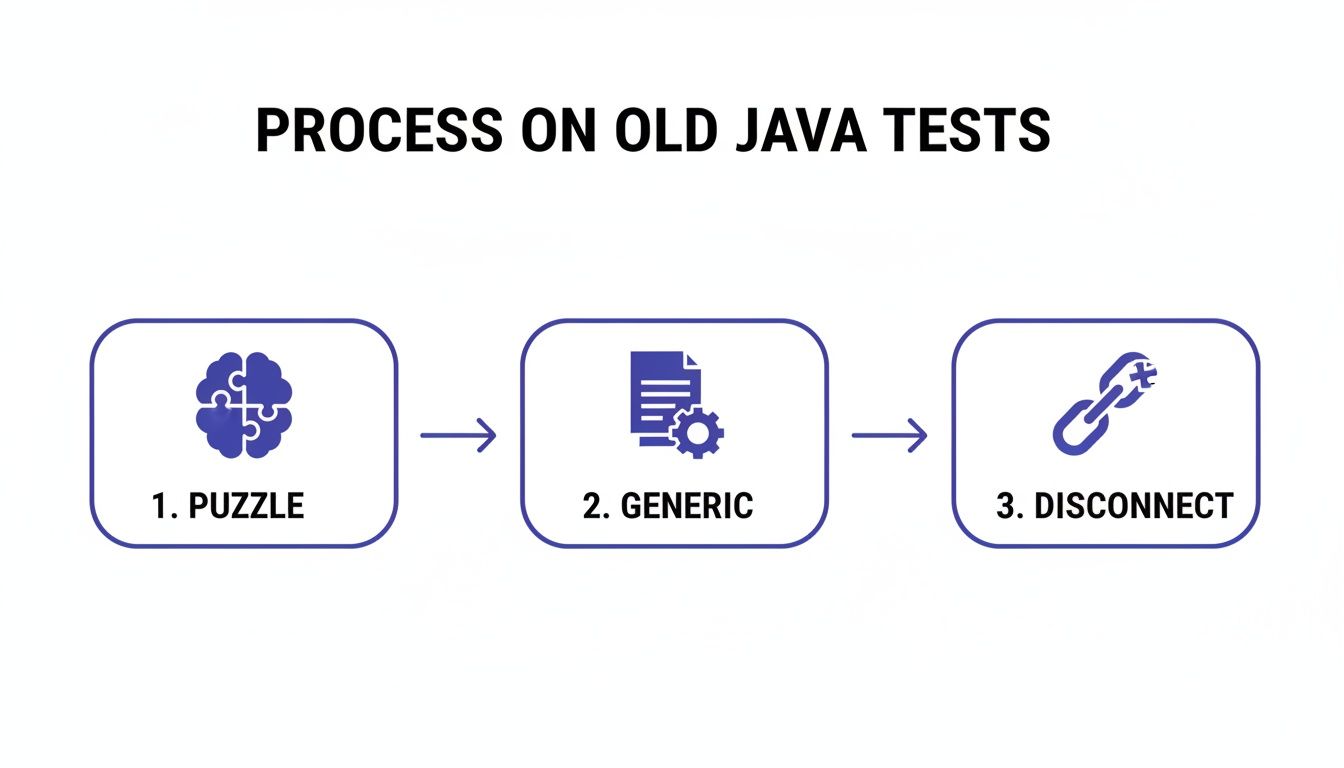
This flowchart captures that outdated process. It starts with a puzzle, moves to generic questions, and can end with a hire who isn't equipped for the real work.
Match the Task to the Seniority Level
A one-size-fits-all test is not an effective approach. What you expect from a junior developer is different from what a senior architect needs to do, and your challenges should reflect that.
For a Junior Java Developer
Here, you're looking for a solid foundation. Can they write clean, readable code? Do they understand core Java concepts and tools? The goal is to confirm they can be productive with some guidance.
- Consume an API: A classic for a reason. Ask them to call a public REST API (like a weather service) and process the JSON response. This shows if they can handle HTTP clients, parse data with a library like Jackson, and map it to objects.
- Work with Collections: Give them a simple dataset—say, a list of
Productobjects—and ask them to filter, sort, or group it using the Collections Framework or Java Streams. These are fundamental tasks they'll perform regularly. - Write Basic Unit Tests: To see if they're ready for a modern team, testing is essential. Provide a simple class and ask for JUnit tests covering the basics and a few edge cases. It's a useful way to see how they think about quality and is a key part of unit testing with Java.
When testing a junior developer, you're not looking for perfection. You're confirming they have the fundamentals down and can start contributing to the team.
For a Mid-Level Java Engineer
Mid-level engineers should be moving beyond the basics. They need to be comfortable within common frameworks and capable of tackling more complex logic with less supervision.
- A Realistic Spring Boot Task: Give them a small, self-contained Spring Boot project and ask them to add a new REST endpoint. This should involve a controller, a service layer, and perhaps an in-memory database like H2. It's a good way to test their grasp of dependency injection and application structure.
- A Simple Concurrency Problem: Present a challenge where they need to process items concurrently using Java's
ExecutorService. This reveals whether they can handle threading safely, a crucial skill for building scalable applications.
For a Senior Java Engineer
For seniors, the focus shifts from implementation to architecture, design patterns, and performance. The challenge should prompt them to make decisions and explain the trade-offs.
- A Practical System Design Scenario: Ask them to sketch out a high-level design for a system like a URL shortener or a notification service. The real test isn't the final diagram; it's their justification for choosing a message queue, a caching layer, or a specific database.
- A Code Refactoring Challenge: Provide a piece of code with long methods, tight coupling, and other "code smells," and ask them to refactor it. This is an effective way to gauge their understanding of clean code principles and their ability to improve a codebase without breaking it.
Build the Test Around Your Tech Stack
Beyond seniority, your coding challenge should be grounded in your company's technology. If your team uses Java 17, Quarkus, and Kubernetes, a test focused on a Java 8 monolith is less relevant.
To make sure your test measures the right skills, think about:
- Java Version: If you use Java 17 or 21, craft a task that uses modern features like records, sealed classes, or virtual threads.
- Frameworks: Center the problem around the frameworks you use, whether that's Spring, Jakarta EE, or Micronaut.
- The Environment: Let them use a familiar setup with Maven or Gradle. The goal is to see them solve the problem, not watch them fight a restrictive test platform.
By designing role-specific challenges that mirror your stack, you turn the assessment from a generic screening tool into a better predictor of on-the-job performance. If you want more inspiration for the conversations around these challenges, these software engineer interview questions can be a useful complement to your coding tests.
Maintaining Test Integrity in the Age of AI
AI coding assistants have changed how developers work. Tools like GitHub Copilot and ChatGPT are becoming a standard part of a developer's daily workflow. This new reality presents a challenge for traditional Java coding tests.
If your assessment hinges on a static bank of well-known problems, you may be testing a candidate's ability to use AI tools rather than their own skills. This isn't a niche trend. BellSoft's recent Java Developer Survey revealed that 74% of developers are already using AI tools to write code.
This means that predictable tests may no longer provide a clear signal of a candidate's ability.
Beyond Static Question Banks
One way to maintain integrity is to design challenges that AI can't easily solve in one shot. Generative AI is good at providing answers to straightforward, self-contained questions. It can be less effective with tasks that require deep context, trade-off analysis, or interaction with an existing codebase.
Instead of asking candidates to build another to-do list from scratch, consider these approaches:
- Code Review Exercises: Give them a pull request that looks correct on the surface but contains subtle logical flaws, security holes, or questionable design choices. Ask them to review it, leave comments, and suggest fixes. This tests their critical thinking and understanding of best practices—skills that are difficult to automate.
- Real-World Debugging: Provide a small, functional application with a bug hidden inside. Their job is to diagnose the root cause and implement a solid fix. This mirrors the day-to-day reality of a software engineer and requires a diagnostic mindset.
- Refactoring Challenges: Present a chunk of "legacy" code that works but is difficult to maintain. Ask them to refactor it to improve readability and efficiency without changing its functionality. This is an effective way to assess their grasp of clean code principles.
The core idea is to shift the focus from code generation to code comprehension and improvement. When a candidate has to understand, critique, and improve an existing system, you can see their expertise more clearly.
Creating Unique and Dynamic Challenges
Another effective tactic is making sure no two candidates get the exact same test. When your assessments are dynamically generated, the risk of leaked solutions or AI-assisted answers is reduced.
Modern assessment platforms can help here. By automatically creating unique variations of a core problem for each candidate, you can build a more fair and secure testing environment. For instance, instead of having everyone call the same static API endpoint, the system could generate a unique endpoint with slightly different data structures for each person. You can see how this philosophy extends to other AI-powered recruitment tools that are changing how we hire.
This approach ensures you're evaluating a candidate's ability to adapt and problem-solve, not just their memory of a known solution. For a look into how AI-generated content can be detected in other fields, this guide on spotting synthetic media offers some insights. The principles of finding non-human patterns can be relevant when trying to gauge if a code submission had significant AI help.
By mixing these task formats with dynamic challenge generation, you can design a Java coding test that gives you a more reliable signal.
Cohesyve
See what candidates can do before you interview them
Cohesyve turns a job description into a role-specific assessment with a scoring rubric. Each candidate gets a different version, so questions cannot be shared. Ten candidates free, no card.
How to Evaluate Results Beyond a Pass or Fail Score
A single score on a Java coding test rarely tells you the whole story. For example, one candidate might achieve a 100% score with messy, unmaintainable code, while another writes a well-designed solution but misses a tricky edge case. If you only look at the score, you might hire the wrong person.
A simple pass/fail grade can miss important nuance.
Treating the coding assessment as just a gate to get through is a missed opportunity. Instead, think of the submitted code as a rich piece of data. It’s your first real glimpse into how a candidate thinks and solves problems. To make an informed decision, you need to look deeper than the raw score.
Adopting a Holistic Evaluation Rubric
Moving past a simple "did they pass?" mindset requires a more structured approach. A multi-dimensional rubric can help you and your team score candidates consistently on the things that predict on-the-job success. This helps ensure every candidate is measured by the same yardstick, which can reduce bias and raise the quality of your hires.
A solid rubric breaks down the assessment into a few key areas, each weighted based on what’s most important for the role. This gives you a clearer picture of a candidate's strengths and areas for development.
A good candidate isn't necessarily the one who gets a perfect score. It's often the one who writes clean, maintainable code and can clearly articulate the trade-offs they made.
Here’s a sample rubric you can adapt for your own Java coding assessments. The key is to adjust the weights based on the seniority and specific demands of the role you’re hiring for.
A Sample Rubric for Evaluating Java Coding Skills
This table offers a practical framework for scoring Java assessments. By evaluating multiple dimensions of a candidate's work, you get a more complete picture of their capabilities than a single score can provide.
| Evaluation Criteria | Weight | Description (What to look for) |
|---|---|---|
| Problem Solving | 30% | Did they fully understand the requirements? Does their approach correctly and efficiently solve the core problem? |
| Code Correctness | 25% | Does the code pass all functional requirements and handle edge cases gracefully? |
| Code Quality | 20% | Is the code clean, readable, and well-organized? Does it follow standard Java conventions and naming practices? |
| Technical Choices | 15% | Did they choose appropriate data structures, algorithms, and libraries? Can they justify their choices? |
| Testing | 10% | If applicable, are the unit tests comprehensive? Do they cover both happy paths and failure scenarios? |
Using a rubric like this helps ensure your evaluations are fair, consistent, and focused on the skills that truly matter for building great software.
Turning the Test into a Conversation Starter
The code submission can be a useful artifact to bring into the technical interview. It helps ground your conversation, turning a generic Q&A session into something more like a practical, collaborative code review.
This is a subtle but powerful shift. Instead of asking abstract, textbook questions, you can dive right into their actual work. This approach feels less like an interrogation and is often more revealing.
For example, compare these two questions:
- Less Effective: "Why did you use a
HashMaphere?" - More Effective: "I see you chose a
HashMapto store the user data. Can you walk me through your thought process and any other data structures you considered?"
The rephrasing invites a story, not just an answer. It opens the door for the candidate to explain their reasoning, revealing the depth of their knowledge and showing you why they did something, not just what they did.
You can also use their solution as a springboard to explore other concepts. If the challenge touched on concurrency, you could pose a follow-up scenario:
- "Let’s imagine this service needs to handle ten times the traffic. What potential concurrency issues might arise with your current implementation, and how would you go about addressing them?"
This turns the evaluation into a collaborative problem-solving session. You get to see how they think on their feet, communicate complex technical ideas, and respond to constructive feedback—all critical skills that a simple automated score could never capture.
Creating a Candidate Experience That Attracts Top Talent
The best Java engineers often have multiple options. In a competitive market, a clunky or frustrating coding test sends a signal about your company culture and engineering standards. A bad experience can damage your employer brand and deter top talent.
Think of your Java coding tests as a candidate's first real interaction with your engineering team. Every detail, from the clarity of the instructions to the relevance of the problem, paints a picture of what it’s like to work with you. A poorly designed process might suggest a lack of respect for their time. A thoughtful one signals a mature, professional organization.
Set Clear Expectations Upfront
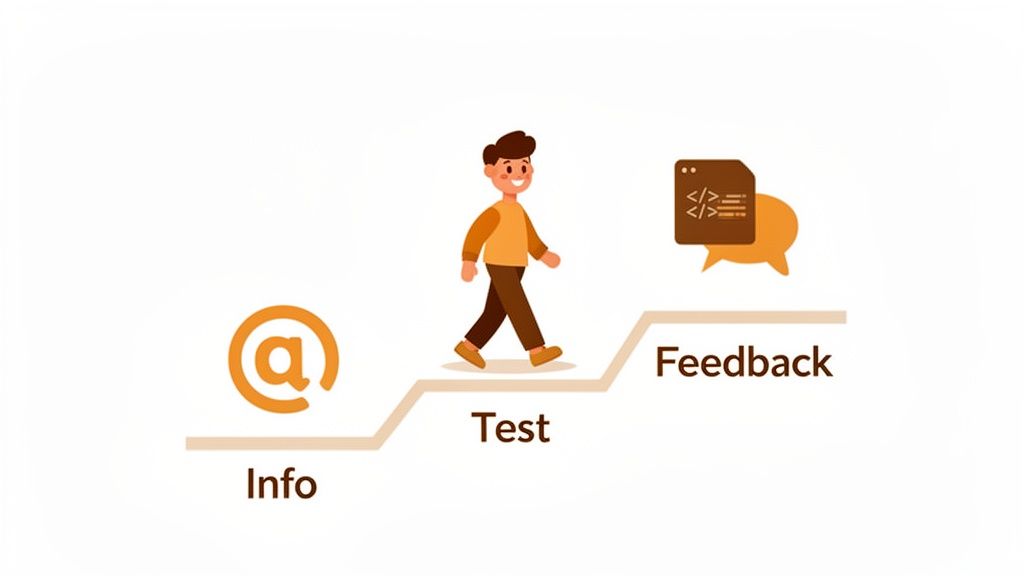
Ambiguity can be a major source of stress in the hiring process. Before a candidate starts a test, they should know what to expect. Vague instructions can cause a great candidate to underperform simply because they misunderstood the guidelines.
To set them up for success, provide clear, concise information:
- Time Commitment: Be honest about how long the test should take. A survey found that 46% of developers consider coding challenges over 90 minutes to be unreasonable. Respect their schedule.
- Evaluation Criteria: Give them a hint about what you're looking for. A simple sentence like, "We value clean code, readability, and testing just as much as a correct solution" helps them focus their energy.
- Tools and Resources: Can they use their preferred IDE? Is looking up documentation on Stack Overflow okay? Clarify these points to prevent frustration.
- The Problem Domain: Give them a high-level preview of the problem. A little context helps them get into the right mindset before the timer starts.
Design Challenges That Respect Their Time
Top engineers are busy. Asking them to spend hours on a generic algorithm puzzle is one way to lose their interest. The best assessments feel less like a test and more like a small, engaging slice of the actual job.
When a candidate feels their time was well-spent on an interesting problem, they stay engaged in the process—even if they don't get the job. The goal is for every applicant to walk away with a positive impression of your company.
The key here is relevance and fairness. Make sure the task's difficulty matches the seniority of the role. You wouldn't give a senior-level system design problem to a junior developer, and a simple API task tells you little about a principal engineer.
When you calibrate the challenge to the role, you show candidates you understand their skill level and value their expertise. This alignment makes the whole process feel more like the start of a professional relationship.
Close the Loop with Timely and Transparent Feedback
A common complaint from developers is the post-test "black hole." They invest time and energy into an assessment, submit it, and then hear nothing. Or worse, a generic, automated rejection email arrives two weeks later. This can harm your reputation in the developer community.
Providing feedback is a sign of respect. You don't need to give a line-by-line code review to every applicant, but a brief, constructive summary can make a significant difference.
A quick note thanking them for their time, acknowledging their effort, and offering a high-level reason for your decision closes the loop professionally. It leaves the candidate with a positive view of your company, strengthening your talent brand for future hiring.
Weaving Assessments into Your Hiring Workflow
A good Java coding test should feel like a natural part of the hiring conversation. If you just drop an assessment into your process without context, you risk creating a clunky experience for candidates and more manual work for your team. The test is most effective when woven seamlessly into your talent pipeline.
This isn't just about process efficiency; it’s about making smarter, faster decisions. When your assessment platform and your Applicant Tracking System (ATS) are connected, you can reduce the time spent sending invites and tracking results. That time is better spent engaging with engineers who have the skills you need.
Finding the Sweet Spot in Your Funnel
Where you place the coding test in your hiring process matters. There are two common approaches, and the right one for you depends on your hiring volume and goals.
The Top-of-Funnel Filter: For high-volume roles, using an assessment right after someone applies can be very effective. It acts as an automated screen for your talent pipeline, ensuring only candidates with a baseline of technical competence reach a recruiter. This can save your team from numerous conversations with applicants who lack the fundamental Java skills.
The Mid-Funnel Gut Check: Alternatively, you could place the test after an initial recruiter chat. This approach lets you present the role and the company first, building rapport before asking a candidate to invest their time. It’s a better fit for senior or hard-to-fill positions where winning candidates over is a priority.
The choice depends on whether your priority is team efficiency or a high-touch candidate experience. There's no single wrong answer, but you should choose the approach that aligns with your goals.
The Power of a Connected ATS
Managing assessments manually can involve spreadsheets, calendar reminders, and potential human error. Connecting your skill-testing platform directly to your ATS is a way to streamline this. It turns a disjointed process into a smooth, automated workflow.
The goal is to let technology handle the logistics so your hiring team can focus on connecting with people. A solid integration doesn't just move data around; it can accelerate your entire hiring timeline.
With a proper integration, the process can run more automatically:
- A candidate reaches a certain stage in your ATS, like "Technical Screen," and an invitation to the Java test is automatically sent.
- As soon as they finish, their score and a link to their work are pushed back into their ATS profile.
- Based on the score, you can automatically move qualified candidates to the "Technical Interview" stage and notify the hiring manager.
This automation frees up your team from administrative work and helps ensure no great candidate falls through the cracks.
Building Better Shortlists with Real Data
Ultimately, a good assessment gives you concrete data to support your hiring decisions. When your systems are connected, you can build qualified shortlists with more confidence. You're no longer just guessing based on a resume; you’re operating with evidence of what a candidate can do.
This data-driven approach is increasingly important, especially for a language as widely used as Java. Since it was open-sourced in 2007, the Java community has grown to over 9 million developers worldwide, creating intense competition for top talent. It's no surprise Java is one of the most tested languages for the 400,000+ companies that rely on it. You can see for yourself just how big the talent pool is and why precise evaluation is important.
By incorporating solid Java coding tests into your workflow, you can move from sifting through hundreds of applications to focusing on a pre-vetted group of contenders. Your team can skip the long shortlists and go straight to engaging with people who have already demonstrated they can do the job.
At Cohesyve, we focus on replacing resume guesswork with dynamic skill verification. Our platform helps design role-specific assessments, ensuring every candidate receives a unique, adaptive challenge. See how you can move from shortlisting to interviewing qualified talent at https://www.cohesyve.com.