Imagine asking a candidate to leave you a detailed voicemail answering your top screening questions, which you can then listen to whenever you have a free moment. That’s the basic idea behind a one way video interview, sometimes called an asynchronous interview. It’s a pre-recorded interview where candidates answer a specific set of questions on their own schedule.
So, What Exactly Is a One Way Video Interview?
At its core, a one way video interview is a practical tool for the first round of candidate screening. Instead of coordinating calendars for a live call, recruiters send candidates a link with pre-written questions.
The candidate then uses their laptop or smartphone to record their answers within a given timeframe and submits the video.
This process separates the recruiter's schedule from the candidate's. You could send out fifty interview requests in the morning and review the recorded responses as they come in, without a single calendar conflict.
The Shift to Asynchronous Screening
This isn't just a passing trend; it reflects a change in how many talent teams operate. The use of one way video interviews has increased significantly, with companies looking for effective ways to handle a large volume of applicants.
Today, a 2022 survey found that 81% of recruiters use some form of video interviewing in their process. For a scaling company, this means you can screen dozens of candidates by watching a few 10-15 minute video clips instead of scheduling back-to-back 30-minute phone screens. You can read more about the rise of asynchronous interviews for modern hiring teams on peoplebox.ai.
This approach gives hiring teams a chance to gauge foundational qualities—like communication skills, enthusiasm, and a basic fit for the role—without the logistical challenges of live calls.
By giving every applicant the same questions, you’re also adding a layer of consistency to your screening. It helps create a more level playing field from the start. It's a practical way to bring structure and scale to the top of your hiring funnel, allowing you to save live interview time for candidates who stand out.
The Pros and Cons of Asynchronous Interviewing
Every hiring tool has its trade-offs, and the one way video interview is no different. It can be a time-saver and bring consistency to your process, but it’s not a complete solution. It's useful to understand both the benefits and potential drawbacks.
The Upside: What Hiring Teams Value
The most immediate benefit is reducing scheduling conflicts. You can screen dozens of candidates across multiple time zones without coordinating calendars, which can help shorten your time-to-hire.
Then there's the consistency factor. In a typical phone screen, the conversation can vary, and every recruiter has their own style. One might focus on culture fit, another on technical skills.
With a one-way video, every candidate gets the same questions in the same order. This helps create a more consistent evaluation process, making it easier to compare responses and reduce the chances of unconscious bias influencing decisions.
When every candidate answers the same set of questions, you're building a foundation for fair, objective evaluation. The focus can shift from a candidate's conversational style to the substance of their answers.
Finally, sharing responses with your team becomes simpler. A hiring manager in a meeting or a department head who is traveling can review the recording whenever they have a free moment.
The Downside: What to Watch Out For
For all the benefits, there are potential risks, which often relate to the candidate experience. The main challenge is the lack of a human on the other end. For a candidate, talking to a screen can feel impersonal.
This can be a concern for some, particularly for senior-level candidates who may expect a more personal process. For example, one survey showed that while 75% of candidates appreciate the convenience of a one-way interview, a number of them also feel uneasy about the lack of real-time interaction. If not managed carefully, this can lead to candidates withdrawing from your pipeline.
Here’s a quick breakdown of the give-and-take:
| Benefit | Potential Drawback |
|---|---|
| Efficiency | Can feel impersonal without live interaction. |
| Consistency | May not capture a candidate's spontaneous thinking. |
| Flexibility | Technical glitches can create a stressful experience. |
| Collaboration | Risk of over-analyzing presentation vs. substance. |
So, how do you address that impersonal feeling? You can inject some humanity back into the process. A helpful way to do this is to have the hiring manager record a brief, friendly video introducing themselves, the role, and the team. It immediately changes the dynamic, showing there's a real person behind the technology and setting a much warmer tone.
It's useful to remember that a one-way video interview is just one tool in your toolkit. It’s effective for initial screening, but it's not designed to capture the nuances of someone's personality or their ability to ask insightful questions. Use it to identify a strong shortlist, then save your high-value, face-to-face time for promising candidates.
Cohesyve
See what candidates can do before you interview them
Cohesyve turns a job description into a role-specific assessment with a scoring rubric. Each candidate gets a different version, so questions cannot be shared. Ten candidates free, no card.
How to Set Up Your Interviews for Success
Setting up a one-way video interview is more than just picking a platform and sending a link. A successful process is one that is insightful for you and respectful of your candidates' time and effort.
Think of yourself as a good host. You would give a guest clear directions and make them feel welcome. The same principle applies here. Let's walk through how to build an asynchronous interview process that works well for everyone.
Design Questions That Reveal Real Skills
The questions you ask are the core of any good interview. In a one-way format, they’re especially important because you can't ask follow-up questions in the moment. Generic prompts like "Tell me about yourself" often invite rehearsed answers.
Instead, your goal should be to get to the core of what the job actually demands.
- Situational Questions: Put them in a realistic, hypothetical challenge. For a customer support role, you might ask, "Describe how you'd handle a call from a frustrated customer whose package is late." This shows their problem-solving and de-escalation skills.
- Behavioral Questions: Dig into their past experiences for evidence of their abilities. For a project manager, a good question is, "Tell me about a time a project fell behind schedule. What specific steps did you take to get it back on track?" This reveals how they’ve applied their skills under pressure.
- Role-Specific Prompts: Give them a mini-task to see their skills in action. For a marketing position, you could ask, "Explain our flagship product to a potential customer in 60 seconds." This directly tests their communication skills and whether they've researched your business.
A word of advice: respect their time. Keep the number of questions manageable—a good range is 3-5 questions, with each answer limited to about 1-3 minutes. This keeps the whole experience under 20 minutes, which is helpful for getting candidates to complete it.
Craft a Positive Candidate Experience
The candidate experience during a one-way video interview can impact your hiring funnel. A clunky or confusing process might deter talented applicants. Your objective is to make them feel supported, not like they're being tested by a machine.
It all starts with being transparent.
Let candidates know exactly what to expect. Tell them how many questions there are, how long it should take, and what the next steps in the process will be. This simple communication can reduce their anxiety.
To add a human touch, record a quick welcome video from the hiring manager. A simple 30-second clip introducing themselves and the role can make the experience feel more personal and two-sided. It’s a small detail that shows there are real people on the other side of the screen.
The infographic below highlights the core benefits of a well-structured process—from efficiency to fairness.
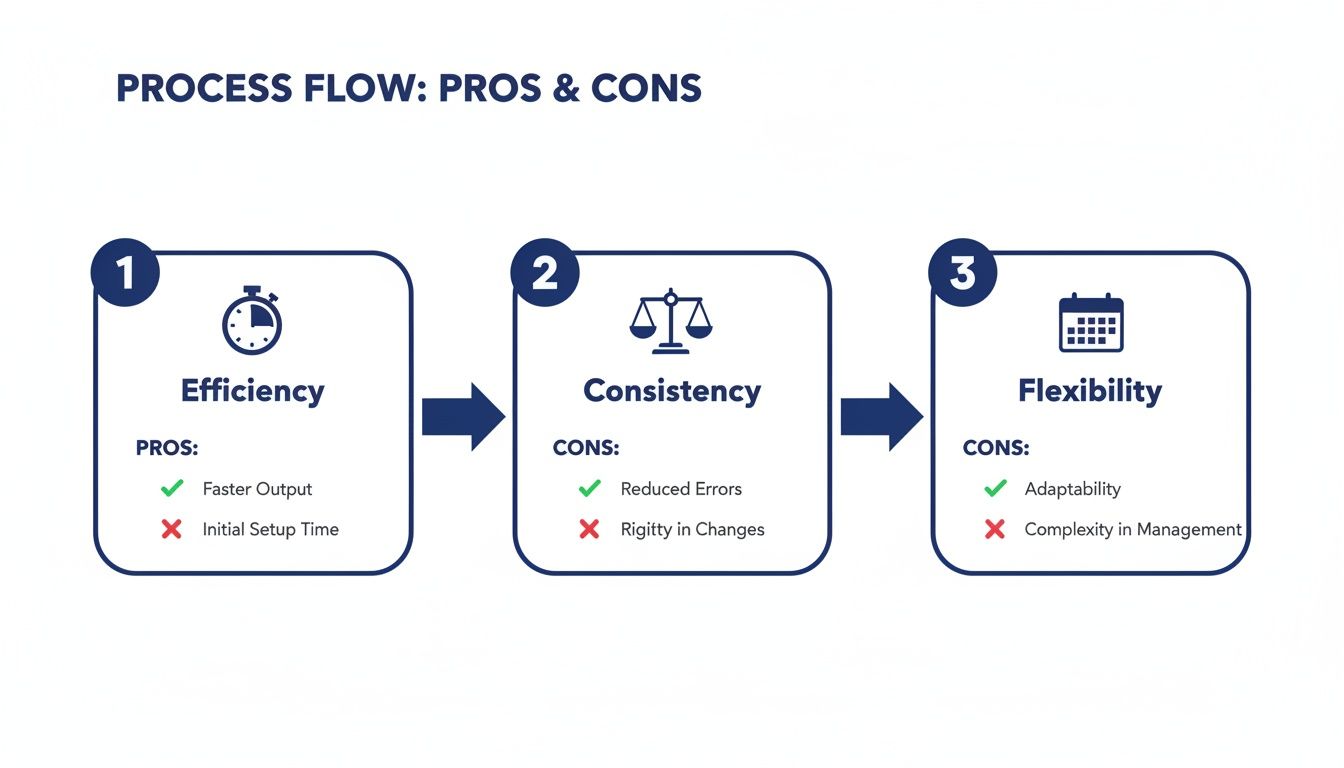
As you can see, each element builds on the last, creating a balanced system that helps both recruiters and candidates when it's put into practice thoughtfully.
Build a Simple and Fair Scoring Rubric
To make your evaluations as objective as possible, you need a scoring rubric. Without one, reviewers may rely on "gut feelings" or be influenced by unconscious bias. A solid rubric ensures everyone on the hiring team is evaluating candidates against the same job-related criteria.
Your rubric doesn't need to be overly complex. Start by identifying 3-4 core competencies that are non-negotiable for the role. These could be things like "Clarity of Communication," "Problem-Solving Skills," or "Technical Knowledge."
Next, define what good, average, and poor look like for each one.
| Competency | 1 (Needs Improvement) | 3 (Meets Expectations) | 5 (Exceeds Expectations) |
|---|---|---|---|
| Communication Clarity | Answer is rambling and hard to follow. | Answer is clear and mostly concise. | Answer is exceptionally clear, structured, and easy to understand. |
| Problem-Solving | Fails to identify the core issue or offers no real solution. | Identifies the issue and suggests a reasonable solution. | Clearly breaks down the problem and proposes a creative, effective solution. |
Using a simple scale like this standardizes feedback and makes it much easier to compare candidates fairly. When you combine this kind of structured evaluation with questions that test practical, on-the-job skills, you start identifying the people who can do the work.
Helping Candidates Navigate the Video Interview
A good hiring process is about giving candidates a platform to show you their abilities. This is especially true when it comes to a one way video interview. For many people, talking to a camera without a person on the other end can feel awkward.
Your role as a recruiter is to bridge that gap. By offering clear, supportive guidance, you’re not just easing their nerves; you’re creating a more level playing field where everyone gets a fair opportunity. This section is about giving candidates the tips they need to feel confident, which, in turn, helps you get the authentic responses you're looking for.
When you show that you understand their position, you build a process that feels respectful.
The Technical Tune-Up
Before a candidate thinks about what to say, they need to check their setup. A technical glitch can increase stress and affect their performance. A quick pre-interview check can make a big difference.
- Test the Tech: Urge them to check their camera and microphone before the deadline. A quick test to ensure the video is clear and the audio is crisp can prevent last-minute issues.
- Find the Light: Good lighting is important. A helpful tip is to sit facing a window or another soft light source. If the main light is behind them, they may appear as a silhouette.
- Stabilize the Camera: Whether they’re using a laptop or a phone, the camera should be steady and at eye level. A simple stack of books can help avoid an unflattering camera angle.
A quiet, distraction-free space is just as crucial. Suggest they find a spot where they won't be interrupted. A simple, uncluttered background keeps the focus on them.
Mastering On-Camera Presence
Once the tech is sorted, the next step is helping candidates present themselves with confidence. Talking into a lens is different from a real conversation, but a few simple pointers can help them connect with the reviewer.
One of the most important tips is to look directly at the camera lens, not at their own face on the screen. This small change can make a huge difference, creating the feeling of eye contact and making their answers feel more personal.
A candidate's ability to communicate effectively in a one way video interview often improves with preparation. Encouraging them to practice helps them move past the initial awkwardness of the format and deliver more natural, thoughtful responses.
Another piece of advice is to use brief talking points, not a word-for-word script. Reading an answer can sound stiff. A few bullet points, however, can keep them on track without sacrificing authenticity. Encourage them to speak at a normal pace and use hand gestures if that's what they do naturally—it adds energy and personality. Small touches like these can dramatically improve the overall candidate experience, making the whole thing feel less like a test.
By offering this kind of guidance, you’re not just being helpful; you’re being strategic. A prepared candidate gives you a much clearer signal of their potential. They’re less likely to be flustered by the format and more likely to provide the thoughtful answers you need to make a good hiring decision.
Weaving Video Interviews into Your Hiring Workflow
Adopting a new tool is one thing; making it a seamless part of your daily operations is another. Successfully integrating a one-way video interview into your hiring process requires a thoughtful approach to technology, team training, and workflow automation. When done right, it adds value without creating new problems.
The goal is to make this step a natural part of your hiring funnel, not a clunky addition.
Choosing the Right Platform and Staying Compliant
Your first big decision is picking the right technology. The market has many options, so you need to focus on what matters for your team and candidates. A platform should be simple to use for both recruiters and applicants.
Look for a few key features:
- Mobile-First Design: Many candidates, especially for high-volume roles, will complete their interview on a smartphone. A smooth mobile experience is a must-have.
- Seamless ATS Integration: Your video platform should integrate with your Applicant Tracking System to avoid manual data transfer.
- Customization and Branding: The ability to add your company logo, brand colors, and a welcome video makes the experience feel more personal.
Beyond features, you have to consider compliance. Hiring laws are complex and vary by location, and video brings its own considerations around data privacy. Make sure any platform you consider is compliant with regulations like GDPR or CCPA and be clear about how candidate data is stored, secured, and used.
Training Your Team for Fair and Consistent Evaluation
One of the potential pitfalls of video interviewing is inconsistent evaluation. If one reviewer focuses on communication style while another only listens for technical keywords, your process will be unreliable. This is where team training and a clear scoring rubric are essential.
Before you send out any interview invitations, get your hiring team aligned on what "good" looks like for the role.
A well-trained team using a clear, consistent rubric is your strongest defense against unconscious bias. The focus should always be on evaluating the substance of a candidate’s answers against the core competencies of the role.
Set up straightforward guidelines for everyone involved in reviewing videos. This training should cover a few key things:
- Using the Rubric: Walk through your scoring guide with concrete examples. Show what a "1-point" answer sounds like versus a "5-point" answer for each question.
- Ignoring Non-Job-Related Factors: Explicitly tell reviewers to disregard things like a candidate's background, accent, or appearance. The content of their answers is what matters.
- Providing Constructive Feedback: Teach your team how to leave specific, actionable notes to back up their scores. This helps with collaboration and creates a more defensible hiring process.
Supercharging Your Workflow by Verifying Real Skills
A one-way video interview is useful for getting a read on communication skills, personality, and motivation. But what about a candidate's ability to do the job? Relying only on video for a technical role can be incomplete.
This is where combining video interviews with skills verification can create a more effective hiring process.
Imagine this workflow:
- A candidate applies and receives an automated invitation to a two-part screening.
- Part one is a quick, one-way video interview focused on their drive and communication style.
- Part two is an interactive, role-specific assessment that tests their real-world problem-solving skills—whether that's writing code, analyzing a dataset, or handling a simulated customer support ticket.
This two-pronged approach gives you a more complete picture. The video provides the human element, while the skills assessment gives you objective data on their capabilities. It moves beyond guesswork and allows you to base your decisions on proven ability. To see how this works in practice, you can explore the variety of modern candidate assessment tools designed to integrate into your workflow.
By separating the evaluation of soft skills from the verification of hard skills, you can build a clearer, fairer, and more predictive hiring process. You’ll move from a shortlist based on "good feelings" to one built on evidence of who can do the job.
Is Your Video Interview Process Actually Working? Here's How to Tell
A new hiring tool should deliver measurable results. To know if your one-way video interviewing process is effective, you need to look at the data. This allows you to move past guesswork and make evidence-based adjustments that strengthen your hiring funnel.
Think of it as a feedback loop. The numbers tell you what’s working well and what might need an adjustment, ensuring the process is a win for both your team and your candidates.
The Metrics That Matter Most
To get a clear picture of your process's health, start by tracking a few core metrics. These data points can quickly highlight any problem areas.
Candidate Completion Rate: This is a key indicator. If many candidates start the interview but don't finish, it could mean the interview is too long, the questions are confusing, or your instructions aren't clear. Aim for a completion rate of 90% or higher.
Time-to-Hire: How long does it take to get a candidate from the video interview stage to a signed offer? A shorter cycle can be a sign that you're identifying top talent efficiently.
Quality of Hire: This is the ultimate test. Look at the performance of new hires who came through your video interviews. Six months later, are they performing well? High-performing employees are a clear sign that your screening criteria are effective at predicting on-the-job success.
Turning Data Into Action
Once you have this data, you can start making targeted improvements.
For example, if your completion rates are low, your interview might be too demanding. Try cutting it down from five questions to three and see what happens.
Or, if you see that different managers are giving very different scores to the same videos, your scoring rubric might be too vague. Get the team together for a calibration session to agree on what a "5-star" answer looks like. To better analyze what candidates are saying, learning how to transcribe video to text online can be a useful tool for deeper analysis.
By tying these hiring metrics back to actual business outcomes, you can demonstrate the ROI of your efforts. A faster time-to-hire and a higher quality of hire can lead to better productivity and lower costs.
Optimization is about continuous improvement. Don't forget to ask candidates for their feedback with a post-interview survey. Mixing that direct feedback with your data is the key to building a process that’s not just efficient, but also fair, engaging, and effective.
To dive deeper into connecting hiring data to broader business goals, it’s worth exploring the fundamentals of HR data analytics.
Frequently Asked Questions
Even with a solid plan, you might still have a few questions about making one-way video interviews work for your team. Let's tackle some of the most common ones.
Are One-Way Video Interviews a Good Fit for Every Role?
No, they are not a one-size-fits-all solution. They work best for high-volume roles, acting as an initial filter to gauge a candidate's communication style and motivation.
For more senior or deeply technical positions, they are more effective when paired with a skill assessment. This lets the video portion focus on personality and culture fit, while objective data from the assessment confirms the person has the skills to do the job.
How Can We Keep Bias Out of the Picture?
Reducing bias is about structure. It's important to use a standardized set of questions for every candidate and a clear scoring rubric based on job-specific skills.
A useful strategy is to have multiple people score the interviews independently before they discuss the candidate. While some platforms offer features to obscure demographic details, supplementing the video with objective data from a skill verification platform can help ground your decision in proven ability rather than just a gut feeling.
What’s the Ideal Length for a One-Way Video Interview?
Keeping it short is usually best. You want to respect the candidate’s time and encourage them to complete the interview.
A good range is 3-5 questions, with each answer capped at 1-3 minutes. The entire experience for the candidate shouldn’t take more than 15-20 minutes. Be upfront about this time commitment in your instructions—it’s a simple step that manages expectations and creates a better candidate experience.
Ready to move beyond guesswork and see what your candidates can do? Cohesyve builds dynamic, role-specific assessments that give you objective proof of skill, helping you identify top performers with confidence. Find out how Cohesyve can transform your hiring process.