Resumes and interviews only tell you part of the story. They show you what a candidate has done, but not necessarily how they do it. Personality testing for hiring offers a structured look at a candidate’s natural behaviors, work style, and motivations.
Unlocking Potential with Personality Testing
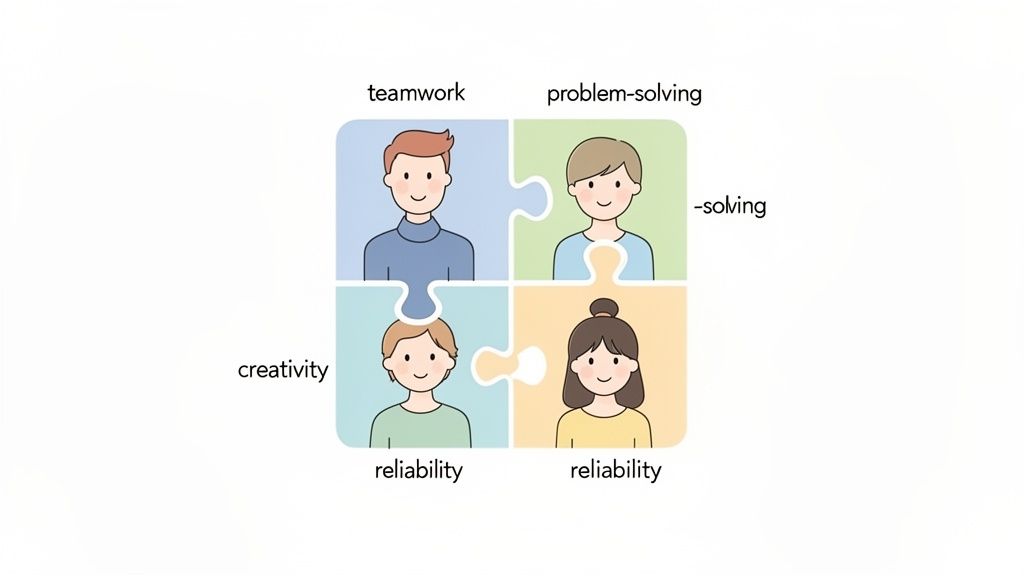
Think about building a team. You wouldn’t just scout for players with the best individual stats; you'd also look for people whose playing styles complement each other. That's the core idea behind personality testing in hiring. The goal isn’t to find one “perfect” personality type. It’s about understanding how someone’s natural tendencies fit the role's demands and the team's existing dynamics.
These assessments are tools that provide information on how a person is likely to behave at work. They offer a structured method for evaluating qualities that are hard to gauge in an interview, like resilience, conscientiousness, or how they adapt to unexpected changes.
Beyond the Resume Data
A typical hiring process often relies on a candidate's self-reported skills and how well they perform under the pressure of an interview. Personality testing adds a layer of objective data to the mix, helping you build a more complete profile of who you're considering.
When used correctly, this approach can be beneficial:
- Improve Team Dynamics: You can identify candidates whose work styles will complement—not clash with—your current team, leading to better collaboration.
- Reduce Subjective Bias: When every candidate takes the same standardized assessment, it helps level the playing field and moves the focus away from "gut feelings."
- Enhance Predictive Accuracy: Getting a read on a candidate's behavioral patterns can help you predict how successful they might be in a specific role long-term.
The purpose of personality testing isn't to put people in a box. It's about adding another data point to your decision-making process. This context, when combined with their proven skills and experience, helps you make more informed hiring choices.
This method acknowledges that how people work is often just as important as what they know. A brilliant coder who can't collaborate may struggle in an agile team. On the flip side, a naturally sociable and empathetic person is likely to be a good fit for a client-facing role.
A Piece of a Larger Puzzle
It’s important to remember that a personality assessment is just one part of a comprehensive evaluation. Its findings are most powerful when you use them alongside other tools. You can learn more about this in our guide on what makes a complete pre-employment assessment strategy.
In the end, the best hiring decisions come from a blend of insights. While a personality test might suggest a candidate is highly conscientious, a practical skills test can confirm they have an eye for detail on a real-world task. This combination ensures you're hiring for both potential and proven ability.
Exploring Common Types of Personality Tests
In hiring, personality tests are tools designed to map out how a candidate naturally behaves at work. The key is knowing that not all assessments are the same—each one gives you a different lens for understanding someone's tendencies.
The goal isn’t to find a "perfect" personality. It’s about gathering information. When you're building a team, you need more than just technical experts. You need collaborators, innovators, and steady hands. Different tests help you spot these different behavioral strengths.
This shift toward data-informed hiring is a growing market. One analysis projects the global personality test sector for recruitment to reach USD 3.5 billion by 2033. This growth is partly due to large companies using these tools to reduce bad hire costs by as much as 30%. You can dig deeper into this growth in a detailed market analysis.
The Big Five (OCEAN) Model
The Big Five is a widely respected and scientifically validated model in personality science. Instead of putting people into rigid boxes, it measures five core traits on a sliding scale.
- Openness to Experience: How curious and creative is someone? A person high in openness is often receptive to new ideas and may thrive in dynamic roles, like a product developer or a creative director.
- Conscientiousness: This is about organization, discipline, and reliability. It’s often a strong predictor of job performance, especially for roles that demand precision, like an accountant or a project manager.
- Extraversion: Where does someone get their energy? Extraverts are often energized by social interaction and tend to be assertive and outgoing, which can be a good fit for sales, public relations, or leadership.
- Agreeableness: This trait reflects empathy, cooperation, and how considerate a person is. It can be valuable in team-first cultures and roles centered on customer service or conflict resolution.
- Neuroticism (or Emotional Stability): How well does someone handle stress? Low neuroticism (meaning high emotional stability) can be an asset in high-pressure jobs, like an ER nurse or event planner.
The Myers-Briggs Type Indicator (MBTI)
The MBTI is a well-known personality framework, sorting people into one of 16 types based on preferences like Introversion vs. Extraversion. It can be a useful tool for team-building workshops and self-discovery.
However, its use in hiring is debated. A primary concern is its "either/or" logic. Most people aren't 100% one thing or the other; our behavior shifts with the situation. For making a hiring decision, it can be more useful to know where someone lands on a spectrum—like the Big Five provides—rather than assigning them a fixed label.
The DiSC Assessment
The DiSC model focuses on workplace behaviors. It groups tendencies into four primary styles, making it easier to understand how people approach their work and interact with others.
A Quick Comparison of Popular Personality Models
To help you see the differences at a glance, this table breaks down what each model measures and where it's often used in the hiring process.
| Test Model | What It Measures | Best Used For |
|---|---|---|
| The Big Five (OCEAN) | Five broad, stable personality dimensions on a spectrum. | Getting a scientifically-backed, holistic view of a candidate's core personality. Good for predicting long-term job performance. |
| Myers-Briggs (MBTI) | 16 personality types based on four psychological preferences. | Team-building and personal development exercises. Generally not recommended for pre-hire screening due to its categorical nature. |
| DiSC | Four primary workplace behavioral styles: Dominance, Influence, Steadiness, and Conscientiousness. | Understanding a candidate's communication style, work pace, and how they'll likely interact with other team members. |
Each of these tools offers a unique perspective. The Big Five gives you robust, foundational science, while DiSC provides a practical snapshot of day-to-day work styles.
The Bottom Line: No single test can give you the complete picture. Think of these assessments as one important piece of the puzzle, providing objective insights that a resume or even an interview can't.
Ultimately, you're trying to look past the resume to see the person. This data helps you understand how a candidate may adapt, collaborate, and contribute to your culture. When you combine these behavioral insights with solid evidence of their skills, you're not just hiring for today—you're building a team that's set up for future success.
Cohesyve
See what candidates can do before you interview them
Cohesyve turns a job description into a role-specific assessment with a scoring rubric. Each candidate gets a different version, so questions cannot be shared. Ten candidates free, no card.
The Benefits and Limitations of Using Personality Data
Personality tests can bring a new dimension to your hiring process, but they aren't a crystal ball. They are most effective when seen as one strategic tool in your toolkit. When used thoughtfully, the data they provide can help you build stronger, more resilient teams.
One of the main benefits is getting a clearer picture of long-term job fit. Traditional hiring can sometimes be uncertain, but adding objective behavioral data helps improve the odds. For example, some studies suggest that teams matched for personality can drive 21% higher profitability. Companies that build cohesive teams often see improved performance. For a closer look at these trends, you can explore the research on personality assessment solutions.
This leads to another advantage: reducing subjective bias. We all have unconscious biases, and "gut feelings" are often unreliable. A standardized personality assessment helps level the playing field, making sure every candidate is measured against the same objective yardstick.
The Upside of Objective Insights
By looking beyond the resume, you start to uncover strengths that may not come across in a 30-minute interview. This is where personality testing can be useful:
- Building Better Teams: Understanding how someone naturally works helps you predict how they'll mesh with your existing crew. You can intentionally build teams with complementary strengths, like pairing a creative, big-picture thinker with someone who's a master of details and execution.
- A Glimpse into Future Behavior: Certain traits, like conscientiousness, are consistently linked to job performance across a huge range of roles. This kind of data can be a leading indicator of who is likely to succeed.
- Smarter Onboarding and Management: The insights don't stop when the offer is accepted. Knowing an employee’s communication style and what motivates them allows managers to provide targeted, effective support from day one.
Personality data offers clues, not conclusions. It gives you a glimpse into a candidate's default settings—how they are likely to act under pressure, approach new challenges, or contribute to a group project.
Understanding the Inherent Limitations
Of course, it's just as important to be realistic about what these tests can't do. Leaning too heavily on personality data can lead to poor decisions and can negatively affect your hiring process.
A common worry is that candidates will try to game the test by giving answers they think you want to hear. While many modern assessments have built-in safeguards to flag inconsistent responses, it’s still a valid concern. This is why personality insights should never be the sole reason for a hiring decision.
Another potential pitfall is the risk of hidden bias baked into the test. If an assessment hasn't been scientifically validated or is culturally skewed, it could unintentionally screen out qualified candidates from diverse backgrounds.
A Piece of a Larger Puzzle
To use personality data the right way, you need to set some clear guardrails.
- Never Use It in a Vacuum: A personality score means little on its own. It needs the context of interviews, reference checks, and—most importantly—hard evidence that the person has the skills to do the job.
- Don't Hunt for a "Perfect" Profile: Avoid the trap of creating a rigid ideal personality type. The best teams often thrive on cognitive diversity, and a mix of different working styles usually leads to better problem-solving.
- Skills Come First: Knowing a candidate is agreeable is nice, but knowing they can write clean code or build a financial model is essential. For more on this, check out our guide on how to build a robust pre-employment skills assessment strategy.
At the end of the day, personality data is a powerful supplement, not a substitute for a thorough evaluation. Its true value comes out when it helps you ask better, more insightful interview questions and build a complete picture of who a candidate really is.
Navigating the Legal and Ethical Landscape
Deciding to use personality tests in your hiring process is a significant step. While moving away from "gut feel" and toward data-informed decisions is a good practice, it also means navigating important legal and ethical waters. Getting this right isn't just about compliance; it's about building a fair process that protects both your company and the candidates you hope to attract.
The biggest legal issue to watch for is disparate impact. This is a legal term for when a hiring practice, even unintentionally, ends up discriminating against people from a protected group (based on race, gender, age, etc.). Even with the best intentions, if your test results consistently screen out one group over another, you could face legal challenges. This is why using a scientifically validated assessment isn't just a good idea—it's essential.
Staying Compliant and Fair
To build a hiring process that's both ethical and legally sound, you need to ground your strategy in a few core principles. The U.S. Equal Employment Opportunity Commission (EEOC) has laid out clear guidance that all boils down to fairness, consistency, and job relevance. Think of these as guardrails that keep your hiring process objective and equitable.
Here are the key checkpoints to keep in mind:
- Job Relevance: The personality traits you're measuring must have a clear, direct link to what it takes to succeed in the job. You can't just screen for "conscientiousness" because it sounds good. You need to be able to show why that trait is critical for a specific role in your company.
- Scientific Validity: Stick with assessments that have been properly vetted for reliability (does it measure consistently?) and validity (does it actually predict job performance?). This is your proof that the test is a legitimate tool.
- Consistent Application: The test has to be given to every single candidate for a role, in the exact same way. You can't pick and choose who takes it or change the rules halfway through. That's a sure way to introduce bias.
A personality test stays on the right side of the law when it acts as a work sample for someone's behavioral tendencies, not as a medical or psychological exam. The focus must always be on job-related abilities.
Protecting Candidate Data and Experience
Beyond the legal rules, you have an ethical duty to your candidates. How you handle their personal information and communicate throughout the process says a lot about your company culture. Honesty and transparency are key here.
Think about it from their perspective. Candidates have a right to know why you're asking them to take a test and what you plan to do with the results. A straightforward explanation can make the difference between a candidate feeling like they're jumping through a mysterious hoop and feeling like they're part of a professional, well-thought-out process.
Make these ethical practices part of your standard procedure:
- Informed Consent: Before they even start the test, clearly explain its purpose. Reassure them that it's just one piece of the puzzle.
- Data Privacy: Have a clear policy for how you store their data securely and ensure it's only used for hiring. Candidates should know who sees their results and how long you keep them on file.
- Reasonable Accommodations: Be ready to offer accommodations for candidates with disabilities. This isn't just good practice; it's required by the Americans with Disabilities Act (ADA).
Navigating this landscape comes down to one simple idea: use assessments to gather job-relevant data in a way that’s fair, consistent, and transparent. A good personality test should bring objective clarity to your hiring conversations, but it's not a substitute for looking at the whole person. When you pair that insight with practical, role-specific skills assessments, you can build a powerful, fair, and legally sound system for finding talent.
How to Build an Effective Assessment Strategy
A personality test is only as good as the strategy behind it. Simply adding an assessment to your hiring process without a clear plan might give you interesting data, but it won't be as effective. A well-thought-out strategy, on the other hand, turns that raw data into a reliable roadmap for finding the right person for the job.
The approach boils down to one idea: personality insights are most powerful when they give context to proven skills. It’s interesting to know a candidate scores high on "conscientiousness." It's more decisive when you see that same candidate demonstrate meticulous attention to detail in a real-world task simulation. This combination moves you from guessing about potential to verifying actual ability.
Start With the Why: Define Your Ideal Profile
Before you even think about which test to use, start with the role itself. A common mistake is looking for a generic "good personality." You need to get specific. Sit down with the hiring manager and the team lead to figure out what success actually looks like in that position.
This means going beyond a simple list of job duties. You have to identify the core behaviors and traits that separate good performers from great ones.
- For a Sales Role: You'll likely want to prioritize things like resilience (the ability to bounce back from a "no") and extraversion (someone who is energized by social interaction).
- For a Software Engineer: High conscientiousness (attention to detail in code) and openness to experience (being eager to adapt to new technologies) are probably key.
- For a Project Manager: You might look for emotional stability (staying calm when deadlines are looming) and agreeableness (knowing how to foster team collaboration).
Once you have this role-specific profile, you have a benchmark. This is how you make sure you’re using personality testing for hiring as a precision tool, not just a vague filter.
When and How to Administer the Test
Timing is important. Where you slot the assessment into your hiring funnel has a big impact on both the candidate experience and the data you get back. Send it too early, and you might deter qualified people who aren't invested yet. Wait too long, and you miss the chance to use the insights to shape your interviews.
A common practice is to place the assessment after the initial resume screen but before the first in-depth interview. This allows you to use the results to craft smarter, more targeted interview questions.
For example, if a candidate's profile suggests they're on the lower end of extraversion but the job is client-facing, you can explore that. Ask specific behavioral questions like, "Tell me about a time you had to build rapport with a difficult stakeholder." This approach uses the data to start a conversation, not end one.
This balanced process of validating, applying, and protecting is the key to a hiring strategy that is both effective and legally sound.
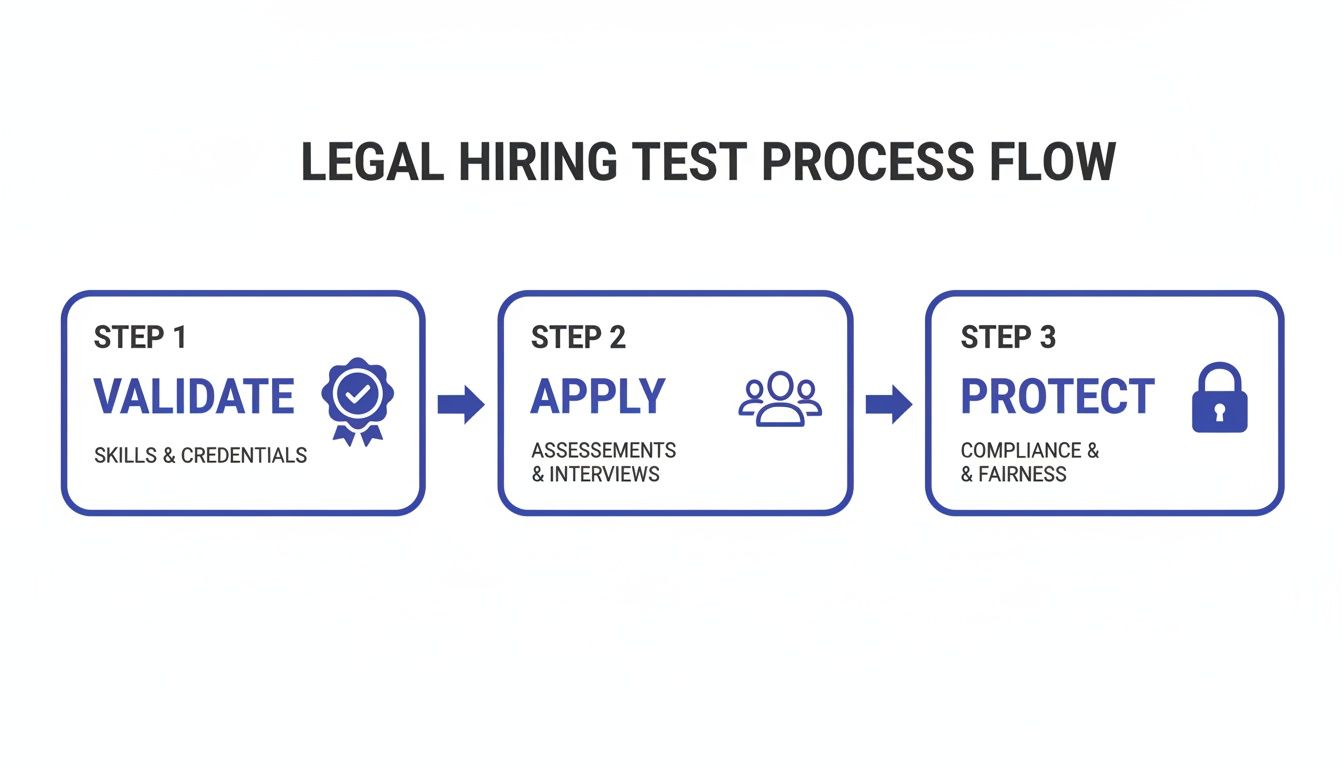
This visual breaks down the essential steps: validate that the test is relevant for the role, apply it consistently to every candidate, and protect their data to keep the process fair and compliant.
Combine Personality Insights with Verifiable Skills
This is a critical step. A personality score is a hypothesis about how a candidate might behave. A skills assessment provides proof of what they can do right now. A robust strategy makes these two things work together.
Think of it this way:
| Data Point | What It Tells You | Example |
|---|---|---|
| Personality Insight | A clue about how they might approach their work. | Candidate scores high in "Openness to Experience." |
| Skills Verification | Proof of what they can actually accomplish. | Candidate successfully solves a novel problem in a case study. |
| Holistic View | The candidate isn't just creative in theory; they can apply that creativity to solve real business challenges. |
This holistic approach ensures you're looking at the whole person. While personality tests give you structured data, a complete strategy often involves assessing character and reasoning through interviews to get the full picture. There are plenty of excellent candidate assessment tools that can help you build out this kind of multi-layered approach.
The personality assessment market is projected to reach USD 11.25 billion by 2025, largely because remote work requires new ways to gauge fit and work style. Today, some platforms handle 60% of initial screenings, helping teams fill roles 50% faster while avoiding the estimated $15,000 cost of a bad hire.
In the end, a great strategy isn't about finding a "perfect" personality score. It's about using behavioral insights to add depth and context to what you already know about a candidate’s skills and experience. It's about building a complete picture so you can be confident you're hiring someone who won't just do the job, but will thrive in it.
Answering Your Top Questions About Personality Testing
Even with a solid plan, a few questions often come up when you start using personality tests. Let's walk through some of the most common ones.
Can't Candidates Just Fake a Personality Test?
It’s a fair question. Of course, a candidate can try to answer questions the way they think you want them to. This is sometimes called "faking good," and it's a top concern for anyone using these assessments.
However, modern, well-designed tests are built to address this. Many have built-in validity scales that flag inconsistent answers. Your best defense, however, is to never rely on one tool alone. A candidate might say they’re incredibly detail-oriented, but a hands-on skills test that asks them to analyze a messy spreadsheet will tell you the real story. When you pair personality insights with objective proof of their skills, you get a much clearer, more reliable picture.
How Do We Pick the Right Test for Our Company?
The best test isn't about your company—it's about the role. The first step is always to map out the core competencies and personality traits that genuinely lead to success in a specific job. What does it actually take to thrive on your sales team or in your engineering department?
Once you have that profile, look for test providers who use scientifically validated models, like the Big Five, and are transparent about their reliability statistics. Also consider the candidate experience. Is the test easy to use, and does it respect their time? A 45-minute test can be a lot to ask of a busy professional. Finally, make sure the vendor complies with all legal standards, like those from the EEOC. Be wary of any test that promises simple answers or tries to box people into rigid "types."
Do These Tests Actually Predict How Someone Will Perform?
By themselves, personality tests are considered moderate predictors of job performance. Some traits, particularly conscientiousness, consistently correlate with success across a wide range of jobs.
The real value emerges when personality testing is one piece of a much larger puzzle. The strongest, most accurate predictions come from a combination of personality data, cognitive ability scores, and—most importantly—verified, role-specific skills.
Think of it this way: a personality test helps you understand how a candidate might approach their work. It provides valuable context. But it should rarely be the deciding factor. When you combine that understanding with hard evidence of what a candidate can do, you build a hiring process that's not only more predictive but also fairer.
Ready to move beyond guesswork and verify real-world skills? Cohesyve’s AI-driven platform designs dynamic, role-specific assessments that let you see exactly what your top candidates can do. Learn how to hire the top 5% of talent faster.