The landscape of technical hiring is shifting. Standard software engineer interview questions often test a candidate's recall rather than their problem-solving ability. A 2021 study indicated that traditional coding interviews can be poor predictors of job performance, sometimes filtering out qualified but nervous candidates who don't fit a specific, rehearsed mold. This approach can value memorization over genuine engineering competence, creating noise that obscures the signals you need to find.
This guide moves beyond the basics. We’ve selected 12 foundational problems designed to uncover how a candidate thinks. You won't just get a list of questions; you'll get a framework for evaluating the answers. We'll break down the 'why' behind each problem, exploring the specific signals they reveal about a candidate's grasp of trade-offs, their communication skills, and their readiness for real-world engineering challenges. The goal is to shift from "Can they solve this puzzle?" to "How do they approach complex problems?"
Here, we will explore:
- Core Concepts Tested: What fundamental computer science principle is at the heart of each question.
- Key Evaluation Signals: What to look for in a candidate’s response beyond just a correct answer.
- Anti-Cheating & Validation: Practical tips to ensure the work you see is genuinely the candidate's.
By focusing on the process and not just the solution, you can design a more authentic evaluation of skill. When designing your own evaluation, it's useful to consider what makes for truly effective software developer interview questions that go beyond mere memorization. This collection is your starting point for building interviews that identify the insightful, adaptable engineers your team needs.
1. Two Sum Problem - Leetcode Classic
The Two Sum problem is a common warm-up in modern software engineer interview questions. It asks a candidate to find two numbers in an array that add up to a specific target value and return their indices. While it sounds simple, this question effectively gauges a candidate's foundational understanding of data structures and algorithmic complexity.
A junior candidate might propose a brute-force approach using nested loops, which results in an O(n²) time complexity. This initial solution opens an opportunity for you to probe for optimization. A more experienced engineer should identify the path to a linear, O(n) solution using a hash map (or dictionary in Python). As they iterate through the array, they can store each number and its index in the map. For each element, they check if the map already contains the required complement (target - current number).
How to Implement and Score This Question
- Initial Prompt: "Given an array of integers
numsand an integertarget, return the indices of the two numbers such that they add up totarget." - Optimization Prompt: "Your current solution is O(n²). Can you think of a way to solve this in a single pass through the array?"
- Follow-ups: Discuss edge cases like arrays with duplicate numbers, negative values, or no valid solution. This reveals their attention to detail.
Scoring Insight: A candidate's ability to articulate the time-space trade-off is key. The optimized O(n) solution uses O(n) space for the hash map, a trade-off many interviewers look for. This approach provides a clear signal of their problem-solving process, aligning well with the principles of skills-based hiring assessments.
In Cohesyve: Use this question as an automated entry-point in an adaptive assessment. A correct and optimized solution can trigger more complex array or hash map problems, while a struggle might route the candidate to simpler, more foundational questions.
2. Reverse a Linked List - Pointer Manipulation
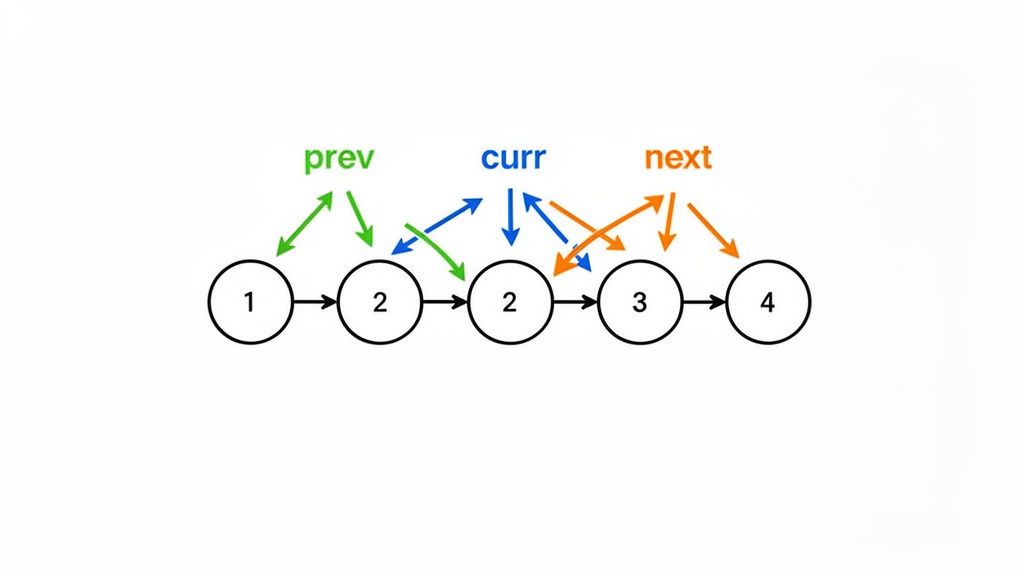
After a warm-up, "Reverse a Linked List" is a logical next step in any slate of software engineer interview questions. This classic problem requires candidates to reverse the direction of a singly linked list, typically in-place. It's a useful test of a candidate's grasp of pointer manipulation, memory management, and their ability to visualize how data structures change during an operation. Unlike simple array traversals, this question helps separate candidates who understand reference semantics from those who may have only memorized algorithms.
A common approach involves iterating through the list, using three pointers: previous, current, and next. The current node's next pointer is redirected to the previous node, and then all three pointers are advanced. This process continues until the end of the list is reached. Asking a candidate to draw this process on a whiteboard before coding can reveal their thought process and prevent common off-by-one errors.
How to Implement and Score This Question
- Initial Prompt: "Given the head of a singly linked list, reverse the list and return the new head."
- Optimization Prompt: "Great, that iterative solution works. Can you now implement it using recursion?"
- Follow-ups: Discuss the space complexity of both the iterative O(1) and recursive O(n) solutions. Ask why an in-place, O(1) space solution might be preferred for systems with limited memory.
Scoring Insight: A strong candidate will not only implement both iterative and recursive solutions but will also clearly explain the trade-offs. The recursive solution, while more elegant to some, incurs a cost on the call stack, making the iterative version preferable for memory efficiency. This distinction demonstrates a deeper, more practical understanding of computer science fundamentals.
In Cohesyve: The platform's interactive coding challenges can auto-detect common pointer logic errors. If a candidate successfully solves this, the adaptive assessment can progress to more complex list problems like detecting a cycle or merging two sorted lists.
Cohesyve
See what candidates can do before you interview them
Cohesyve turns a job description into a role-specific assessment with a scoring rubric. Each candidate gets a different version, so questions cannot be shared. Ten candidates free, no card.
3. Valid Parentheses - Stack-Based Problem
The "Valid Parentheses" problem is a classic for a reason. It requires candidates to determine if a string containing parentheses, brackets, and braces is balanced and correctly ordered. This question moves beyond basic array manipulation to test a candidate's understanding of stack data structures and their Last-In, First-Out (LIFO) behavior, which is fundamental to parsing and syntax validation.
A candidate should recognize that an opening bracket must be closed by its corresponding type in the correct order. An intuitive and efficient way to solve this is by using a stack. As they iterate through the string, they push opening brackets onto the stack. When they encounter a closing bracket, they check if the stack is empty or if the top element is the matching opening bracket. If it is, they pop from the stack; otherwise, the string is invalid. A valid string will result in an empty stack at the end.
How to Implement and Score This Question
- Initial Prompt: "Given a string
scontaining just the characters '(', ')', '{', '}', '[' and ']', determine if the input string is valid." - Optimization Prompt: "For a simplified version with only one type of parenthesis, like '()()', could you solve this without a stack, perhaps with just a counter? What are the limitations of that approach?"
- Follow-ups: Ask about memory considerations for extremely long input strings. This probes their understanding of how data structures consume memory and potential performance bottlenecks.
Scoring Insight: A strong candidate will not only implement the stack solution correctly but also clearly explain why a stack is the appropriate data structure. They should be able to articulate the LIFO principle and how it models the "nested" nature of the parentheses. This demonstrates a deeper conceptual understanding beyond just memorizing an algorithm.
In Cohesyve: Use this as a mid-funnel question to assess logical reasoning. You can also leverage the voice role-play feature to have candidates verbally explain the stack concept and their implementation, providing a signal on their communication and technical articulation skills.
4. Merge K Sorted Lists - Heap and Divide-Conquer
This problem asks a candidate to merge multiple sorted linked lists into a single sorted list. As one of the more advanced software engineer interview questions, it combines data structures (linked lists, heaps) and algorithmic paradigms (divide and conquer). It’s a good tool for separating candidates who can solve isolated problems from those who can synthesize multiple concepts to build a robust solution.
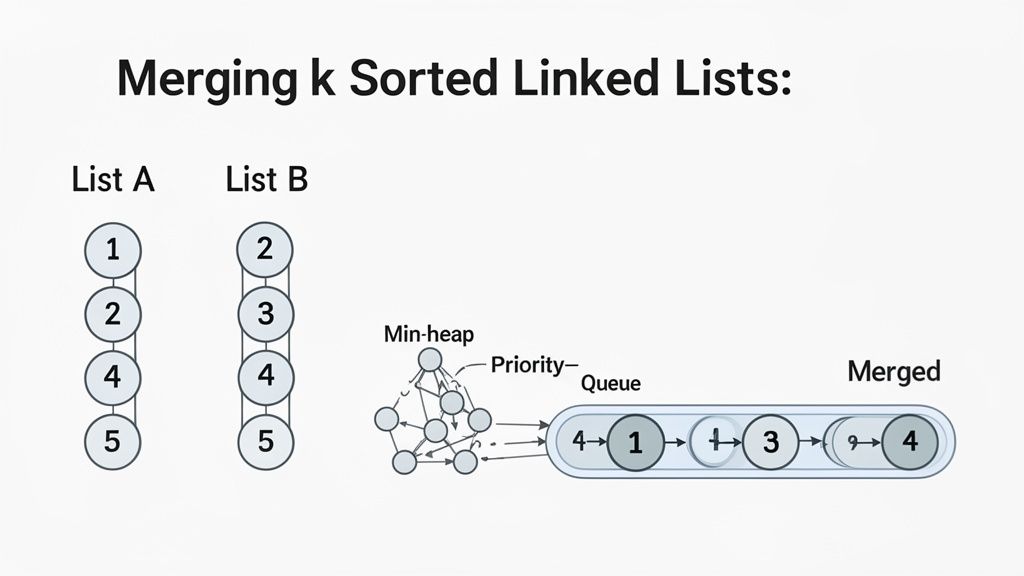
A mid-level engineer might suggest iteratively merging two lists at a time, but this leads to a suboptimal time complexity. A strong candidate will propose one of two primary solutions: using a min-heap to efficiently track the smallest element across all k lists, or a divide-and-conquer approach that recursively merges pairs of lists. Both approaches demonstrate a deeper understanding of complexity and trade-offs.
How to Implement and Score This Question
- Initial Prompt: "You are given an array of
klinked lists, where each linked list is sorted in ascending order. Merge all the linked lists into one sorted linked list and return it." - Optimization Prompt: "Can you analyze the time and space complexity of your approach? What happens if
kis very large compared to the average list length?" - Follow-ups: Ask the candidate to compare the heap-based solution with the divide-and-conquer strategy. Discuss scenarios with varying list lengths (e.g., one very long list and many short ones).
Scoring Insight: A candidate’s ability to justify their chosen approach is important. For example, explaining why a min-heap offers an efficient O(N log k) solution (where N is the total number of nodes) reveals a strong grasp of data structure mechanics. This shows they can select the right tool for a complex job.
In Cohesyve: This question serves as an excellent differentiator later in an assessment. If a candidate breezes through earlier data structure problems, Cohesyve’s adaptive engine can present this item to gauge their ability to handle multi-part, complex algorithmic challenges.
5. Longest Substring Without Repeating Characters - Sliding Window
This problem challenges candidates to find the length of the longest substring within a given string that does not contain any repeating characters. It’s a step up from basic array manipulation and serves as a useful vehicle to introduce and evaluate a candidate's grasp of the sliding window technique, a pattern for solving many substring and subarray problems.
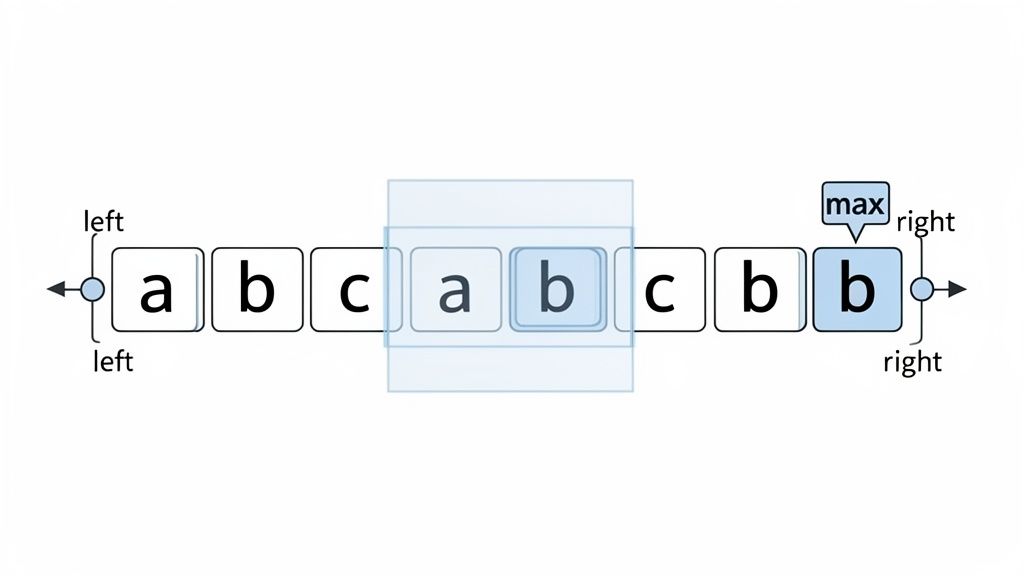
The problem tests pattern recognition and algorithmic optimization. A naive O(n³) or O(n²) solution is possible by checking every single substring, but an efficient candidate will implement a sliding window using two pointers. They'll expand the window by moving the right pointer and shrink it by moving the left pointer whenever a duplicate character is encountered. A hash map or set is used to keep track of characters currently inside the window, leading to an optimal O(n) time complexity. This is one of the classic software engineer interview questions for assessing dynamic problem-solving.
How to Implement and Score This Question
- Initial Prompt: "Given a string
s, find the length of the longest substring without repeating characters. For example, in 'abcabcbb', the answer is 3 ('abc')." - Optimization Prompt: "Can you solve this without checking every possible substring? Think about how you can keep track of the characters in your current substring as you iterate through the string once."
- Follow-ups: Ask the candidate to return the actual substring, not just the length. Discuss the trade-offs between using a hash set versus a hash map (a map can store character indices, which simplifies shrinking the window).
Scoring Insight: A candidate's ability to visualize the two pointers (the "window") and articulate how it expands and contracts is the key signal. Top candidates will immediately recognize this as a sliding window problem and implement an O(n) solution with O(k) space, where k is the size of the character set.
In Cohesyve: This question is ideal for assessing pattern recognition. You can set it up to provide optional hints about the sliding window technique if a candidate spends too much time on a brute-force path. A successful solution can unlock more advanced dynamic programming or two-pointer problems.
6. Binary Tree Level Order Traversal - BFS and Queue
The Binary Tree Level Order Traversal is a classic problem that tests a candidate's understanding of tree data structures and graph traversal algorithms. It requires traversing a binary tree level-by-level, from left to right, and grouping the nodes at each level. This question is a direct application of Breadth-First Search (BFS) and effectively evaluates a candidate's ability to manage state using a queue.
A strong candidate will recognize this as a BFS problem and propose an iterative solution using a queue. They will process nodes level by level, adding the children of all nodes at the current level to the queue for the next iteration. This approach demonstrates a practical grasp of algorithm implementation, which is a key signal in software engineer interview questions. Asking them to compare this with a Depth-First Search (DFS) approach can reveal deeper conceptual knowledge.
How to Implement and Score This Question
- Initial Prompt: "Given the root of a binary tree, return the level order traversal of its nodes' values. For example, group the nodes at each level in a separate list."
- Optimization Prompt: "How would your solution's memory usage be affected by a very wide tree versus a very deep tree? When might a DFS approach be more memory-efficient?"
- Follow-ups: Ask for both iterative (queue-based) and recursive implementations to test their versatility. A good communication check is to ask them to explain the concept of a queue to a non-technical stakeholder.
Scoring Insight: The candidate's ability to articulate the BFS vs. DFS trade-off is crucial. BFS is useful for finding the shortest path, while DFS can be more memory-efficient for deep, narrow trees. This discussion showcases their analytical skills and ability to choose the right tool for a given problem structure.
In Cohesyve: Use this as a follow-up after a simpler warm-up question. The platform's voice role-play feature is perfect for follow-ups like, "Explain what a queue is to a junior engineer," allowing you to directly assess their communication and mentorship potential.
7. LRU Cache - Design Problem
The LRU (Least Recently Used) Cache is a classic among software engineer interview questions that bridges data structures and system design. It requires candidates to design a cache with a fixed capacity that evicts the least recently used item when it's full. The challenge lies in implementing get and put operations with an average time complexity of O(1), a constraint that forces a thoughtful choice of data structures.
This problem is excellent for assessing a mid-level or senior engineer's ability to combine multiple data structures to meet specific performance requirements. The optimal solution typically involves using a hash map for O(1) lookups and a doubly-linked list to maintain the order of use. The hash map stores keys and pointers to nodes in the list, while the list allows for O(1) removal and insertion of nodes at its head (most recently used) and tail (least recently used).
How to Implement and Score This Question
- Initial Prompt: "Design and implement a data structure for a Least Recently Used (LRU) cache. It should support
get(key)andput(key, value)operations in O(1) average time complexity." - Optimization Prompt: "Can you explain why a hash map and a doubly-linked list is an effective combination? What are the drawbacks of using an array or a singly-linked list instead?"
- Follow-ups: Ask about thread safety and how they would handle concurrent requests to the cache. Inquire about edge cases like putting an existing key or a get operation on a non-existent key.
Scoring Insight: A strong candidate will not only implement the solution but will also clearly articulate why this combination of data structures is necessary to achieve the O(1) complexity. Their ability to manage pointers in the linked list without introducing bugs is a strong signal of careful coding, a key element in effective pre-employment skills assessments.
In Cohesyve: Use this as a core problem for mid-level backend roles. Configure a subjective reasoning prompt asking candidates to justify their data structure choices before they begin coding. The platform’s code editor can then validate the correctness and efficiency of their implementation against a suite of test cases.
8. Word Ladder - BFS Graph Problem
The Word Ladder problem is an excellent mid-level question that turns a simple word puzzle into a test of graph theory. It requires a candidate to find the shortest path to transform a startWord into an endWord by changing only one letter at a time, with each intermediate word existing in a given dictionary. This question assesses a candidate's ability to abstract a problem into a graph and apply the right traversal algorithm.
An adept candidate will recognize this as a shortest path problem on an unweighted graph, making Breadth-First Search (BFS) the ideal algorithm. The key challenge lies in how they model the graph. A common approach is generating potential "neighbor" words (one letter different) on-the-fly for the current word and checking if they exist in the word list. This avoids the costly pre-computation of a full adjacency list, which can be inefficient for large dictionaries.
How to Implement and Score This Question
- Initial Prompt: "Given a
beginWord, anendWord, and awordList, find the length of the shortest transformation sequence frombeginWordtoendWord. If no such sequence exists, return 0." - Optimization Prompt: "Your solution works, but what if the
wordListis extremely large? How would that affect your choice of generating neighbors versus pre-building a graph?" - Follow-ups: Ask how to reconstruct the actual path of words, not just its length. This tests their ability to extend the core algorithm. Discuss the trade-offs between pre-processing the
wordListfor faster neighbor lookups.
Scoring Insight: A candidate's ability to model the problem as a graph is the primary evaluation point. Stronger candidates will discuss the time complexity of generating neighbors versus looking them up and justify why BFS is the correct choice over DFS for a shortest path problem. This shows algorithmic understanding beyond simple coding.
In Cohesyve: Use this as a core problem in a mid-level assessment. Precede it with an adaptive multiple-choice question testing their knowledge of graph traversal algorithms like BFS vs. DFS. A correct answer here would unlock this more complex, hands-on coding challenge.
9. Median of Two Sorted Arrays - Binary Search
This advanced problem is a good test of a senior engineer's algorithmic depth. The task is to find the median of two sorted arrays, nums1 and nums2, of sizes m and n respectively. A naive approach involves merging the two arrays and finding the middle element, resulting in an O(m+n) time complexity. While functional, this solution misses the core challenge.
The optimal solution requires a binary search approach, achieving a time complexity of O(log(min(m,n))). This method involves partitioning the smaller array and finding a corresponding partition in the larger one such that all elements in the left combined partition are less than or equal to all elements in the right combined partition. It’s an effective way to evaluate a candidate’s ability to apply a familiar algorithm to an abstract search space and handle complex edge cases with precision.
How to Implement and Score This Question
- Initial Prompt: "Given two sorted arrays,
nums1andnums2, return the median of the two sorted arrays." - Optimization Prompt: "Your current solution is linear. Can you devise a solution with logarithmic time complexity without merging the arrays?"
- Follow-ups: Discuss handling arrays of vastly different sizes, empty arrays, or arrays with even versus odd total element counts. These scenarios reveal their logical rigor.
Scoring Insight: The conversation around this problem can be more important than the final code. A candidate who can clearly articulate the binary search partitioning logic, even if they struggle with the implementation, demonstrates strong conceptual understanding. This distinguishes them from candidates who can only solve problems by rote memorization, a key indicator for roles requiring deep problem-solving skills.
In Cohesyve: This question is ideal for the later stages of an adaptive assessment for senior roles. Successfully solving it can confirm a candidate’s mastery of advanced algorithms, unlocking a final set of architectural or system design challenges. An incorrect or naive solution might suggest a need to verify their understanding of more fundamental search and sort algorithms.
10. Serialize and Deserialize Binary Tree - Complex Design
This problem bridges the gap between pure algorithms and system design thinking, making it one of the most effective software engineer interview questions for mid-level and senior roles. It requires a candidate to design an algorithm that converts a binary tree into a string (serialize) and another that rebuilds the original tree from that string (deserialize). Success here demonstrates an understanding of tree traversals (like pre-order or level-order), data representation, and state management.
The initial discussion should center on the choice of traversal. A candidate might suggest a pre-order traversal because it places the root node first, simplifying reconstruction. They would need a way to represent null nodes, often using a special character like "#", to preserve the tree's structure. This question reveals how a candidate thinks about encoding and decoding information, a critical skill in building robust systems.
How to Implement and Score This Question
- Initial Prompt: "Design a pair of algorithms to serialize a binary tree to a single string and then deserialize that string back into an identical binary tree."
- Optimization Prompt: "Your string representation is human-readable but verbose. How would you design a more compact, space-efficient representation?"
- Follow-ups: Discuss handling different data types in nodes, concurrency issues if multiple threads access the tree, or how this concept applies to serializing complex objects in a distributed system.
Scoring Insight: A top-tier candidate will not only implement a working solution but will also articulate the trade-offs between different traversal methods (e.g., pre-order vs. level-order) and encoding formats. Their ability to explain why their chosen method works is a strong signal of design maturity.
In Cohesyve: Frame this problem within a case study interview. For instance, present a scenario like: "We need a feature to save and load complex user-generated structures from a disk. Design the core logic for this." This contextualizes the problem and assesses practical application skills beyond simple algorithm recitation.
11. Longest Increasing Subsequence - Dynamic Programming
The Longest Increasing Subsequence (LIS) problem is a cornerstone of dynamic programming software engineer interview questions. It requires a candidate to find the length of the longest subsequence in an array where all elements are in strictly increasing order. This question is excellent for assessing a candidate's ability to break down a complex problem into smaller, overlapping subproblems and build a solution from the ground up.
A standard approach involves a DP array, say dp, where dp[i] stores the length of the longest increasing subsequence ending at index i. This leads to an O(n²) solution where the candidate iterates through the array, and for each element, they look back at all previous elements to find the longest subsequence they can extend. This solution is a strong signal for mid-level engineers. Senior candidates can be pushed toward a more advanced O(n log n) solution using a combination of dynamic programming and binary search.
How to Implement and Score This Question
- Initial Prompt: "Given an integer array
nums, return the length of the longest strictly increasing subsequence." - Optimization Prompt: "Your O(n²) solution works well. Is there a way to improve the time complexity? Think about how you are searching for the previous longest subsequence."
- Follow-ups: Ask the candidate to reconstruct the actual subsequence, not just return its length. This tests their ability to track the path that led to the optimal solution.
Scoring Insight: A candidate's ability to define the state of their DP array (what
dp[i]represents) is a critical evaluation point. Explaining the recurrence relation clearly demonstrates a deep understanding of the problem's structure. This approach validates their algorithmic reasoning, a key component explored in examples of content validity.
In Cohesyve: This question serves as an excellent differentiator. Configure an assessment to accept the O(n²) solution but automatically present the optimization prompt. A candidate who successfully implements the O(n log n) solution can be routed to more advanced graph or tree DP problems.
12. Regular Expression Matching - Complex DP
For senior engineering roles, Regular Expression Matching is a challenging problem that can separate proficient coders from algorithmic architects. This question asks candidates to implement a function that matches an input string against a pattern supporting . (any single character) and * (zero or more of the preceding element). It's a classic dynamic programming (DP) problem that tests a candidate's ability to break down a complex, recursive problem into a manageable state-based solution.
A candidate's initial thoughts often revolve around recursion or backtracking, which can be a valid starting point. However, this approach can run into performance issues with overlapping subproblems. The real test is whether they can identify this inefficiency and pivot to a two-dimensional DP table. This table typically maps the string and pattern prefixes, with each cell dp[i][j] representing whether the first i characters of the string match the first j characters of the pattern. The core challenge lies in defining the state transition logic, especially for the * character.
How to Implement and Score This Question
- Initial Prompt: "Implement a function that supports regular expression matching for
.and*." - Key Insight Prompt: "How would you handle the
*character? What are the two possibilities it introduces for the preceding element?" - Follow-ups: Ask for the DP recurrence relation in mathematical notation. Follow up with "What if we needed to return which specific parts of the string matched the pattern?" to test their understanding beyond a simple boolean result.
Scoring Insight: A top-tier candidate will not just code the solution but will clearly articulate the DP state and transitions. Their ability to explain how the
*character translates into either "zero occurrences" or "one or more occurrences" of the previous character within the DP table logic is a critical evaluation point. This reveals a deep and structured thought process.
In Cohesyve: This question serves as an excellent final challenge in a senior-level assessment. Use a subjective reasoning prompt like, "Walk through the DP logic for matching the string 'aab' against the pattern 'c*a*b'." This forces them to explain their logic, ensuring they didn't just memorize the code.
12 Coding Interview Problems Comparison
| Problem | Implementation complexity | Resource requirements | Expected outcomes | Ideal use cases | Key advantages |
|---|---|---|---|---|---|
| Two Sum Problem - Leetcode Classic | Low | O(n) time, O(n) extra space (hash map) | Return indices of two numbers summing to target; tests hash map use | Warm-up interview, basic algorithm screening | Quick to implement and grade; clear optimal vs brute-force |
| Reverse a Linked List - Pointer Manipulation | Low–Medium | O(n) time; O(1) iterative space (O(n) recursive stack) | In-place list reversal; validates pointer/reference handling | Assess reference semantics, memory handling, junior-to-mid level | Reveals true understanding of references; iterative vs recursive trade-offs |
| Valid Parentheses - Stack-Based Problem | Low | O(n) time, O(n) space (stack) | Binary valid/invalid result; tests LIFO thinking | Parsing basics, syntax validation, early interview rounds | Objective scoring; foundational stack concept applicable broadly |
| Merge K Sorted Lists - Heap and Divide-Conquer | Medium–High | O(nk log k) time with heap (or divide & conquer), O(k) extra | Single merged sorted list; tests integration of heaps and lists | Database merges, distributed aggregation, mid-level evaluation | Differentiates candidates by scalability and systems thinking |
| Longest Substring Without Repeating Characters - Sliding Window | Medium | O(n) time, O(min(n, charset)) space (hash map/set) | Length (or substring) of longest unique-character window | Text processing, streaming data, pattern-recognition interviews | Teaches reusable sliding-window pattern; elegant optimal solution |
| Binary Tree Level Order Traversal - BFS and Queue | Low–Medium | O(n) time, O(w) space where w = max width (queue) | Level-by-level node groups; tests BFS and queue usage | Hierarchical data traversal, tree/graph foundations | Clean, extendable solution; gateway to more complex tree problems |
| LRU Cache - Design Problem | Medium–High | O(1) get/put with HashMap + DoublyLinkedList; moderate implementation effort | Functional cache with eviction policy; evaluates design choices | System design, caching, senior/mid-level interviews | High real-world relevance; distinguishes design and data-structure skill |
| Word Ladder - BFS Graph Problem | Medium | O(n * l * 26) neighbor generation heuristics; BFS memory for visited nodes | Shortest transformation sequence; tests graph modeling | Spell-check/autocorrect, graph-thinking interviews | Tests implicit graph construction and optimization thinking |
| Median of Two Sorted Arrays - Binary Search | High | Optimal O(log(min(m,n))) time; complex edge-case handling | Median across two arrays; demonstrates advanced optimization | Senior algorithm interviews, optimization-focused roles | Strong performance differentiation; advanced binary-search insight |
| Serialize and Deserialize Binary Tree - Complex Design | High | O(n) time and O(n) space; careful format and parsing design | Reversible serialization/deserialization of tree structures | Data persistence, network transmission, senior assessments | Real-world design relevance; evaluates end-to-end design and edge cases |
| Longest Increasing Subsequence - Dynamic Programming | Medium–High | O(n²) DP or O(n log n) optimized; O(n) extra space | Length (or sequence) of LIS; tests DP formulation and optimization | DP-focused interviews, sequence analysis tasks | Teaches DP fundamentals and optimization progression |
| Regular Expression Matching - Complex DP | Very High | 2D DP O(n*m) time/space; intricate case handling | Full pattern matching for . and * semantics; rigorous correctness test | Senior algorithm roles, regex engine related work | Clear senior-level differentiator; deep DP and case-analysis skills |
Designing Better Interviews, Not Just Better Questions
This list of software engineer interview questions highlights a clear pattern. From reversing a linked list to designing an LRU cache, these problems are useful tools for evaluating foundational knowledge in data structures, algorithms, and problem-solving. However, having a good list of questions is only the first step. The true challenge lies in how you deploy them.
The risk of relying on a static set of famous problems is well-documented. With platforms like LeetCode, candidates can, and often do, memorize optimal solutions. Some studies suggest that nearly a third of candidates have encountered the exact technical question before their interview. This can turn an exercise in problem-solving into a test of memory, which may be a poor predictor of on-the-job performance. The goal isn't just to find someone who knows the answer; it's to find someone who can derive the answer and communicate the process effectively.
From Static Questions to Dynamic Assessments
Effective hiring teams are moving beyond a "gotcha" culture of obscure questions. Instead, they are evolving their process to measure applied skill in a context that mirrors actual work. This shift involves several key principles:
- Prioritize Problem-Solving Over Recitation: The value isn't in a candidate reciting the O(n) solution for "Longest Substring Without Repeating Characters." It's in their ability to articulate the trade-offs of a brute-force approach, whiteboard the sliding window technique, and discuss edge cases. The conversation around the code is often more insightful than the code itself.
- Embrace Variation and Adaptation: A simple technique is to modify a classic problem. Instead of asking for the standard "Two Sum," ask for a variation where the input is a stream of numbers or where you need to find three numbers that sum to a target. These small tweaks disrupt memorized patterns and encourage genuine, real-time problem-solving.
- Integrate Role-Specific Context: A generic question becomes more powerful when framed within your company’s domain. For an e-commerce company, an LRU cache problem can be reframed as "design a cache for recently viewed products." This not only tests the technical concept but also assesses the candidate's ability to connect abstract principles to business needs.
Building a Scalable and Fair Hiring Engine
Relying on individual interviewers to create unique, role-specific variations for every candidate is not a scalable strategy. It introduces inconsistency and can open the door to bias. This is where a structured, platform-based approach becomes useful. For interviewers aiming to assess a candidate's architectural thinking, a deep understanding of system design principles is key to crafting insightful questions.
The future of technical hiring is adaptive. It involves generating unique, fair, and relevant challenges for every candidate, tailored specifically to the requirements of the role you're filling. By converting the foundational concepts explored in this article into interactive, real-world scenarios, you can gain a much clearer signal on a candidate's abilities.
Key Takeaway: An effective interview process measures how an engineer thinks, not just what they know. The shift from static questions to dynamic, adaptive assessments can be an impactful change to improve hiring accuracy and identify talent who can solve your company's unique challenges.
Ultimately, the goal is to build a hiring process that is as thoughtfully engineered as the software your team creates. It should be robust, fair, and optimized to identify the signals that truly matter. This approach not only helps you find better engineers but also creates a better candidate experience, strengthening your employer brand in a competitive market.
Ready to move beyond static question lists and build a more predictive hiring process? Cohesyve transforms your job descriptions into custom, adaptive skill assessments that measure on-the-job capabilities, not just memorized answers. See how you can hire with more confidence and less bias at Cohesyve.