A staff recruiting agency acts as a talent broker. They are a strategic partner connecting your company with skilled professionals who may not be actively scrolling through job boards. Think of them as dedicated talent scouts who can save you time while providing access to a wider pool of candidates.
What Does a Staff Recruiting Agency Actually Do?
It’s easy to view a recruiting agency as just another vendor, but that’s a limited perspective. A good agency becomes an extension of your own hiring team, bringing a focus and network that’s tough to build in-house.
While your HR department is juggling benefits, payroll, and employee relations, an agency has one mission: finding the right person for your open role.
Their value becomes clear when you’re trying to fill a niche or highly specialized position. Agencies spend years building and nurturing networks of professionals. This includes the often hard-to-reach passive candidates—talented individuals who are currently employed but might consider a move for the right opportunity. This is a significant talent pool you might otherwise miss.
The Core Functions of a Recruiting Partner
An agency’s day-to-day work involves more than just forwarding resumes. It's a methodical process designed to deliver quality, not just quantity. They can save your team from sifting through hundreds of applications that aren't a good fit.
The principles behind their process are similar to learning how to qualify sales leads effectively; it’s all about strategically identifying the best fit.
Here’s what that typically looks like:
- Sourcing Candidates: They tap into their networks, industry contacts, and specialized databases to find potential matches.
- Screening and Vetting: This involves conducting initial interviews and assessments to confirm that candidates have the skills and experience you need.
- Presenting a Shortlist: Instead of a pile of resumes, you get a curated list of top contenders ready for an interview.
- Managing the Process: They handle the logistics—scheduling interviews, gathering feedback, and serving as the go-between for you and the candidate.
A common myth is that agencies only deal with temp jobs. In reality, they handle a wide spectrum of roles, from short-term contracts to placing C-suite executives in industries like tech, finance, and healthcare.
A Growing Market for Talent Brokering
The demand for these specialized services is growing. According to some market analyses, the global recruitment and staffing market is projected to expand significantly over the next decade. This growth highlights how vital these agencies have become for businesses trying to keep up with workforce changes and fill critical skill gaps.
To put it all into perspective, here’s a quick look at how an agency partnership can address common hiring headaches.
Agency Partnership at a Glance
| Your Hiring Challenge | How an Agency Solves It | The Primary Benefit |
|---|---|---|
| Limited Candidate Pool | Access to a network of active and passive candidates. | You see top talent you might not find on your own. |
| Time-Consuming Screening | They handle sourcing, vetting, and initial interviews. | Your team only meets qualified, interested candidates. |
| Hard-to-Fill Niche Roles | Specialized recruiters have deep industry knowledge and contacts. | Faster placement for critical, specialized positions. |
| Lack of Market Insight | Provide real-time data on salaries, competition, and trends. | You make more competitive and informed hiring decisions. |
Ultimately, working with the right agency isn't just about filling a seat. It's about making a strategic investment in your company's people.
Navigating the Different Types of Recruiting Agencies
Choosing a staff recruiting agency is a bit like picking the right tool for a job. You wouldn't use a sledgehammer to hang a picture frame. Selecting the right kind of agency for your hiring needs is just as critical, and picking the wrong one can be a common mistake.
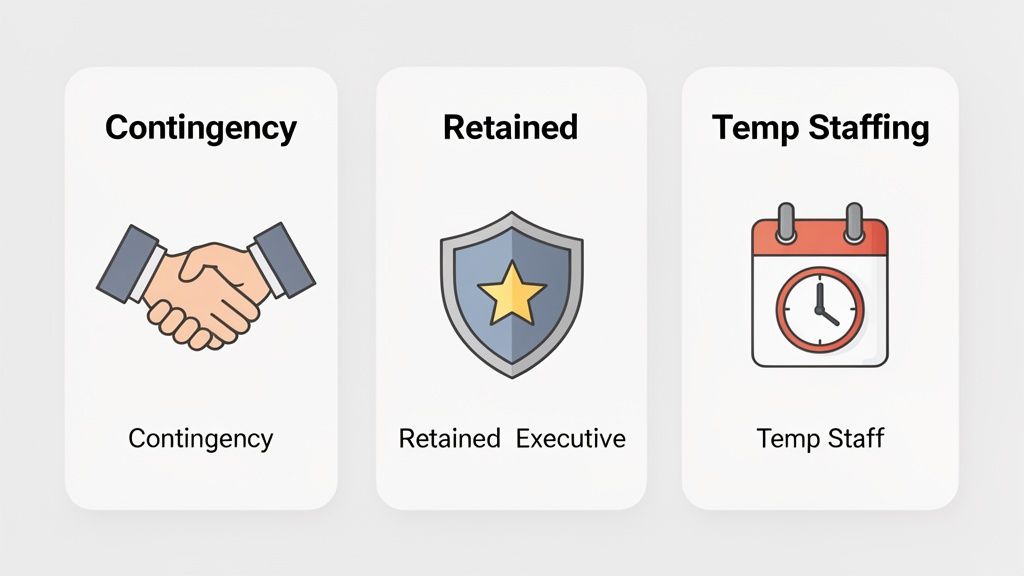
The world of recruiting isn't one-size-fits-all. Agencies operate on different models and often specialize in specific fields, which allows them to offer a deeper level of expertise. Getting a handle on these differences is your first step toward finding a partner who can deliver.
Generalist vs. Specialist Agencies
The first big decision you'll face is whether to go with a generalist or a specialist. A generalist agency works across various industries to fill roles from admin support to sales reps. They’re versatile and can be a good resource when you're hiring for common roles where the skills aren't highly specialized.
On the flip side, a specialist agency has carved out a specific niche. They focus on a single industry, like technology, healthcare, or finance. Their recruiters often come directly from the field they now recruit for, giving them a native understanding of the roles and a strong network of talent. If you need a Senior Data Scientist, a tech-focused agency will almost always find more suitable candidates, and find them faster, than a generalist firm.
The edge a specialist agency offers isn't just their contact list; it's their context. They understand the subtle differences between a "good" and a "great" candidate in their field because they speak the language.
This deep focus lets them more accurately vet a candidate's background and judge their potential cultural fit. But even then, the real test comes down to verifying practical skills—something that a resume or interview alone can't always reveal.
Contingency Search
This is a common model you'll run into. With a contingency search, the agency only gets paid if you hire a candidate they presented. This means there are no upfront costs. You can even engage multiple contingency agencies for the same role, creating some competition to find the best person.
- Best For: Most non-executive roles, from mid-to-senior level.
- Why it Works: The "no hire, no fee" approach is appealing, and it's a solid strategy for roles where there's a healthy talent pool.
- A Key Consideration: Because their payment isn't guaranteed, contingency recruiters may naturally gravitate toward the roles they think they can fill the fastest.
Retained Search
For critical, high-level, or highly confidential roles, a retained search is often the standard. In this arrangement, you pay an exclusive agency an upfront fee (a retainer) to begin the search. You'll typically make additional payments at key milestones in the process. This exclusivity and financial commitment guarantee you the agency’s full attention and resources. The search they conduct is deeper, often targeting top executives who aren't actively looking for a new job.
- Best For: C-suite executives, specialized leadership roles, or confidential searches.
- Why it Works: It ensures a dedicated, thorough search process for your most important hires. The agency becomes an extension of your team.
- A Key Consideration: This model requires an upfront investment and a high level of trust in the agency you choose.
Temporary and Contract Staffing
Finally, you have temporary staffing, which is a practical solution for project-based work, seasonal rushes, or covering for an employee on an extended leave. These agencies have a bench of pre-vetted professionals who are ready to start on short notice. It gives you flexibility to scale your workforce up or down as your business needs change, all without the long-term commitment of a permanent hire.
Many also offer a temp-to-hire option, which is a useful way to evaluate a candidate’s real-world performance on the job before deciding whether to make them a full-time offer.
Cohesyve
See what candidates can do before you interview them
Cohesyve turns a job description into a role-specific assessment with a scoring rubric. Each candidate gets a different version, so questions cannot be shared. Ten candidates free, no card.
How Recruiting Agencies Charge: A Guide to Pricing and Contracts
When you decide to partner with a recruiting agency, you're making a strategic investment in your company's future. Before you can see the results, you need to get comfortable with the financial side of things.
Agency fee structures can feel a bit confusing at first, but they almost always boil down to a few standard models. Understanding how they work is key to budgeting and building a partnership that makes sense for your bottom line.
To get the most out of your budget, it helps to understand the different agency pricing models. Knowing the ins and outs prevents surprises and helps you pick the right financial path for every role you’re trying to fill.
The Three Main Ways Agencies Structure Their Fees
An agency's fee isn't an arbitrary number. It’s directly linked to the difficulty of the search, the seniority of the role, and the level of commitment from both parties. Let's look at the three main models you'll encounter: contingency, retained, and a hybrid model sometimes called a "container."
Contingency Search: This is common in the recruiting world, especially for mid-level positions. The concept is simple: you only pay if they succeed. The agency earns its fee—typically 20% to 30% of the candidate's first-year salary—after you hire someone they presented.
Retained Search: When you're hiring for the C-suite or need to fill a critical leadership role with discretion, a retained search is often the best approach. This is an exclusive partnership. You pay the fee in stages—usually one-third to start the search, another third when they present a shortlist of vetted candidates, and the final payment upon hiring.
Container Search: Think of this as a middle ground. The container model sits between contingency and retained. You pay a smaller, non-refundable engagement fee upfront to get the search started, and the rest is due when you make the hire. This shows you're serious, which in turn can lead to a more dedicated effort from the agency.
To put it in perspective, a 20% contingency fee on a role with a $150,000 salary means a $30,000 payment to the agency. The key here is that you don't pay until your new hire is officially on board. That performance-based model helps manage financial risk.
Let's see how these models stack up in a real-world scenario.
Comparing Recruiting Agency Fee Structures
The table below breaks down the common agency fee models, showing you what to expect in terms of cost, when you'll pay, and which situations each model is best for.
| Fee Model | Typical Cost Structure | When You Pay | Best Suited For |
|---|---|---|---|
| Contingency | 20-30% of first-year salary | Upon successful hire | Mid-level to senior roles with a good talent pool |
| Retained | 25-35% of first-year salary | In three installments (upfront, shortlist, hire) | Executive, C-suite, and confidential searches |
| Container | 20-30% of first-year salary | Small upfront fee, with balance on hire | Priority searches needing more focus than contingency |
Ultimately, the right model depends on the urgency and importance of the role you're trying to fill.
Don't Skip the Fine Print: Key Contract Terms
Beyond the fee structure, the contract itself defines the partnership. It lays out the rules of engagement and protects both you and the agency. Taking the time to read it carefully before signing can save you headaches later.
Two clauses, in particular, deserve your attention: the guarantee period and any exclusivity terms.
The Guarantee Period: This addresses the "what if" question. What if the person you hire quits or is let go within a few months? A solid contract will include a guarantee period, which is often around 90 days. If your new hire leaves during that window (for reasons other than a layoff), the agency should either find you a replacement at no extra cost or offer a prorated refund.
Exclusivity Clauses: This part of the contract dictates whether you can work with other agencies on the same search. A retained search is, by nature, always exclusive. For contingency roles, you can often engage multiple agencies at once. However, some firms might ask for a brief period of exclusivity in exchange for dedicating more resources to your opening.
Getting clear on these terms upfront gives you the power to negotiate a fair, balanced agreement. The goal is a transparent partnership where everyone is on the same page, setting the stage for a great hire.
The Real Pros and Cons of Using a Recruiting Agency
Deciding to bring in a recruiting agency is a big move. While they can boost your hiring efforts, it’s smart to go in with a clear understanding of what to expect. Knowing the real advantages and potential pitfalls is key to building a partnership that pays off.
Think of it like hiring a personal shopper for talent. They know where to look and can bring you options you might not find on your own. But the quality of what they bring back depends entirely on how well you explain what you’re looking for.
The Upside: What a Great Agency Brings to the Table
The most immediate benefit is speed. An open role can be a drain on your team's productivity and morale. Agencies focus on talent acquisition, so they can often shorten the hiring cycle.
But it's about more than just filling seats faster. A good agency partnership delivers strategic advantages:
- Access to Passive Candidates: This is their strength. They have networks full of high-performing people who aren’t actively looking for a job. These can be some of the best candidates, and you’ll almost never find them on a public job board.
- A Lighter Administrative Load: The work of sourcing, screening, and scheduling interviews for dozens of applicants is a major time commitment. An agency handles that heavy lifting, freeing up your internal team for higher-value work.
- Deep Market Expertise: A specialized recruiter gives you a real-time pulse on the market. They know the going rate for salaries, what your competitors are offering, and what top talent in your field wants. That kind of information helps you build a more competitive offer.
The Downsides: Potential Roadblocks to Watch For
Of course, it’s not always a perfect process. The most obvious drawback is the cost. Agency fees are a significant investment, and you have to weigh that against the hidden costs of letting a critical position go unfilled.
A common frustration is getting candidates who look great on paper but can't deliver in practice. A polished resume can highlight experience, but it rarely proves a candidate’s real-world problem-solving skills or how they'll perform under pressure.
This leads to a few common challenges you should be ready for:
- The Risk of a Cultural Mismatch: If an agency doesn't truly understand your company culture, they might send you candidates who are technically skilled but wouldn't be a good fit for your team. This is why the initial briefing is so important.
- The Resume vs. Reality Gap: Some people are good at writing resumes and interviewing, but they may lack the practical skills to do the job well. An agency’s initial screen might not catch this, putting the burden of deep skills verification back on your team.
- Inconsistent Candidate Quality: Without clear, consistent communication and feedback, you might get candidates who miss the mark. This can defeat the purpose of saving time. Improving the candidate experience on your end is also crucial for creating a better feedback loop with your agency partner.
The staffing industry is evolving to solve some of these problems, with new technology helping agencies manage large candidate pools more effectively. The market is also fragmented; for instance, some reports indicate the top 10 firms hold less than 6% of the market share, which means there are many specialized players. You can find more data on staffing industry trends at GlobeNewswire.
At the end of the day, the best results often come from combining an agency's sourcing power with your own solid process for verifying a candidate's true abilities.
How to Choose the Right Agency Partner
Picking the right staff recruiting agency is a critical part of the process. A great partner becomes an extension of your team, while the wrong one can waste time and budget. The key is to look past the sales pitch and get into the details of how they operate.
Your goal is to find someone who understands your industry, aligns with your company culture, and knows what a "quality" hire looks like for you. That means you need a structured plan for vetting potential agencies, one that prioritizes evidence over promises.
This decision tree can help you figure out if an agency is the right call for your current hiring needs.
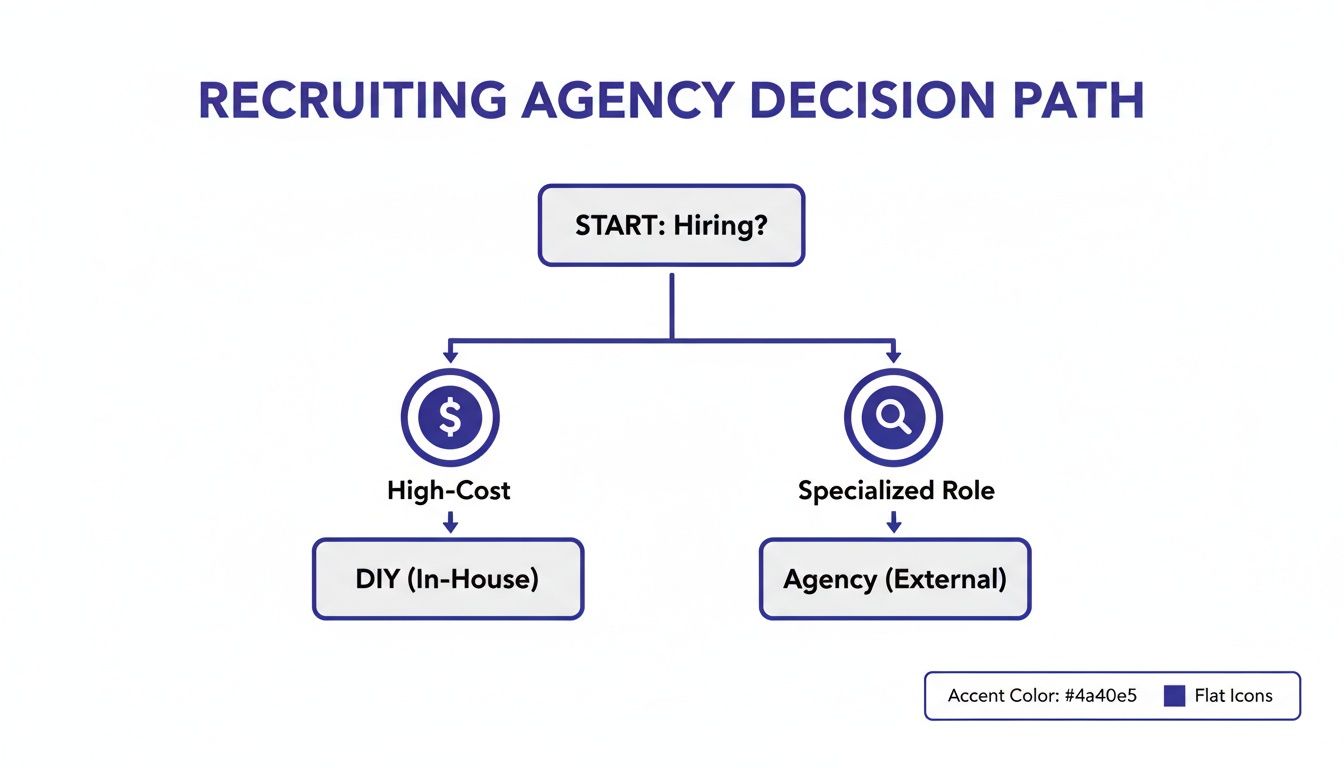
The flowchart highlights a key point: when you're looking for highly specialized talent, an agency’s network and expertise can give you a significant advantage.
Create Your Vetting Checklist
Before you start talking to agencies, you need to know what you’re looking for. A solid checklist ensures every potential partner is measured by the same standard. It keeps you focused and helps you make a choice based on data, not just a gut feeling.
Make sure your checklist covers these core areas:
- Industry and Role Specialization: Do they have deep experience in your industry, whether it's SaaS, healthcare, or finance? Ask them for examples of similar roles they’ve filled recently.
- Proven Success and Client References: A confident agency will be able to share case studies or connect you with satisfied clients. Don't be shy about asking for references and actually calling them.
- Communication Style and Cadence: How will you stay informed? A clear communication plan—like weekly check-ins or candidate summary emails—is the mark of a professional operation.
- Market Knowledge and Reach: Their grasp of the talent market is a valuable asset. The global staffing scene has regional variations, and an agency with that kind of market intelligence can give you a competitive advantage. You can dig deeper into these trends with insights on the global staffing industry from Workwell.
Go Beyond the Resume in Your Discovery Calls
Once you have a shortlist, the real work begins. Those initial discovery calls are your chance to see past the polished exterior and understand their process for vetting talent. It’s easy to find candidates who look good on paper; it's much harder to find ones with proven, real-world skills.
This is where you need to start asking direct questions. A resume can list technologies and buzzwords, but it tells you little about a candidate's ability to solve problems, think critically, or work with a team.
A revealing question to ask an agency isn't "How do you find candidates?" It's "How do you validate their skills?" Their answer will tell you a lot about the quality of candidates you can expect.
If an agency’s process is limited to keyword matching and a few basic screening questions, that's a red flag. You're looking for a partner who knows that competence has to be demonstrated, not just described on a PDF. To get more ideas on modernizing your hiring, check out these talent acquisition best practices in our guide.
Sample Questions to Ask Potential Agencies
To cut through the noise, you need to ask sharp, process-focused questions. These are designed to reveal how an agency operates, helping you spot a strategic partner.
Here are a few questions to get started:
- For a technical role: "Walk me through your process for assessing the practical, problem-solving skills of a senior software developer. How do you go beyond what's on their resume?"
- For a sales role: "How do you test a candidate's ability to handle objections or pitch a value proposition in a real-world scenario?"
- Regarding process: "If we sign a contract today, what are the first concrete actions you take in the first 48 hours to get the search moving?"
- On feedback: "How do you use our feedback from the first few candidates to refine the search and improve the quality of future submissions?"
Their answers will paint a clear picture of their depth and expertise. An agency that can confidently lay out a multi-layered verification process is one that’s focused on delivering high-impact hires, not just a high volume of resumes.
Maximizing Your Partnership for Hiring Success
Signing a contract with a recruiting agency isn't the finish line—it's the starting point. The real work is in turning that new relationship into a process that consistently finds you the right people. It’s all about building a genuine partnership.
The cornerstone of any good partnership is communication, and that starts with a thorough job intake meeting. This is your chance to go beyond the standard job description. You need to paint a clear picture of what success looks like, what your team culture is really like, and the specific problems this new hire will be expected to solve. The more context you provide, the better they can target their search.
Once they start sending candidates, you have to establish a tight feedback loop. This isn't about micromanaging. It's about calibrating their search. Quick, direct feedback on the first batch of candidates helps them zero in on what you're actually looking for, saving everyone time down the road.
Integrating Workflows for Better Results
To make the agency feel like an extension of your own team, it helps to sync up your tools and processes. A great place to start is by giving them access to your Applicant Tracking System (ATS). This simple step keeps everyone on the same page, provides a single source of truth for every candidate, and stops great people from getting lost in messy email chains.
A powerful move is to standardize how you both evaluate talent. If you're just relying on resumes and gut-feel interviews, you're inviting bias and inconsistency into the process. This is where a consistent skill verification process becomes invaluable.
By equipping your agency partner with a uniform assessment tool, you ensure every candidate they submit has demonstrated their real-world abilities. You're no longer comparing subjective interview notes; you're comparing objective performance data.
This one change shifts the dynamic. Instead of getting a list of candidates who look good on paper, you get a pre-vetted shortlist of people who have already proven they can do the work. You can learn more about the impact of using objective candidate assessment tools in our detailed guide.
This kind of alignment makes your hiring process more efficient and can dramatically improve the quality of your hires. It changes the conversation from "Does their resume have the right keywords?" to "How well did they actually solve the problem?" That's what turns a vendor relationship into a true strategic partnership.
Frequently Asked Questions About Recruiting Agencies
Thinking about bringing in a recruiting agency can feel like a big decision, so it's natural to have questions. Let's walk through some of the most common ones we hear from founders and hiring managers.
When Is the Right Time to Hire a Recruiting Agency?
The best time to call in an agency is when you hit a hiring roadblock that your own team can't easily clear. It’s like bringing in a specialist when you need a specific job done right.
You should seriously consider an agency when:
- You need to fill a highly specialized role and don't have a ready-made network of niche talent.
- Your team is already stretched thin and doesn't have the time to dedicate to a high-stakes or high-volume search.
- You're expanding into a new city or country and need people who understand the local talent market.
- A search needs to be confidential, like when you're replacing a key executive who is still in the role.
If you have the internal resources and the position is a standard one for your industry, handling it in-house can work just fine. But for those business-critical roles that are hard to fill, an agency’s focused expertise can be a major asset.
How Do I Measure the ROI of a Recruiting Agency?
Calculating the return on investment from a recruiting agency is about more than just the placement fee. The real value comes from the business impact of filling a role faster and with a higher-quality person.
A bad hire can be expensive. Industry estimates often place the cost at 30% of the employee’s first-year salary. A great agency can be your best defense against that by bringing you thoroughly vetted, high-quality candidates.
To get a true sense of ROI, you should track a few key metrics:
- Time-to-Fill: How many weeks or months did the agency save you?
- Quality of Hire: How are the agency's placements performing six months or a year down the line?
- First-Year Retention Rate: Are the people they find staying with the company?
And don’t forget the opportunity cost of an empty desk. If an agency fills a critical sales role three months sooner than you could have on your own, the revenue generated in that time can make the ROI clear.
Should I Use Multiple Agencies for the Same Role?
It seems logical: more agencies, more candidates. But in reality, pitting multiple agencies against each other for the same role on a contingency basis can backfire. It can create a race to the finish line where quality suffers, and it signals to the agencies that you aren't fully committed.
A better strategy is to do your homework and select one or two agencies that truly specialize in your field. By giving them an exclusive or retained search, you build a genuine partnership. This motivates them to assign their best people to your search, leading to better candidates and a smoother process.
At Cohesyve, we believe the best hires come from proving skills, not just reading resumes. Our platform empowers you to see what candidates can actually do by creating role-specific assessments that test for real-world ability, ensuring your next hire is a top performer. See how it works at Cohesyve.